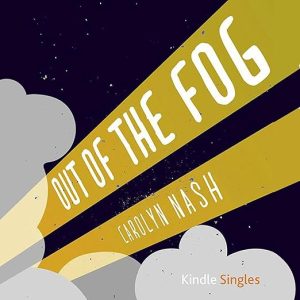
I picked up Out of the Fog on a Tuesday evening when I had roughly two hours and no patience for anything that required significant emotional investment. What I got was a short thriller that knew its own dimensions and worked within them with real efficiency. The author, Carolyn Nash, writes Molly Deacon as the kind of protagonist who is funny about her own anxiety right up until the moment she is not anxious at all, and that inversion from comic catastrophizing to actual action is the book's central and most satisfying pleasure.
A note on the metadata before anything else: the author is listed as Dana Morningstar in some places, but the book's own author note identifies Carolyn Nash as the pen name under which this fiction was published. Nash adopted that pseudonym to protect the privacy of her son, who is the subject of her memoir Raising Abel about raising a severely abused adopted child. That context makes Molly Deacon's decision to intervene on behalf of a stranger being harmed feel less like genre convention and more like something the author has thought about seriously.
What We Made of It
The Mittyesque quality of Molly's imagination is the book's most distinctive feature. She has a well-developed habit of mentally rehearsing worst-case scenarios, imagining disasters in vivid detail before they arrive. This turns out to be both character comedy and structural setup: when genuine danger arrives, Molly has already, in some sense, rehearsed for it. The gap between her internal disaster theater and the actual disaster she finds herself in is one of the better running jokes in a story this short, and Nash lands it repeatedly without it becoming mechanical.
Ilyana Kadushin handles this comic register with precision. Molly's dry self-awareness does not soften the tension of the thriller sequences but it does give the character a specific personality that prevents her from being simply a victim in motion. Kadushin's voice has a quality that works well for first-person female protagonists who are simultaneously vulnerable and more capable than they believe themselves to be. One reviewer specifically noted enjoying the suspense and gentle humor in combination, and Kadushin is a significant reason that combination works.
Why Out of the Fog Works as an Audiobook
Alan Cartwright, the man Molly intervenes to protect, is a gay man being beaten by a bully backed by an unruly bar crowd. Nash does not sentimentalize the rescue or the relationship that develops between Molly and Alan in the aftermath. They are two people in a very bad situation together, which is a more interesting dynamic than either gratitude or heroism would produce on its own. One reviewer noted that Nash gives the reader two well-developed characters desperate to create a best-case-scenario happy ending out of a scary situation, which is an accurate description of what makes the book work rather than simply function as a premise.
One dissenting reviewer found the poketa poketa literary device used to render Molly's Mitty-like imaginings thoroughly annoying, and this is fair warning for listeners who find stylistic tics in prose distracting. The device appears multiple times across the short runtime, and your tolerance for it will shape your experience of the early chapters significantly. That said, Kadushin delivers these passages in a way that makes the comedy land more cleanly than the same material might read on the page, where the repetition could feel more intrusive.
What Might Not Land
A two-hour audiobook occupies a particular position in the format. It is too short for the investment of a full novel but too long to function as a short story. Out of the Fog manages this awkward middle ground by being very clear about what it is not doing. It is not a character study. It is not a genre deconstruction. It is a thriller with a specific protagonist in a specific situation, and it uses its runtime to execute that premise with precision rather than expanding into territory it has not earned the right to occupy.
The ending is abrupt in the way that short thrillers often are: the chase resolves, the danger passes, and the book closes quickly. Some readers will want more. The emotional aftermath of what Molly has been through is gestured at rather than examined, and the relationship between Molly and Alan after the ordeal is left largely unexplored. But within the constraints of the form, the ending is proportionate. A dissenting reader who found it boring and plot-thin was responding to a genuine mismatch between expectation and reality rather than a failure of execution.
One element that works particularly well in the audio format is how the book handles Molly's internal monologue. Dana Morningstar's narration captures the specific texture of anxious-but-competent thinking, the kind of mental chatter that sounds catastrophic but coexists with functional performance. Molly is not paralyzed by her anxiety. She is inconvenienced by it in ways that are genuinely funny, and then she is not, and the transition is managed with a timing that translates well to audio. Listeners who have found psychological thrillers frustrating because the protagonists make inexplicably poor decisions will appreciate that Molly's choices, even under pressure, retain an internal logic that holds up on reflection. That consistency is harder to achieve than it looks.
Who Should Listen to Out of the Fog
Out of the Fog is well suited to listeners who want a tight, efficient thriller they can finish in a single sitting without the investment of a full novel. It is not for readers who need extensive character development, significant world-building, or a complex mystery to unravel. If you have two hours and want a protagonist who makes you laugh and then makes you slightly breathless in quick succession, this is a reasonable bet. Listeners who found the rating lower than expected should note that the dissenting reviews reflect mismatched expectations about scope rather than a failure of execution within the book's own clearly stated terms.
Frequently Asked Questions
Is Out of the Fog a full-length novel or a short story? What is its actual runtime?
It runs approximately two hours and twenty minutes, placing it in the short fiction or novella category rather than full-length novel territory. It is priced and marketed accordingly.
Who is the actual author? The listing shows Dana Morningstar but the text credits Carolyn Nash.
Carolyn Nash is the pen name under which this fiction was published. The author's own note explains that the pseudonym was adopted to protect the privacy of her son, who is the subject of her memoir Raising Abel.
Does Ilyana Kadushin's narration add meaningfully to the experience, or would this work equally well as a straight read?
Kadushin adds real value here. Molly's imaginative inner voice and the book's tonal blend of humor and tension both come through more cleanly in her performance than they might on the page.