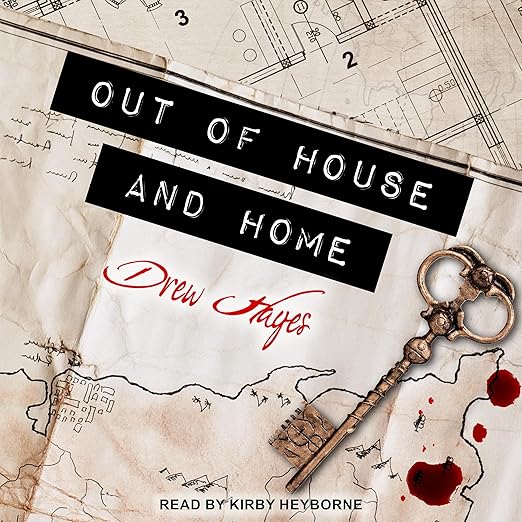
Drew Hayes has built something unusual with the Fred, the Vampire Accountant series: a long-running urban fantasy that manages to sustain both its comedy and its character development through seven volumes without either quality calcifying into habit. Out of House and Home is Book 7, and the craft involved in writing that seventh entry, in keeping a reader satisfied while genuinely advancing the story, is the thing worth appreciating before anything else. This audiobook, narrated once again by Kirby Heyborne, demonstrates that Hayes has not run out of ideas for Fred and his found family, and that Heyborne has become so fluent in these characters that the performance feels less like narration and more like the story simply existing in audio form.
The setup for this entry follows directly from the wedding that concluded the previous volume. Fred expected things to settle, and finds instead that someone from his past has decided that settling is not an option. The threat in this entry is more personal and more structurally interesting than some of the earlier antagonists. Rather than a supernatural power or a political faction, Fred is dealing with someone who has studied him and is attacking him specifically, which forces Hayes to be more precise about what Fred's actual vulnerabilities are. The result is a book that interrogates the found family premise rather than simply continuing it.
Our Take on Out of House and Home
The title's double meaning is literal and thematic. Fred's clan loses their physical home, which is both a practical crisis in the world of supernatural politics and a resonant emotional blow for a group whose entire identity as a chosen family is organized around a shared domestic space. Hayes is good at this kind of double register. The plot mechanics have emotional consequences that the characters are allowed to feel and articulate, which is rarer in this subgenre than it should be. The reviewer who called the series "tremendously likeable" with "episodic and concise" action that leaves "plenty of time for character interaction and development" has identified exactly what makes Hayes's approach work at full strength.
The balancing act between Fred's accounting business and his supernatural responsibilities has been a running joke and a structural device since the first book, and Hayes continues to find new permutations of it. In this entry, the business subplot is not just comic relief. It intersects with the threat in ways that Fred's particular skill set is uniquely positioned to address. One of Hayes's consistent pleasures is that Fred's competence as an accountant is never played purely for laughs. It is actually useful, and watching Fred apply rigorous financial thinking to supernatural problems is consistently satisfying across all seven volumes.
Kirby Heyborne is the series' secret structural advantage. Urban fantasy audiobooks live or die on ensemble casting. When a series has fifteen named characters with distinct speech patterns and emotional registers, the narrator's ability to differentiate them becomes load-bearing. Heyborne handles the Fred ensemble without apparent effort at this point, which suggests the kind of deep familiarity with the material that only comes from sustained engagement over a long series. Fred's mild-mannered pragmatism, Krystal's controlled intensity, and the various personalities in the clan each come through with consistent specificity that rewards the long investment of a seven-book listening run.
The eleven-hour runtime gives Hayes room to let the middle section breathe in ways that shorter urban fantasy entries sometimes do not. The period between Fred's clan being displaced and the full confrontation with whoever is responsible is used for genuine character work. Relationships are tested, loyalties are clarified, and the question of what the House of Fred actually means to each member is explored with more emotional precision than the series has previously managed. Two separate reviewers describe the book as making the stories "long enough and detailed enough it's like you're reading two books in one," and that cumulative density is the intended effect of Hayes's pacing strategy.
What to Watch For in Out of House and Home
This is not an entry point. Starting here without the previous six books will result in significant confusion about relationships, powers, and the various political structures of the supernatural world Hayes has built. The series rewards reading in order, and Out of House and Home in particular assumes detailed knowledge of the wedding events from the previous volume. New listeners should begin with the first Fred book and trust that the series builds its investment gradually before paying it back generously.
Watch for the ways that Hayes develops Krystal's perspective in this entry relative to earlier books. She has been primarily reactive to Fred's crises in prior volumes; here she has her own response to the displacement of the clan that adds dimension to a character who can sometimes read as defined entirely by her relationship to the protagonist. The handling is subtle rather than announced, but it is one of the signs that Hayes is thinking structurally about the series as a whole rather than just delivering another installment.
Who Should Listen to Out of House and Home
Anyone who has followed the Fred, the Vampire Accountant series through its previous six entries will want this audiobook, and Heyborne's narration provides a listening experience that is actually more pleasurable than the print version for readers sensitive to ensemble voice differentiation. New listeners to urban fantasy who appreciate comedy and character over relentless action should start with the first Fred book. The series is genuinely cumulative, and the payoffs in this seventh entry depend on prior investment. If you love Terry Pratchett's ability to make workplace competence heroic, or Jim Butcher's found-family dynamics without the grimness, Fred is the series worth discovering, and this audiobook is among its stronger entries.