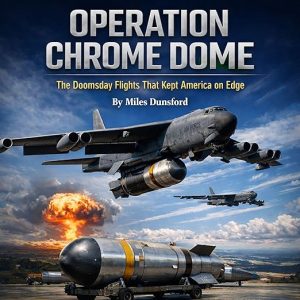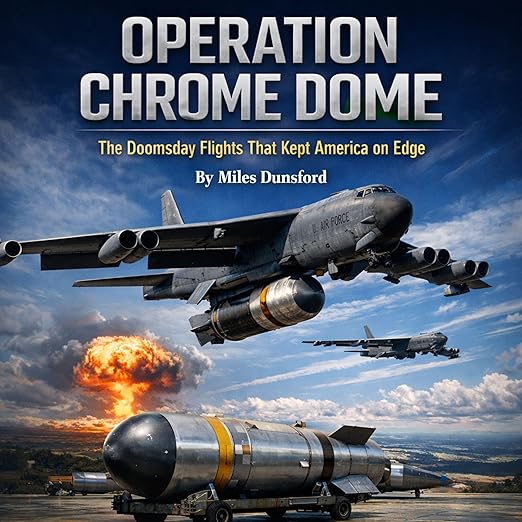
I had heard of the Goldsboro B-52 crash the way most people have, a vague awareness that at some point during the Cold War a plane carrying nuclear weapons went down over North Carolina and that something very nearly went very wrong. Operation Chrome Dome is the first full account I've listened to that places that incident inside its proper context: a sustained military program in which nuclear-armed B-52 bombers were kept airborne around the clock for years, with all the mechanical, human, and political fragility that entails.
Miles Dunsford writes in the mode of popular military history, vivid, accessible, structured around specific incidents rather than abstract strategic analysis. The book was published in early 2026 by Zentara UK as part of a Cold War Operations Revealed series, and it carries the hallmarks of that kind of project: strong on atmosphere and detail, occasionally light on the kind of archival sourcing that would anchor the more specific claims. That caveat noted, the underlying story is extraordinary enough to make the book compelling regardless.
The program itself ran from 1960 to 1968, during which the United States kept nuclear-armed bombers in constant rotation over strategic corridors including polar ice routes and ocean approaches to the Soviet Union. The logic was deterrence: if a Soviet first strike destroyed land-based missiles, the airborne bombers would provide a retaliatory capability that couldn't be neutralized in a single blow. It was, as Dunsford describes it, a system designed to prevent nuclear war by maintaining a permanent readiness for nuclear war.
The friction between that strategic purpose and operational reality is where the book earns its tension. The air crews and ground teams who maintained the program lived inside a system that demanded perfection under conditions that reliably produced fatigue, error, and mechanical failure. Dunsford traces the specific mid-air refueling procedures, the flight corridors, the safety systems, and the institutional culture of absolute discipline with enough detail to make you feel the grinding effort required to keep the program running. The Broken Arrow incidents, instances where nuclear weapons were involved in accidents, are documented with the specificity the subject deserves.
What Stands Out
The Goldsboro crash of 1961 is the book's dramatic centerpiece, and Dunsford handles it well. A B-52 broke apart in flight over North Carolina, releasing two nuclear weapons. One device behaved exactly as designed and armed itself as it fell; it was recovered in a field, having failed to detonate by virtue of a single component functioning correctly. The political and military response to the incident, and the decision to suppress public knowledge of how close the near-miss had come, is narrated with appropriate gravity. Dunsford is right that this incident shaped the eventual decision to end Chrome Dome, and he traces that policy evolution clearly.
The book also covers the public dimension of the program's secrecy: the rumors that spread when local communities stumbled into nuclear incidents, the official denials, and the slow erosion of institutional credibility as crashes became radioactive rather than merely tragic. This is Cold War history at a human scale, not grand strategic analysis but the lived experience of people who were asked to maintain a permanent posture of existential readiness.
What to Watch For in Operation Chrome Dome
The book's single Audible rating at time of this writing is a 3.0, which is too few reviews to draw strong conclusions from, but the concern raised, that the writing is aimed at general readers rather than specialists, is accurate and worth knowing in advance. Dunsford does not engage with classified documents or newly declassified archives in ways that would place this alongside the scholarly literature on nuclear close calls. Listeners familiar with Eric Schlosser's Command and Control will find this a lighter treatment of adjacent material. It's an introduction rather than a definitive history.
At six hours, it's a compact listen that covers a lot of ground quickly. Some readers may wish for more time spent inside specific incidents or with specific crew members, the human drama that makes the best military history feel novelistic. Dunsford keeps a documentary pace that serves clarity but occasionally sacrifices depth.
Best Suited For
This is a natural listen for anyone interested in Cold War military history, nuclear policy, or the institutional history of the US Air Force. It's accessible enough for general history listeners and specific enough to satisfy those with existing knowledge of the period. Fans of Eric Schlosser's Command and Control or Daniel Ellsberg's The Doomsday Machine will find this a shorter, more focused companion on nuclear operations. Listeners who want scholarly rigor or a full archival treatment should seek out the academic literature; listeners who want a well-paced introduction to a genuinely alarming story will find this one delivers.
In Brief
- Voice: Erin B. Clark delivers a clear, steady performance that suits the military-history documentary style, functional and professional, though the material occasionally demands more dramatic urgency than the narration provides.
- Big ideas: nuclear deterrence as organized risk, the gap between strategic theory and operational reality, the politics of near-catastrophe
- Atmosphere: Taut and informative, with a persistent undercurrent of dread
- Worth it?: A well-structured account of a genuinely alarming chapter in Cold War history, strong on operational detail, occasionally thin on source depth, but compelling throughout.
Before You Listen
How does Operation Chrome Dome compare to Eric Schlosser's Command and Control as a treatment of nuclear close calls?
Schlosser's book is more comprehensive, more deeply sourced, and covers a broader range of nuclear incidents across multiple programs. Dunsford's book is a more focused treatment of Chrome Dome specifically, written for general readers at a faster pace. They work well as companion reads, with Schlosser providing depth and Dunsford providing a specific case study.
Does the book explain what the Goldsboro incident actually involved and how close it came to catastrophe?
Yes. The Goldsboro B-52 crash of 1961 is the book's central dramatic event. Dunsford describes how one of the two nuclear devices aboard armed itself during the fall and what specific mechanical component may have prevented detonation, with the implication that a single point of failure separated routine from catastrophe.
Is narrator Erin B. Clark's performance appropriate for this kind of military history?
Clark delivers a clean, professional performance that serves the documentary style of the writing. The narration prioritizes clarity over dramatic effect, which suits the factual register of the text but occasionally undersells the emotional weight of the near-miss incidents being described.