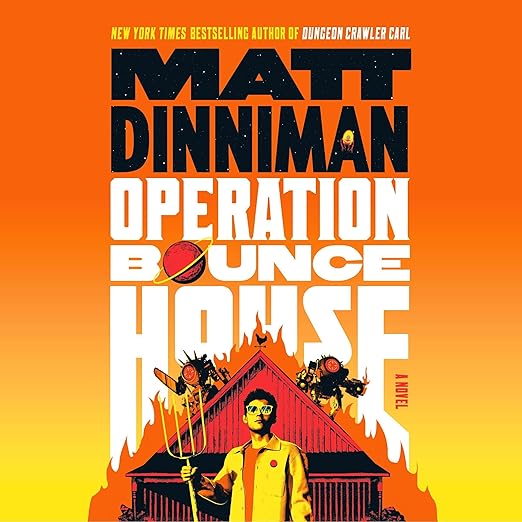
At a Glance
- Narrator: Travis Baldree is the named reader, with a town-sized ensemble, a machine army and a robot hive queen all landing inside a single performance
- Subjects: Colonial dispossession, monetized cruelty, machine sentience, small-town solidarity
- Tone: Propulsive, funny and meaner than it first lets on
- Bottom line: A standalone that earns its emotional payoff in a fraction of the pages a series would need, filed on this listing under the wrong genre entirely.
Somebody on Earth pays for the privilege of piloting a war machine, and the target is a farm on a colony planet somebody else lives on. This audiobook puts you on the farm for ten hours and forty-eight minutes. Matt Dinniman's premise is one clean, horrible idea: if a corporation has to clear a planet of its settlers, why spend money printing soldiers when bored customers will pay for the chance to do it themselves?
Oliver Lewis Wants Only an Ordinary Life
Oliver Lewis wants almost nothing. He would like to run the family ranch with his sister, play a gig or two with his band, and keep an aging fleet of intelligent agriculture bots running as long as they will go. New Sonora is a colony still waiting for its transfer gate to open fully, which will restore instant travel and proper communication with Earth, and Oliver considers that good news. Establishing how modest a life is at stake before anything is taken away is the oldest trick in this kind of story and it works every time it is done properly.
Apex's Logic Needs No Villains at All
Apex Industries is the mechanism. Hired to carry out what the copy calls an eviction action, the company works out that a war costs less if the participants pay to attend, so Earth's bored customers design their own machines and pilot them remotely from home. The name of the game gives the book its title. What makes the idea land is that nothing about it requires villains: every incentive in the chain is ordinary commercial logic, applied to people who were promised they would be left in peace.
One reader calls the result a meditation on what it is to be a sentient being and a critique of humanity, then makes a sharper craft observation: Oliver is a very straightforward character, and he needs to be, because he is the lens everything else is seen through. Precisely so, and it is the choice the whole novel rests on. A more complicated protagonist would have competed with the machines, the town and the paying audience for attention.
Baldree Voices a Colony, Machines, and Rodger Rodger
Attachment forms fast, which is the technical achievement here. An entry from somebody who spent seven books growing close to the cast of Dinniman's ongoing series reports needing only a handful of chapters to feel the same way about the people of this one, and credits the author's knack for building characters whose empathy reflects the chaos of the world we actually live in. Doing that inside a standalone, with no accumulated affection to draw on, is much harder than doing it across a series.
Travis Baldree is credited as the reader, and the workload implied by that credit is substantial: a colony town's worth of neighbors, machine chatter from the attacking side, a sister, a best friend, an ex-girlfriend and a hive queen robot named Rodger Rodger, all inside one performance, with the comic register and the grief register frequently arriving in the same scene. Not one of the five entries here mentions the reading at all, so the credit line is the whole of the available evidence. Cue up a passage where the town is talking over itself rather than an action sequence, since the ensemble is where the risk sits.
Tonally the book is doing more than it advertises. A four-star verdict lists what is actually under the plot: xenophobia, the question of what constitutes sentience, toxic internet culture, and what it means to live a good life, delivered at speed and littered with laugh-out-loud dialogue. The same entry measures the book against two acknowledged classics of the form, concludes it is not quite in that company, and still calls it stellar and real literature. That is a useful calibration: ambitious, successful, not yet canonical.
Filed as a Thriller, Built as Colonial War
Shelving is the first thing a buyer should distrust. This record is filed under mystery, thriller and suspense, and tagged Thriller and Suspense, on a novel the description itself describes as a fight for a planet against machines piloted by gamers. Science fiction is listed second. Anybody browsing the thriller category expecting a thriller will find a colonial war story with a game economy attached, and anybody browsing science fiction may never reach it.
Three numbers appear on this page and no two of them agree. The five written grades average 4.8. The badge above them reads 4.5. The rating total underneath reads one. A single vote cannot produce 4.5, the five visible verdicts do not produce it either, and the tally does not match the number of people who have plainly written something. The reception is real and enthusiastic; the summary figure standing in for it is not summarizing anything on the page.
Rusty Parts and a Planet's Paying Customers
Listeners who arrived from Dinniman's other work will need no persuading, and one entry admits the bias openly before recommending it anyway, praising the light-hearted fun, the heart-string moments, and the snapshots of ordinary life woven between the main story. Newcomers are equally well served, since nothing here depends on a previous book. Anybody who likes science fiction that runs on anger at a system rather than on hardware will find this squarely aimed at them.
Not for you if you need your science fiction sober, because the comic register is constant and some of the machinery is played for farce. Readers who dislike stories where an ordinary person improvises against overwhelming force should also stay away, since that is the entire plot. Ten hours and forty-eight minutes buys an old book inherited from a grandfather, a bucket of rusty parts and one stubborn farmer against a planet's worth of paying customers, and the novel never pretends those odds are anything other than absurd.
Do you need to have read Dungeon Crawler Carl before this audiobook?
Not at all. The publisher presents this as a separate novel from the same author, with its own planet, cast and rules, and nothing in the setup depends on the earlier series. The story begins from scratch and finishes inside itself, so a newcomer loses nothing by starting here.
Does the audiobook run on combat the whole way through?
Most of it, since the plot is a paid siege from beginning to end. The description spends just as much effort on what is being defended, though: a family ranch, an aging fleet of farm robots, a band, a sister. The fighting registers because the ordinary life around it is established first.
Who is Oliver Lewis and what does he actually want?
A colonist on New Sonora with modest plans: keep the family land going alongside his sister, play the occasional gig, and coax a few more seasons out of a fleet of aging agricultural robots. His ambitions are small by design. The plot arrives when Earth decides the colony it promised to leave alone is worth clearing.