Quick Take
- Narration: Carietta Dorsch handles the extreme content without flinching, she gives George a gentle, earnest quality that makes the horror-comedy contrast land, which is precisely what the material demands.
- Themes: Filial devotion taken to grotesque extremes, the outsider who just wants to belong, poverty and desperate ingenuity
- Mood: Darkly comic, gleefully repulsive, sincerely affectionate toward its monstrous protagonist
- Verdict: Exactly what splatterpunk devotees want and absolutely nothing that anyone else should approach, the comedy of good intentions executed with complete narrative honesty about what George is.
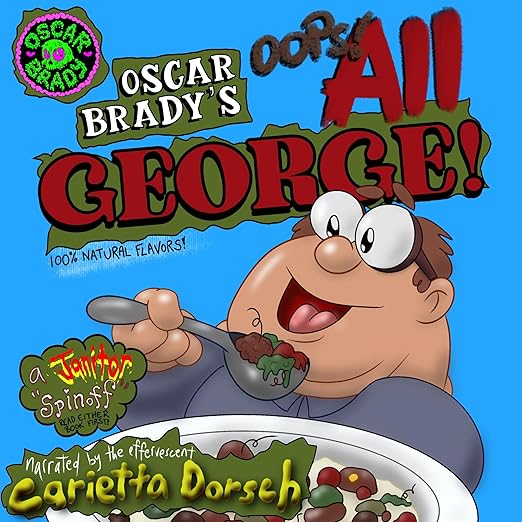
I want to begin by being as clear as the author’s own disclaimer: this audiobook is nasty. Oscar Brady is not kidding when he warns listeners. Oops! All George! is a spinoff of Brady’s 1980s slasher-inflected splatterpunk story Janitor, and the affable custodian George Crowley, who loves his ailing mother and has a very particular dietary palette, is not a character designed for general audiences. If you have arrived here by accident while looking for something lighthearted, this is your exit. The genre classification as comedy-humor is accurate in the sense that there is genuine dark comedy operating here, but the operative descriptor in the synopsis is nassssssstyyyyyyyyy, spelled exactly that way, which gives you the authorial register.
That said, within its own precise and fully committed subgenre, this is a book that knows what it is and executes it with skill. Brady is working in a tradition of extreme horror that treats its protagonists’ monstrousness with a strange affection, the reader of this kind of fiction is not looking for redemption arcs or moral tidiness but for the particular frisson of caring about someone whose actions should preclude sympathy. George is a case study in that dynamic. He works two jobs. He cannot afford his mother’s medical care. He has a very unusual appetite that, it turns out, saves him substantially on groceries. The comedy arises from the gap between George’s fundamental decency toward his mother and the absolute depravity of how he solves his financial problems.
The Spinoff Structure and Why It Works
Brady is explicit that you do not need to have listened to Janitor to follow this story, and that is a meaningful design choice. Spinoffs that require homework punish new readers; this one does not. George is introduced with enough context that his particular characteristics land without prior knowledge, and the splatterpunk world is established efficiently rather than by reference. The story is short at two hours and forty minutes, which is probably exactly right for this material. The premise would struggle to sustain a longer runtime without repetition, and Brady does not ask it to.
Carietta Dorsch and the Problem of Narrating George
Narrating a character like George requires a specific calibration: too much knowing irony and the horror deflates; too much sincere tenderness and the comedy deflates. Dorsch finds the register that makes the book’s tonal bet pay off. She plays George as genuinely trying, a person of limited means and earnest love for his mother who happens to be doing something unforgivable. The listener ends up feeling, against all reasonable instincts, something like sympathy for him. Reviewers noted specifically Brady’s achievement in making readers feel for every character, and Dorsch is a significant part of how that happens in the audio version.
Who This Is Strictly For
Extreme horror and splatterpunk readers who have been in the genre long enough to know where their tolerance sits. Readers of Jack Ketchum, Edward Lee, or the more transgressive end of the horror spectrum will recognize the tradition. Listeners who crossed over to horror from literary fiction and think of their horror consumption as psychological rather than visceral should exercise serious caution. The synopsis uses the word extreme and deploys its warning twice. Believe both. For the listener who has been looking for exactly this thing, however, it delivers.
Frequently Asked Questions
Do I need to listen to Janitor before Oops! All George!, or does this splatterpunk spinoff stand alone?
It stands entirely alone. Brady designed it as a spinoff, not a sequel, and explicitly states in the synopsis that prior knowledge of Janitor is not required. All context needed to understand George and his situation is established within this story.
How graphic is the content in Oops! All George!, is this extreme horror or horror-adjacent dark comedy?
Extreme horror. Brady’s own warning in the synopsis should be taken literally. The content is graphically visceral and is designed for readers and listeners who actively seek that experience in the splatterpunk tradition. This is not a book that softens its premise.
At two hours and forty minutes, does Oops! All George! feel like a complete story or a fragment?
It feels complete. The novella length is appropriate for the material, and Brady does not pad it. The story has a beginning, a middle, and an ending consistent with its own internal logic. The short runtime is a feature of the format, not a limitation.
Is the George character meant to be sympathetic, or is he purely a horror villain in protagonist’s clothing?
He is genuinely sympathetic within the novel’s terms. The comedy and the horror both depend on the reader caring about George’s love for his mother and his desire to fit in. Brady and Dorsch both work to make that sympathy real rather than ironic.