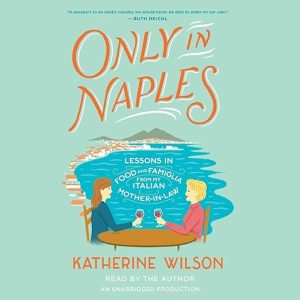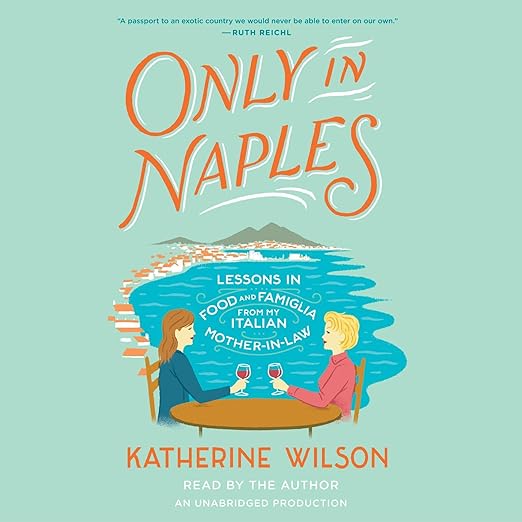
I put on Only in Naples on a slow Sunday afternoon when I had nowhere to be. Eight hours later I surfaced from it feeling like I had just spent a long, slightly overwhelming lunch with an Italian family I had never met but somehow missed immediately after leaving. Katherine Wilson narrates her own story, and there is something about hearing the author's actual voice deliver lines like "mealtimes are sacred" and "food must be prepared fresh and consumed in compagnia" that makes the whole experience feel unusually intimate, as if she is telling you this across a kitchen table rather than reading from a script.
The memoir covers Wilson's trajectory from young American consulate intern in Naples to fully initiated Avallone family member, wife, and mother. The arc spans years but the book never drags, largely because Wilson understands that the real subject is not her love affair with Salvatore but her love affair with his mother, Raffaella. That relationship, between the confused American girl and the elegant Neapolitan matriarch, is the engine of everything here. It is a book about what it means to be educated by someone who loves you, and about what you have to surrender to accept that education.
Wilson's Raffaella Teaches Crust Rules and Loyalty
The central dynamic of this book is a masterclass in the memoir genre: Wilson gives us a mentor figure who is specific enough to feel real and universal enough to resonate far beyond Naples. Raffaella's lessons are practical and philosophical at once. Never eat the crust of a pizza first. Always stand up and fight for yourself and your loved ones. These are not abstract wisdom nuggets; they arrive embedded in scenes, in arguments, in Sunday meals that last for hours. Readers who came up on the Italian-American immigrant narratives of writers like Adriana Trigiani will recognize the texture immediately, but Wilson earns her own distinct register because she is always the outsider looking in, aware of her foreignness even as she slowly ceases to feel it.
The food writing throughout is precise without being precious. Wilson describes a ragù, a rigatoni alla Genovese, a pasta al forno loaded with four kinds of cheese and béchamel, in ways that make the listener genuinely hungry. The detail about beating octopus with a hammer to achieve tenderness stays with you. It sounds violent. In context, it reads as an act of love. This is the kind of writing where technique and feeling are inseparable, and it characterizes the book as a whole.
Reichl Calls It a Passport Into Naples
Several reviewers have noted the book's warmth and wit, and they are not wrong, but what surprised me was how precise Wilson's comic timing is in the audio version. She delivers culture-clash moments, the hidden jars of peanut butter, the chaos of Neapolitan traffic, with a dry observation followed by genuine delight. She is never condescending about her adopted culture, nor is she starry-eyed in the way that some American-in-Italy memoirs can become. Ruth Reichl wrote that Wilson offers readers a passport to somewhere they could never enter on their own, and I think that is exactly right. The Naples of this book is not the tourist's postcard version. It is loud, occasionally infuriating, deeply communal, and completely alive.
The memoir spans courtship, culture clashes, Sunday services, marriage, and motherhood, and Wilson handles the time compression well. You are aware that years are passing but the book never feels rushed. The concept of sdrammatizzare, the Neapolitan art of sucking tragedy from something and laughing it out, becomes both a recurring theme and a structural principle. When things go wrong, as they reliably do, Wilson applies this philosophy with increasing fluency. The lesson takes the entire book to learn, and the reader learns it alongside her.
Gentler Than Ferrante's Naples of Violence
One reviewer, posting three stars, called this an easy read that is interesting mainly to people who like to travel. That is an undersell, though there is a grain of truth embedded in it. The emotional stakes are relatively low throughout. Nobody is in serious danger. The conflicts are cultural and relational rather than existential. If you came to this expecting the intensity of Elena Ferrante's Neapolitan Novels, which the marketing copy invokes, you will find something far gentler. Ferrante's Naples is a place of violence and class rage and female ambivalence. Wilson's Naples is a place of abundant food and loving chaos and a mother-in-law who teaches you to live fully. Both portraits are valid. They are just very different books.
The memoir's final third moves more quickly through the years of motherhood and settled life, and it loses a little of the crackle that makes the early sections so entertaining. The transformation from outsider to insider is complete, which means some of the productive tension the book thrived on earlier has dissipated. This is perhaps inevitable in any memoir about belonging: once you belong, there is less to say about the effort of getting there.
Bard and Weiss Fans Will Feel at Home
Listeners who love food memoirs with a strong sense of place, who enjoyed books like Elizabeth Bard's Lunch in Paris or Luisa Weiss's My Berlin Kitchen, will feel completely at home here. Anyone drawn to Italian family dynamics, Neapolitan culture specifically, or the experience of cultural assimilation told with humor rather than anguish will find this deeply satisfying. If you need high dramatic stakes or a plot-driven structure, this memoir will feel light. It is deliberately built around pleasure: the pleasure of food, of belonging, of a city that forces you to let go and start living rather than merely planning to.
Before You Press Play
- Performance: Katherine Wilson reads her own memoir with warmth and natural rhythm, her voice carrying both comic timing and genuine emotion without theatrical overreach.
- What it covers: Immigrant identity, found family, food as cultural language
- Feel: Sunlit and exuberant, with occasional sharp self-awareness
- Our call: A rich, sensory memoir for anyone who has ever felt transformed by a place and the people in it.
Common Questions
Do you need to know Naples or Italian culture to enjoy this memoir?
Not at all. Wilson is writing for outsiders by design since she spent years being one herself. The cultural details are explained naturally as she encounters them, so no background knowledge is required.
How much of the book is actually about food versus the relationship with Raffaella?
The two are deeply intertwined. Food is the primary language through which the relationship with Raffaella is conducted, so separating them is almost impossible. Recipes and cooking scenes appear throughout but always in service of the emotional story.
Does Katherine Wilson narrating her own audiobook add anything specific to the experience?
Yes, noticeably. Her comic delivery is precise and her warmth for the people she describes comes through in her voice in ways a hired narrator could not easily replicate. Listener reviews consistently mention the naturalness of her performance.