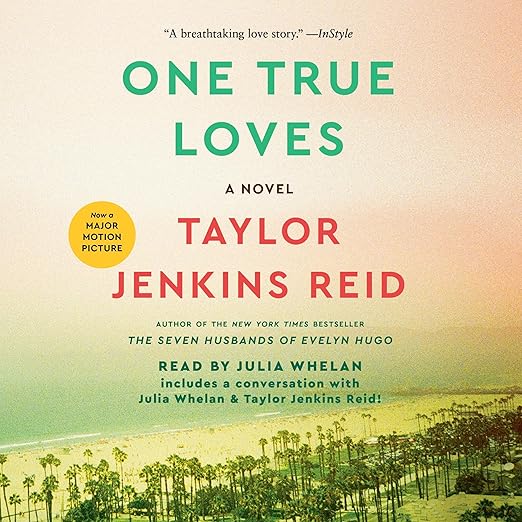
At a Glance
- Narrator: Julia Whelan's performance is exceptional, handling Emma's grief, recovery, and impossible dilemma with the same emotional precision that made her the obvious choice for Taylor Jenkins Reid's audiobooks.
- Subjects: Whether love has limits, identity rebuilt after loss, the difference between a first love and a lasting love
- Tone: Emotionally gutting and quietly hopeful, with Reid's signature readability pulling you through the devastation
- Bottom line: Reid poses an impossible romantic scenario and answers it with more honesty than most love stories are willing to risk.
I listened to One True Loves on a long drive, which I would not recommend to anyone who cries easily behind the wheel. Taylor Jenkins Reid sets up her central dilemma in the first line of the novel, a line several reviewers quoted directly because it does in one sentence what most novels spend chapters building toward: Emma is finishing dinner with her family and her fiance when her husband calls. The husband she thought was dead. The husband who has been trying to get home to her for years.
The structural premise is not subtle, and Reid does not pretend it is. Emma married Jesse in her twenties. They traveled. They lived, as the synopsis puts it, life to the fullest. Then his helicopter went down over the Pacific, and he was gone. Years pass. Emma moves home, rebuilds, falls in love with Sam, and gets engaged. Then Jesse is found alive. What follows is the novel's actual subject: not whether Emma will choose Jesse or Sam, but who Emma has become in the years since she lost Jesse, and whether any version of going back is possible.
What Taylor Jenkins Reid Delivers
This is now a major film, and listening to the novel in audio makes it easy to understand why it attracted that adaptation. The story has a cinematic clarity of premise that translates immediately. But what makes the novel work is subtler than the premise suggests. Reid is interested in what grief does to identity, how a person rebuilds themselves around an absence and whether that rebuilt self can survive the absence being filled again. Emma at thirty is not Emma at twenty-two. Neither is Jesse. That gap is where the novel does its most interesting work.
Multiple reviewers noted that they felt devastated regardless of which outcome they were rooting for, and that the novel's ending felt both inevitable and earned once they understood the rationale Emma was using. That response suggests Reid has found the precise moral geometry the story requires rather than reaching for a twist. The question is not which man Emma loves. It is which woman Emma is.
What Taylor Jenkins Reid Gets Right
Julia Whelan narrating Taylor Jenkins Reid is by this point a genuine partnership. Whelan's voice has become associated with Reid's fiction in the way that a specific song becomes associated with a specific memory. She understands the rhythm of Reid's prose, the way emotional punches are landed through deceptively simple sentences rather than elaborate construction, and she delivers those punches without telegraphing them. This edition also includes a bonus conversation between Whelan and Reid recorded exclusively for the audiobook, which adds context for both the novel and their working relationship.
At 8 hours and 53 minutes, this is a single-day or two-day listen. The pacing matches the emotional architecture. Reid does not linger in the grief sections or rush through the recovery. The timeline moves with Emma's interiority rather than against it.
Where Taylor Jenkins Reid Loses Some Ground
The novel's treatment of Sam, the fiance who brought Emma back to life, is one of its more delicate achievements. He is not a consolation prize or a narrative placeholder until Jesse returns. His relationship with Emma is genuinely rendered, and the reader is not permitted to dismiss him as the wrong choice before understanding what he means to the person Emma had to become. That evenhandedness is what makes the central dilemma actually difficult rather than cosmetically difficult.
Reid's prose is readable to the point of deceptive ease. Reviewers consistently note flying through her novels, which sometimes leads to undervaluing how precisely constructed they are. The opening line above is a deliberate choice. The structure of Emma's timeline, which moves between past and present to establish what each relationship cost and built, is doing careful work throughout.
Who Should Pick Up One True Loves
Readers who loved The Seven Husbands of Evelyn Hugo and have not yet come to this earlier novel should find it immediately. The emotional ambition is the same, even if the scale is smaller. Women's fiction and contemporary romance readers who want the genre's emotional range without formula resolutions will appreciate how Reid refuses to make the choice easy. Listeners who want a clear villain or a clearly wrong choice may find the evenhandedness frustrating. Reid is not interested in making this simple. She is interested in making it true.
A Few Questions About One True Loves
Is this a good starting point for Taylor Jenkins Reid, or should I begin with another of her novels?
It is a strong entry point. The premise is immediately gripping and the novel is self-contained. Readers who start here often then seek out The Seven Husbands of Evelyn Hugo and Daisy Jones and the Six. Any of the three works as a first Reid.
What does the bonus conversation between Julia Whelan and Taylor Jenkins Reid add to the audiobook?
It was recorded exclusively for this edition and covers both the novel's themes and the working relationship between narrator and author. For listeners interested in how the audiobook was approached and what Reid intended with the story's central question, it adds genuine context.