The Short Version
- Read by: Fiona Hardingham, also known for My Not So Perfect Life and Sword Catcher, carries Megs's skeptical, mathematical voice throughout.
- At its heart: the origin of Narnia, sibling devotion, skepticism giving way to wonder
- Vibe: Gentle, literary, and quietly moving
- Short version: Narnia lovers get a genuinely fresh angle on Lewis's creative life, built around a sibling bond that several reviewers single out as the real heart of the book.
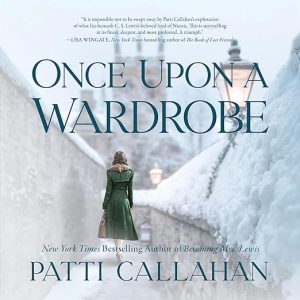
A question a sick eight-year-old can't stop asking, "Where did Narnia come from?", drives the entire plot of this audiobook, and Patti Callahan builds a genuinely moving structure around it: instead of answering directly, C. S. Lewis tells a bright young mathematician stories from his own life and lets her draw her own conclusions, which she then carries home to the brother who needed them most.
A Closer Look at Once Upon a Wardrobe
Margaret "Megs" Devonshire is seventeen, studying mathematics and physics at Oxford in 1950, exactly the kind of rigorously logical protagonist who initially tells her brother George that Narnia "is just a book for children, and certainly not true." George, homebound by illness and fixated on Lewis's newly released The Lion, the Witch and the Wardrobe, pushes her past that easy dismissal, sending her to ask the author himself where the story actually came from.
Reviewer Rickey's summary captures the book's central irony well: Megs is "a logical person wanting a logical answer to her brother's question," and instead gets "stories from the author she doesn't understand," which she nonetheless carries home and passes on. That mismatch between what Megs wants and what Lewis actually offers is where the novel's real tension lives, not in any external plot conflict but in a character's slow, reluctant opening toward something logic alone can't resolve.
A woman studying mathematics and physics at Oxford in 1950 is itself a detail worth sitting with rather than passing over, a specific, period-grounded kind of unusual that gives Megs's insistence on logical, provable answers real character weight rather than making her simply a stand-in skeptic. When Lewis himself, a professor at her own school, is the one she has to work up the nerve to approach, that academic proximity, teacher and student sharing an institution, adds a layer of real intimidation to what could otherwise have been a simple fan-letter premise.
What Makes Once Upon a Wardrobe Worth Hearing
Callahan positions this explicitly as a companion piece to the earlier Becoming Mrs. Lewis, and Stephanie McCall's review draws that connection directly, noting Callahan "brought both locales to life, combining painstaking detail" in both books. For listeners who already spent time with Callahan's version of Lewis's later life, this earlier-set story offers a different angle on the same man, filtered through a teenager's skepticism rather than an adult romantic partner's perspective.
Jonica E. Suver's review singles out a specific line from the book that stayed long after finishing it: "I think the lion follows all of us around. We just have to look for him," attributed to George's quiet, unchildish certainty about Aslan. That reviewer calls the bond between Megs and her brother the single most moving element of the whole novel, evidence that the sibling relationship, not the Lewis biography angle, is what actually lands hardest for at least some readers.
Warnie, Lewis's own brother, appears alongside him during Megs's visits too, a quiet doubling of the sibling theme running through the main plot: Megs and George on one side, Lewis and Warnie on the other, two sets of brothers whose closeness shapes the story each of them ends up telling. The synopsis itself calls the book "an emotional journey into the books and stories that make us who we are," and pitches it specifically as suited for book clubs, language that signals Callahan built this for group discussion as much as solitary listening.
Things to Know Before Starting Once Upon a Wardrobe
Narrator Fiona Hardingham also reads My Not So Perfect Life and Sword Catcher according to the listing itself, prior narration credits worth knowing if either of those titles gives a sense of how that voice handles a young lead's internal perspective, since Megs carries most of this book from the inside. Getting from those 4 counted votes to the displayed 4.7 badge only works if the site is truncating decimals rather than rounding them the way most people would expect, a narrower technical footnote than a real statement about how listeners actually feel.
Two of the five written reviews cut off before finishing a thought: Stephanie McCall's on "combined painstaking detail with a comfortingly pace," and Rickey's on "she must make a," so read both as partial impressions rather than complete arguments. Rickey's review does mention the book contains "a few errors" without specifying what kind, which is worth flagging as an open question rather than a settled criticism.
Who Patti Callahan Is Writing For
Narnia lovers looking for a fresh angle into Lewis's creative life, rather than a straightforward biography, are the clearest audience, and tinuviel moore's review, itself written with the same fairy-tale cadence the book opens with, "a middle-aged girl, weighed down by the death, disease, disaster, and dissension screaming from the headlines," makes the strongest case that this material connects even for readers who arrive skeptical the way Megs herself does.
Readers of Callahan's Becoming Mrs. Lewis will find real value in seeing the same historical figure from an earlier vantage point, and Mary Monsalve's review, posted from Germany rather than the United States, is a useful reminder that this book's appeal to Narnia fans travels well beyond one country's market.
Anyone hoping for a plot-driven historical novel with rising external stakes should adjust expectations; the tension here stays internal and quiet, built around one teenager's slow reconsideration of what counts as true, and it never becomes a conventional page-turner in the process. At just over 7 hours, it's a manageable length for a book club pick too, short enough to finish without the multi-week commitment a longer historical novel would demand of a group trying to coordinate everyone's schedule.