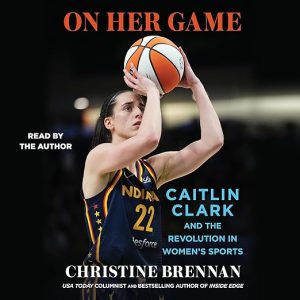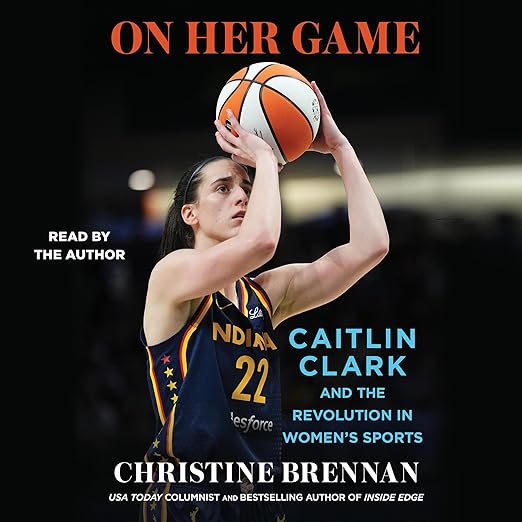
Caitlin Clark's record-setting career at Iowa and her record-breaking WNBA rookie season raised questions that extended well beyond basketball. Award-winning USA Today columnist Christine Brennan spent the 2024 season reporting from inside that story, and her audiobook On Her Game, which she narrates herself, is the result of that access. The book is an instant New York Times bestseller because Brennan delivers what the audience for this story has been hungry for: not a celebration, not a defense, and not a takedown, but a rigorous journalistic account of what actually happened when an athlete of Clark's magnitude arrived in a sport that was genuinely unprepared for her.
The scope is wider than Clark alone. Brennan situates Clark's rise in the fifty-year context of Title IX, the 1972 law that opened competitive sports to women and girls in America, and argues that Clark's ascendance represents the arrival of what that law always promised: a generation of female athletes whose excellence could command the national sports conversation on its own terms. That historical framing lifts the book above sports biography and gives it the significance the subject deserves.
Brennan Covered This With Her Own Notebook
Brennan's self-narration is essential to this audiobook in a way that is not always true for author-read non-fiction. She is not simply reading her own words. She is narrating material she reported personally, and the difference is audible. The passages about Clark's Olympic snub by USA Basketball, the charter flight controversy, and the troubling outbreaks of jealousy and resentment Brennan documents are not abstract reporting. They are events Brennan covered with her own notebook and recorder, and her narration carries that intimacy. When she describes Clark always taking the high road in the face of criticism, the observation has the weight of someone who watched it happen repeatedly rather than synthesized it from secondary sources. Brennan's decades of broadcast experience also mean she knows how to pace a spoken narrative, and the audiobook does not drag during the sections that require careful contextual setup before the reporting lands.
The book is also honest about the complicated dynamics Clark's success created in the WNBA, specifically the tensions around a white player becoming the dominant story in a predominantly Black league. Brennan addresses this with journalistic care rather than political framing, reporting what people said and what drove the friction without reducing it to a simple narrative. That kind of reporting requires real access and real courage to publish, and it is one of the most valuable things Brennan delivers in this account.
Holding an Audience With Voice as Well as Words
The case for the audiobook format is Brennan's narration. She is a television commentator as well as a print journalist, which means she knows how to hold an audience with voice as well as words. The behind-the-scenes reporting, including details about Clark's formative experiences, the logistics around charter flights for player safety, and the WNBA's institutional unpreparedness for the level of national scrutiny Clark brought, is delivered with the specificity of journalism rather than the generality of biography. These are facts Brennan gathered herself, and the narration reflects that ownership.
At a 4.7 rating across 546 reviews, this is one of the most positively received books in the women's sports space in recent memory. Reviewers who became Clark fans during her WNBA rookie season describe the book as giving them a complete picture of events they watched in fragments. The reporting on how Clark was treated by the league, players, and media covers territory that generates strong feelings, and Brennan navigates it with the journalist's discipline of letting documented facts carry the argument.
The 8-hour-and-48-minute runtime provides the space to do the story justice without padding. Brennan covers Clark's college career with genuine detail before moving to the WNBA, and the balance between biography and contextual analysis gives the audiobook both the satisfaction of a well-told individual story and the broader resonance of an important sports and cultural moment.
An Earthquake Captured Before the Aftershock
Readers who want a purely celebratory biography of Clark will find Brennan's reporting more complicated than that. The book does not shy from the tensions, resentments, and institutional failures that surrounded Clark's WNBA arrival. Brennan is clearly an admirer of Clark as an athlete and person, but she is primarily a journalist, and the journalistic obligation to report what happened takes precedence over producing an uncomplicated tribute. For listeners who followed the 2024 WNBA season closely, some of this territory will be familiar, though Brennan's behind-the-scenes access provides new information throughout.
The book is also specifically focused on Clark's career through the 2024 WNBA season. Given how rapidly Clark's story is still developing, this is inherently a document of a particular moment rather than a comprehensive career retrospective. Future seasons will produce a different book. This one captures the earthquake, not its full aftershock.
Parents Raising Daughters in Sport
This audiobook is for anyone who followed Caitlin Clark's college or WNBA career and wants a deeply reported account of what drove it, complicated it, and gave it historical significance. Sports fans across genders who care about the evolution of women's athletics will find Brennan's Title IX framing genuinely illuminating. Listeners who value journalism over hagiography and want complicated truths rather than clean narratives will appreciate Brennan's reporting instincts throughout. Parents raising daughters in sport, coaches, and anyone interested in the intersection of athletics, race, gender, and American sports culture will find On Her Game rewarding well beyond the basketball.
Quick Take
- Voice: Christine Brennan self-narrates with the authority of a veteran journalist who covered the story firsthand, delivering both the reported facts and her own analysis with a conviction that no hired narrator could replicate.
- Big ideas: Caitlin Clark's rise, women's sports and cultural visibility, Title IX legacy
- Atmosphere: Urgent and admiring, with honest reporting on the tensions Clark's success created
- Worth it?: Brennan's access, reporting depth, and firsthand perspective make this the definitive account of Caitlin Clark's emergence as both a sports phenomenon and a cultural turning point.