At a Glance
- Read by: Roger Wayne brings a measured, world-weary quality to Bukowski's verse and prose that suits the material without romanticizing it. His pacing leaves room for the darker poems to land without melodrama.
- At its heart: Alcohol as creative fuel, the cost of excess, solitude and connection
- Vibe: Raw and reflective, cycling between bleak comedy and genuine sorrow
- Short version: Essential Bukowski for readers who want to understand the relationship between his drinking and his writing, gathered in one carefully curated collection.
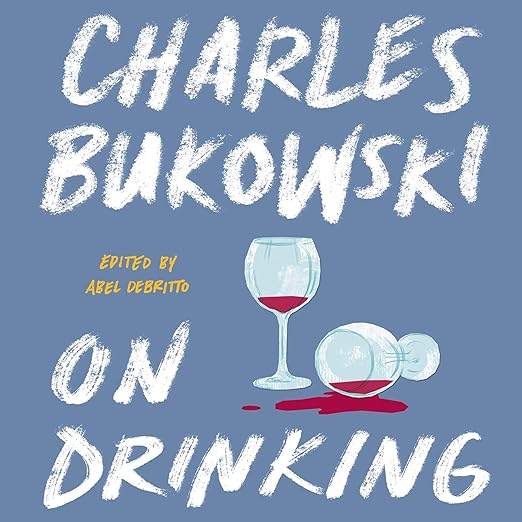
Bukowski wrote about alcohol the way some writers write about love: obsessively, contradictorily, with a honesty that is difficult to look away from even when it makes you uncomfortable. The audiobook On Drinking, drawn from editor Abel Debritto's careful selection of Bukowski's most significant work on the subject, is not a collection designed to celebrate excess or romanticize the hard-drinking poet life. It is something more complicated: a document of a man's conflicted relationship with the thing that both freed and damaged him, spanning poetry and prose, the funny and the devastating, across nearly his entire career. Roger Wayne narrates across four hours and fourteen minutes.
Dying With Boots On and a Symphony Playing
Abel Debritto, the foremost Bukowski scholar, assembled this collection with the kind of editorial judgment that only comes from deep immersion in a writer's complete work. The selection spans the full range of Bukowski's engagement with alcohol: the celebratory early work, the increasingly frank acknowledgment of dependency, the late-career reflections of someone who has survived what he probably should not have. What Debritto understands, and what the collection demonstrates clearly, is that alcohol was not incidental to Bukowski's writing. It was structural. The poem simply titled Drinking, quoted in the synopsis, captures this without ambiguity: for me it was or is a manner of dying with boots on and gun smoking and a symphony music background. That is not a man glamorizing his vice. That is a man accounting for it with unsettling clarity. The four-hour-and-fourteen-minute runtime is exactly right for this kind of material: long enough to develop thematic weight, compact enough to avoid the diminishing returns that a longer collection might suffer. The editorial decision to organize the material thematically rather than strictly chronologically gives the collection an internal coherence that a simple career-spanning anthology might not have achieved. You hear the through-line of Bukowski's relationship to alcohol rather than just its chronological evolution, which makes the overall argument of the collection considerably clearer.
Wayne Trusts the Language to Do the Work
Roger Wayne's narration is the right instrument for this material. Wayne does not perform Bukowski. He does not lean into the growl or the persona that other readers might emphasize. His delivery is measured and direct, which is precisely what these poems require. Bukowski's best work does not need theatrical reading; it needs a voice that trusts the language to do its work. Wayne earns the trust of the text by getting out of its way when the writing is strong and providing steady ground when the prose passages demand more. One longtime Bukowski reader noted in their review that this collection works well even for those who own his mainstream publications, as a complement and deepening of what is already familiar. For listeners new to Bukowski, this is a smarter entry point than many of his standalone collections precisely because the editorial selection has been made by someone who knows the full catalog and has chosen the work on this theme most likely to reveal how central alcohol was to what he did. The variety on offer, moving between poems that provoke genuine laughter and passages that record genuine damage, keeps the listening experience from settling into a single register. Wayne's consistency in tone across that tonal variation is one of the narration's most significant assets: he does not announce the shifts in mood but allows them to arrive naturally, which is exactly how the material should be delivered.
He Kept Drinking, Kept Writing, Paid the Cost
The collection carries a 4.8 rating across 344 reviews, which reflects genuine enthusiasm from readers who know Bukowski well enough to evaluate the curation. A reviewer who noted they can relate to this topic and still laugh touches on something important: this is not entirely grim material. Bukowski's relationship to alcohol was also a source of genuine comedy, social observation, and hard-won fellowship, and Debritto has included enough of that range to prevent the collection from collapsing into a single note. What listeners should understand is that On Drinking is not a narrative. It does not tell a story from beginning to end in the conventional sense. It is a thematic anthology, and it rewards the kind of listening you give to poetry: attentive, willing to sit with ambiguity, not rushing toward resolution. The prose interspersed between poem sets provides texture and grounds the more elliptical verse in recognizable scene and detail. Listeners who need narrative structure or a clear moral resolution will find neither here, and they should know that before they begin. The collection also does not offer redemption. Bukowski did not get sober and write about his transformation. What the later-career material reflects is someone who kept drinking and kept writing and kept paying the cost of both, and Debritto's selection is honest about that trajectory without editorializing around it.
Writing That Holds Up Without the Legend
Anyone already familiar with Bukowski who has not encountered this specific collection should make time for it. Debritto's curation gives familiar material new context and makes the thematic arc of Bukowski's drinking clearer than any individual book manages. Readers new to Bukowski who are curious about what the sustained critical attention to this writer is about will find this an honest introduction: the best of the work on this theme is here, and so is the darkness that any honest engagement with his life requires. Listeners who can tolerate ambivalence and appreciate writing that refuses easy moral resolution will find this audiobook one of the more rewarding experiences in contemporary American poetry available in audio form. Bukowski's longevity as a cultural figure is often discussed in terms of his persona, the rough-edged working-class chronicler who drank too much and wrote anyway, but what Debritto's curation reveals is that the actual quality of the writing justifies the attention independently of the legend. These poems hold up when read straight, without the biographical scaffolding, which is how Roger Wayne reads them. That is the highest compliment you can pay this kind of collection. Listeners in recovery or with personal experience of dependency should approach the material knowing it does not offer a cautionary narrative or recovery framework; it is honest about the damage without offering a resolution, which some will find resonant and others will find difficult.