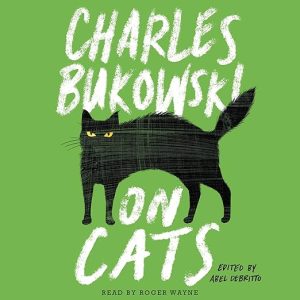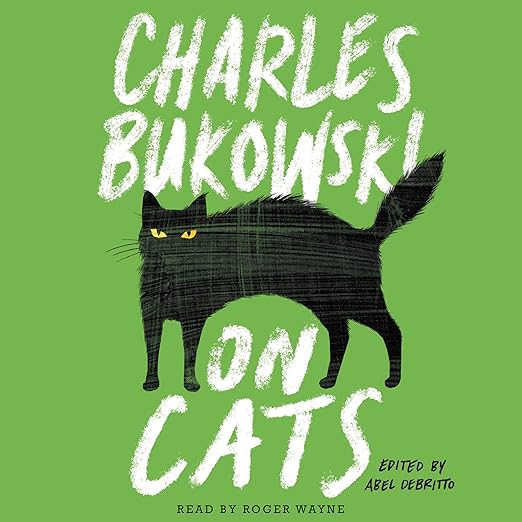
What does it reveal about a writer when you find out what he loves? Charles Bukowski spent decades building a persona around failure, alcohol, and the grinding texture of working-class life in Los Angeles. He was not supposed to be tender. And yet On Cats, this small audiobook running just over an hour and narrated by Roger Wayne, keeps complicating that image in ways that feel more honest about Bukowski than most of his larger work. This collection of reflections, poems, and short pieces gathers everything Bukowski wrote about the cats who shared his life, and what emerges is something genuinely revealing about the man behind the mythology he cultivated so carefully for so many years.
The audiobook draws from across Bukowski's catalog, assembling fragments that span his career. He was not writing a coherent book about cats. He was writing about whatever was in front of him, and cats kept appearing because they were there, in his apartment, on his pages, watching him work at the typewriter. The collection format means the listening experience has a discontinuous quality that suits the material well, each piece complete in itself, the whole greater than the sum of its parts.
He Called the Cat the Beautiful Devil
The editorial frame around this collection is important to understand before listening. This is not Bukowski writing for an audience of cat lovers. These are pieces written across decades in which cats appeared as genuine presences in his daily life, and what he made of them tells you something specific about his sensibility. He called the cat the beautiful devil. He described cats as forces of nature, elusive emissaries of beauty and love, and for someone whose literary persona ran on deliberate ugliness, that language is striking and worth sitting with.
Wayne's narration earns the material. Bukowski's prose has a specific rhythm, blunt and then suddenly lyrical, and it requires a reader who understands when to press into the roughness and when to let the tenderness land. Wayne does not over-smooth the edges or play for easy sentiment, which is exactly right. One reviewer described the collection as a great book and very insightful, seen through the eyes as only Charles Bukowski could. That particular quality, the specificity of a singular consciousness rendering a subject that others would render sentimentally, is what makes the short runtime feel full rather than thin.
The collection also serves as a useful corrective to the Bukowski mythology. The cats in these pieces are not symbols or projections; they are animals whose particular behaviors Bukowski observed with care and rendered with precision. He writes about them stalking prey, crawling across his typewritten pages, waking him with claws across the face. He writes about their deaths with grief that he would not perform elsewhere. The intimacy is specific and earned, which is what separates the best nature writing from sentimentality, and Bukowski, for all his abrasiveness, understood that distinction.
Wayne's Voice Gives Scattered Fragments Coherence
The argument for choosing the audio version of this collection over the print is partly about compression. At 1 hour and 19 minutes, this is a dense experience when listened to in a single sitting, and the continuity of Wayne's voice gives the fragments a coherence they might lose on a page where you can put it down between pieces. The rhythm of the prose comes through in audio in a way that rewards attention without demanding sustained effort.
The collection is also part of a thematic trilogy alongside On Love and On Writing, and the three together form a portrait of Bukowski's inner life that his novels and poetry collections gesture toward but never quite assemble in one place. The cats function as a kind of lens: through his relationship with these animals, you see his capacity for care, his respect for creatures that operate on their own terms, and his fundamental preference for the company of beings who make no social demands on him. There is a coherent worldview embedded in these short pieces, and it is more generous than Bukowski's reputation would suggest.
Closer to an Extended Essay Than a Narrative
The short runtime will surprise listeners expecting a conventional audiobook experience. At just over an hour, this is closer to an extended essay collection than a full narrative, and the fragmented structure means there is no arc to follow in the traditional sense. Each piece is complete in itself, and the collection rewards a particular kind of attention: unhurried, willing to sit with individual observations rather than pushing toward a conclusion.
Listeners new to Bukowski who come here expecting the raw, confrontational voice of his novels will find something quieter and more complicated. The roughness is still there, but it keeps getting interrupted by genuine affection, which is disorienting if you expect Bukowski to be consistently hard. Existing fans of his work tend to find this one of the more personally revealing things he put into the world. The 4.4 rating from 710 listeners reflects a broad audience, some encountering Bukowski through this accessible entry point, others adding it to a collection of his work already well established on their shelves.
A Tender Portrait of an Unsentimental Man
Bukowski readers who want to hear something unexpected from a familiar voice will find this audiobook genuinely rewarding. Cat owners with a literary bent, and anyone interested in short-form American prose that carries emotional weight without straining for it, are the natural audience here. The short runtime also makes it an easy entry point for listeners curious about Bukowski but wary of committing to his longer, more abrasive work first.
Listeners expecting conventional memoir or narrative nonfiction should adjust expectations. This is a curated collection of fragments, not a sustained argument or story. Anyone looking for biographical detail about Bukowski's life beyond his relationship with these animals will need to look elsewhere. But for what it is, it delivers exactly what it promises: a tender and particular portrait of an unsentimental man who loved his cats without apology and wrote about them with the same precision he brought to everything else.
In Brief
- Read by: Roger Wayne matches the gruff tenderness of Bukowski's prose without over-performing the rough edges, finding the genuine affection underneath the bluster.
- At its heart: Human-animal connection, creative solitude, beauty in the unglamorous
- Vibe: Wiry and tender, unexpectedly moving
- Short version: A short, surprising window into Bukowski's softer interior, best for existing fans or readers curious about what care looks like when filtered through one of American literature's most resistant voices.
Frequently Asked Questions
Is On Cats a good starting point for readers who have never read Bukowski before?
It is an accessible entry point because of its short runtime and warmer emotional register compared to much of his other work. However, the collection assumes some familiarity with Bukowski's voice and worldview to fully appreciate what is surprising and revealing about it. New readers may find it thin rather than moving without that context.
Is this audiobook part of a series, and do I need to listen to the others first?
On Cats is part of a thematic trilogy alongside On Love and On Writing, but the three books are independent. Each collects Bukowski's writings on a specific subject and can be listened to in any order. Many readers find On Cats the most emotionally surprising of the three.
How does Roger Wayne's narration handle Bukowski's distinct prose style?
Wayne captures the rhythmic tension in Bukowski's writing between bluntness and sudden lyricism without over-performing either quality. His delivery maintains the wiry, unsentimental quality of the prose while allowing the genuine affection in the cat pieces to land. It is a restrained and accurate performance.
At just over an hour, does this audiobook offer enough content to justify the listening time?
The short runtime is a feature of the collection format rather than a sign of thin material. Each piece is complete and carries weight, and the cumulative effect of listening straight through is meaningful. It is best approached as a literary experience rather than a comprehensive resource on Bukowski.