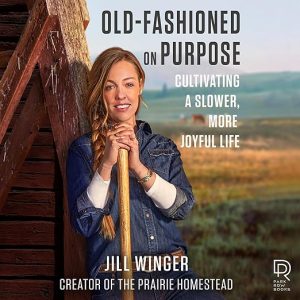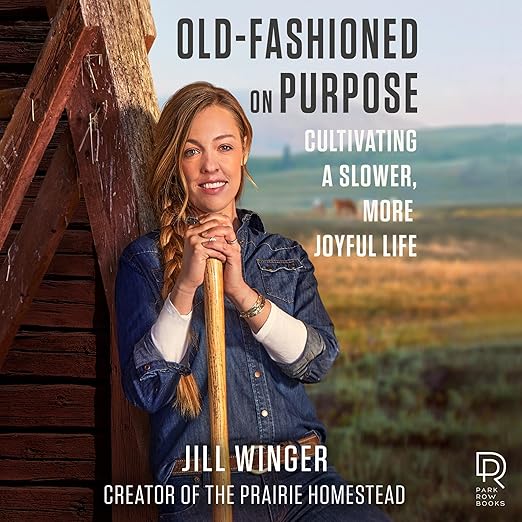
Jill Winger built the Prairie Homestead blog and the Old-Fashioned On Purpose podcast before writing this book, and that sequence matters for understanding what Old-Fashioned on Purpose is and is not. The audiobook, self-narrated by Winger at eight hours and fifty-seven minutes, is not a pastoral fantasy or a luddite manifesto. It is a practical and philosophically grounded argument that the skills we have discarded in the rush toward convenience, cooking from scratch, growing food, handiwork, and a slower relationship with daily time, are the same ones many people are now quietly desperate to reclaim. Winger narrates from the position of someone who made this transition herself on a Wyoming ranch, and the audiobook version benefits enormously from her own voice delivering that experience.
No Farm Required for This Rallying Cry
The book's timing is explicitly acknowledged in the synopsis: when the pandemic hit in 2020 and flour and vegetable seeds flew off the shelves, it confirmed something Winger had been arguing on her blog and podcast for years, that the longing for sourdough bread and fresh vegetables is not a trend but the surface expression of a deeper need. She is careful not to romanticize homesteading as an escape; the book is honest that you do not need to live on a farm to cultivate a simpler life, and the advice is grounded in the realities of people living in suburbs and cities as much as on rural properties. That inclusivity is one of the book's genuine strengths, and it separates Old-Fashioned on Purpose from the genre of rural-living memoir that implicitly requires acreage to participate in its vision.
Reviewer Teresa Choate captured something important when she described the book as "a rallying cry to stop being passively numb and wake up." What Winger is arguing is not that technology is bad or that progress is inherently destructive, but that the passive consumption of convenience is its own kind of trap, and that the specific activities she advocates, gardening, cooking, handiwork, creating routines with intention, are not sacrifices of comfort but investments in the kind of satisfaction that convenience actively forecloses. That argument is made with enough personal specificity to feel grounded rather than preachy.
Jill Winger's Voice Makes the Case for Audio
Winger self-narrating is the primary reason to choose audio over print for this book. Her voice carries the particular warmth of someone whose public persona has been built on direct, practical communication, and the audiobook sounds like a conversation with her rather than a recitation of a manuscript. A reviewer who had already followed the blog and podcast noted they were not disappointed by the book, which is the specific kind of endorsement that self-narrated audiobooks depend on: the voice must match the persona, and Winger's does.
The supplemental PDF that accompanies the audiobook is worth noting. Some of the practical tips, DIY projects, and specific strategies that work well as reference material on a printed page are less useful in audio form. Listeners who plan to use the book as a practical guide rather than simply as motivational reading should download the PDF alongside the audio. That said, the core of the book, its philosophical argument for simplification and its honest account of what the transition to more intentional living actually involves, works entirely in the audio format without any visual supplement.
At just under nine hours, Old-Fashioned on Purpose paces itself well. Winger moves between personal narrative, practical guidance, and philosophical reflection without losing the thread, and the audio format suits that movement. A reviewer described it as a top-ten read that they intend to keep as a reference during their homesteading journey, and the audiobook's pacing reflects the book's design as both a one-time listen and a returnable resource.
People Feel Unfulfilled Despite Being Connected
The most direct articulation of Winger's central argument comes in the sections where she examines why people feel unfulfilled despite being "more connected than ever before." She is not making a Luddite case; she is making a psychological and physiological one about what kinds of activity the human brain and body are adapted for, and what kinds of sustained satisfaction require engagement rather than passive receipt. Those sections are where the book earns its Hal Elrod endorsement and its foreword from Rory Feek, two voices with their own audiences in the simplicity and faith-adjacent lifestyle space.
Also worth your attention are the sections Winger devotes to the kitchen specifically. Her argument that cooking from scratch is not merely about food quality but about the particular kind of attention and presence it demands is well-developed, and the chapter on finding joy in the kitchen even for people who profess to hate cooking is one of the more persuasive pieces of practical philosophy the audiobook offers. She does not shy away from the difficulty; the point is that the difficulty is part of the value, not an obstacle to it.
Prairie Homestead Fans Over Off-Grid Radicals
This audiobook is well-suited for listeners who have found themselves drawn to homesteading, simple living, or back-to-basics content online and want a structured argument for why those impulses make sense alongside practical guidance for acting on them. Followers of Winger's existing Prairie Homestead content will find the audiobook consistent with her voice and approach. Listeners who have enjoyed Erin Benzakein's work on intentional growing, or the broader slow-living publishing wave that includes titles like Shannon Amidon's or Sarah Ban Breathnach's earlier Simple Abundance, will recognize the philosophical territory and find Winger's agricultural specificity a useful addition. Those looking for radical off-grid instruction will find Old-Fashioned on Purpose more philosophical than operational, which is a feature rather than a limitation given how the book is positioned.
Questions Listeners Ask
Is Jill Winger's audiobook narration consistent with her voice on the Prairie Homestead podcast and blog?
Yes. Winger self-narrates, and the tone is consistent with her established public persona as a practical, warm, and direct communicator. Existing followers of the podcast and blog will find the audiobook a natural extension of that voice.
Is Old-Fashioned on Purpose audiobook suitable for urban or suburban listeners, or does it assume rural living?
Winger explicitly addresses listeners in cities and suburbs throughout the book and is careful to distinguish between the homesteading ideal and the practical applications available to people without farmland. The audiobook's advice on cooking, gardening, and intentional living is largely applicable regardless of geography.