Quick Take
- Narration: Gerhard Weigelt delivers a clear, no-frills read that suits the manual’s practical tone without adding warmth or personality the material doesn’t ask for.
- Themes: Self-sufficiency, water and energy independence, food preservation and resilience
- Mood: Practical and encouraging, built for first-timers
- Verdict: A solid entry point for listeners who want to start moving toward off-grid readiness without wading through overwhelming technical content.
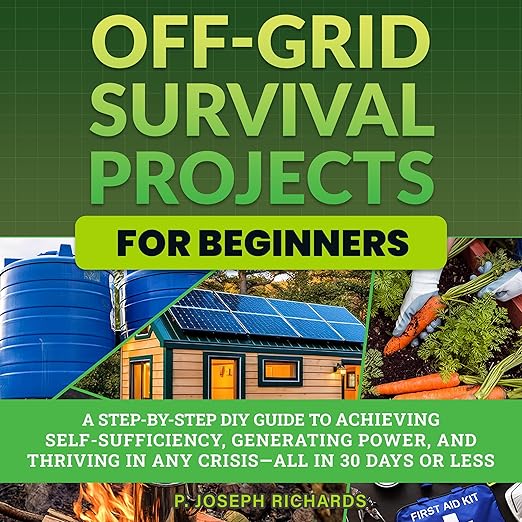
I came to this one after a stretch of dense literary fiction and was genuinely glad to have something that asked nothing of me except attention. I put it on during a Saturday morning of errands, the kind of listening context where a book either snags you or fades into background noise, and Off-Grid Survival Projects for Beginners held its own better than I expected for a sub-four-hour practical guide aimed at absolute newcomers.
P. Joseph Richards writes with the sensibility of someone who has actually taught this material to skeptical beginners rather than to enthusiasts who were already half-converted. The opening chapters on what off-grid living truly involves, and how to set realistic goals rather than romantic ones, do a useful job of managing expectations before the project-level instruction begins.
Our Take on Off-Grid Survival Projects for Beginners
What distinguishes this from the more breathless homesteading guides I’ve encountered is the proportionality of its ambitions. Richards is not asking you to sell your house and move to forty acres. He is asking you to do one thing at a time: collect and purify water, understand basic solar panel principles, learn to preserve food. The step-by-step structure means each chapter functions as a self-contained unit, which is well-suited to audio where you cannot easily flip back to review a technique.
One reviewer, a professional water treatment operator, specifically noted that the book covers topics most comparable titles skip. That observation tracks with what I heard: the water collection and purification section is more thorough than I expected from a beginner guide, covering both daily-use systems and emergency preparedness scenarios without becoming a technical manual. The balance between practical detail and accessibility is genuinely well-managed for the target audience.
Why Listen to Off-Grid Survival Projects for Beginners
The 3-hour-and-39-minute runtime makes this a good candidate for a road trip or a dedicated afternoon. It does not overstay its welcome, and the structure means you can re-listen to specific sections without needing to work through the whole thing again. Gerhard Weigelt reads with clean articulation and a steady pace that works well for instructional content, though he brings less personality to the material than a narrator like this sometimes gets. That is not a flaw exactly, just a characteristic: this is narration that gets out of the way of the information.
The book also includes a companion PDF in your Audible library, which matters here more than it does for most nonfiction. Projects involving solar panel orientation or food preservation techniques benefit from visual reference, and Richards has made that material available in a format where you can actually look at it.
What to Watch For in Off-Grid Survival Projects for Beginners
At under four hours, this is genuinely a starter guide, not a comprehensive manual. Experienced homesteaders or anyone who has already spent time with off-grid literature will find it covers familiar ground without significant depth on any single topic. The mindset habits section in the final chapters is the least distinctive part of the book, drifting toward the kind of general resilience framing that fills the self-help shelf. It reads like a closing chapter added to round out the structure rather than something that grew organically from the material.
For complete beginners, none of that will matter. The project-by-project architecture is exactly what that audience needs: clear, achievable steps that build confidence without requiring a full lifestyle overhaul before you see any results.
Who Should Listen to Off-Grid Survival Projects for Beginners
Best suited to listeners who are curious about self-sufficiency but have no background in it and feel intimidated by the more technical literature. It also works well for people in suburban or semi-rural settings who want emergency preparedness skills without committing to full homestead living. If you already have working knowledge of solar installation, food preservation, or water systems, this will not add much. But as a first introduction to the subject, it earns its high rating and its reputation as an entry point that actually treats beginners with respect.
Frequently Asked Questions
Does the audiobook work without the companion PDF, or do I need to follow along visually?
The audio holds up on its own for most of the content. The companion PDF is most useful for the energy and water system chapters, where diagrams help clarify spatial setups. For food preservation and mindset sections, audio alone is sufficient.
Is this useful for urban or suburban listeners, or is it aimed at rural homesteaders?
Richards explicitly frames the guide for people who want to start small regardless of location. The water collection and food preservation projects are applicable in urban and suburban settings. Some of the energy and shelter content assumes more outdoor space, but the book’s framing is deliberately non-prescriptive about lifestyle.
How does Gerhard Weigelt’s narration handle the instructional, step-by-step sections?
He reads clearly and at a measured pace, which suits instructional content well. He does not dramatize the material, and some listeners may find the delivery a bit flat. For a practical guide rather than a narrative memoir, it is a reasonable fit.
Is Off-Grid Survival Projects for Beginners genuinely for beginners, or does it assume some prior knowledge?
It is genuinely entry-level. The book spends time defining terms and explaining why each project matters before explaining how to do it. Reviewers with professional backgrounds in water treatment and camping confirmed that even experienced practitioners found value, but the target reader is someone starting from scratch.