Quick Take
- Narration: Dr. Michelle Savage’s delivery is clear and informative, suited to the overview format, though it cannot compensate for the book’s depth limitations.
- Themes: Off-grid homesteading, energy and food independence, transitioning from urban to rural life
- Mood: Aspirational and practical in a broad-strokes way
- Verdict: A genuine starting point for complete beginners, but listeners who have already done any research on off-grid living will find the coverage too surface-level to be useful.
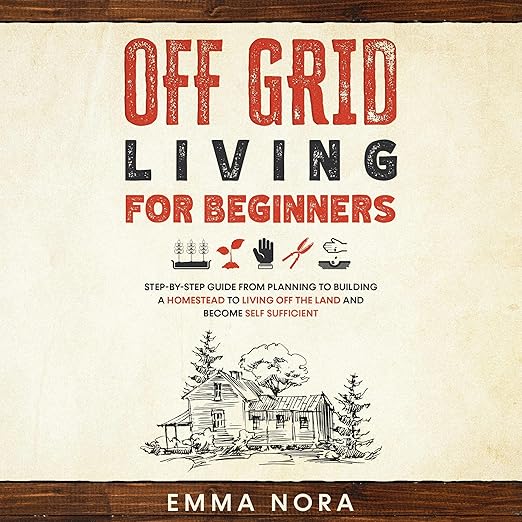
I spent a weekend last autumn listening to a cluster of off-grid and homesteading audiobooks for a piece I was working on about the genre’s recent surge in popularity. Off Grid Living for Beginners by Emma Nora arrived in that stack with reasonably good ratings and a very broad promise: it would take you through each strategic step in preparing, building, and settling into a life independent from grid technology. That is a large promise, and the book delivers on part of it.
The question with any title explicitly aimed at beginners is what counts as beginner, and where exactly the coverage ends. Nora’s answer is somewhere earlier than most practical listeners will expect. The book covers the terrain it describes, explaining what to look for in land selection, how to think about water access, which energy systems exist, what agricultural approaches are available. This is genuinely useful orientation-level content for someone who has never thought about any of these things in systematic terms.
Our Take on Off Grid Living for Beginners
The honest assessment is that this is a survey course rather than a how-to manual. Nora describes the categories of decision and action involved in going off-grid without drilling into the specific mechanics of any of them. One reviewer put it bluntly: there is plenty of information about what to do, but this ain’t for someone who needs to know how. That criticism is structurally accurate. The book’s strength is orienting someone who does not yet have a map of the terrain; its weakness is that it often refers listeners to other sources for actual implementation guidance.
At just over three hours, the runtime reflects this scope. Nora covers a lot of ground, including the six-step long-term approach she attributes to successful homesteaders, income-generating strategies that can support an off-grid lifestyle such as farmers markets and crop subscription schemes, and the psychological dimensions of transitioning from urban to rural living. The chapter structure is clear, with recaps at the end of each section, which works well in audio format.
Why Listen to Off Grid Living for Beginners
Dr. Michelle Savage narrates with a clear and unhurried delivery that suits the informational content. For a short guide, this is an appropriate choice; she does not dramatize or editorialize, keeping the focus on the material. The audio format works reasonably well for this type of content, though the absence of visual aids, charts, or illustrations, which one reviewer noted as a significant gap in the print version, is equally felt in audio where you cannot even reference an appendix while listening.
The book’s strongest section covers the practical question of how to practice off-grid living before making a full commitment, which is genuinely useful advice for anyone considering the transition. The idea of building skills and systems incrementally rather than making an all-or-nothing leap is sensible guidance, and Nora presents it with enough specificity to be actionable at the planning stage even if the implementation details remain elsewhere.
What to Watch For in Off Grid Living for Beginners
Listeners who arrive with any research background will run out of new information quickly. Multiple reviewers who described themselves as already familiar with the basics found the coverage frustratingly thin, and one was dismissive enough to question whether the book had any audience beyond someone who genuinely does not know that solar panels exist. That is harsh, but it points to a real limitation: the beginner this book is aimed at is a very early-stage beginner.
The bibliography that one reviewer described as the book’s most useful resource is not accessible in audio format in the same way it would be in print or ebook form, which is a practical consideration worth noting for listeners who plan to follow up on the referenced materials.
Who Should Listen to Off Grid Living for Beginners
Best suited for listeners who are completely new to the concept of off-grid living and want a broad orientation before going deeper. If you have already read one or two other titles in this space, you will find little here that you do not already know. The format and runtime make it a reasonable choice for a first listen on a commute or walk, as long as you go in with calibrated expectations. Follow it with more specific resources on whichever aspect of off-grid life most interests you.
Frequently Asked Questions
Does Off Grid Living for Beginners give specific instructions for building systems like solar or water collection?
No. The book describes these systems at an orientation level and refers listeners to other sources for implementation specifics. It is a survey of what is involved rather than a technical guide.
Is this audiobook worth listening to if you have already researched off-grid living?
Probably not. Multiple reviewers with prior knowledge found the coverage too surface-level to be useful. It is aimed at complete beginners who are orienting themselves before any deeper research.
How does the narrator Dr. Michelle Savage handle the practical content?
Her delivery is clear and straightforward, appropriate for informational content of this kind. The narration is not a barrier to the material, though it also cannot add depth that the text does not contain.
Does the book address how to transition gradually rather than all at once?
Yes, and this is one of its stronger sections. Nora explicitly covers how to practice off-grid systems and skills while still connected to grid technology, which is practical advice for anyone considering a staged transition.