Quick Take
- Narration: Donald Cuddington reads in a clear, measured style that suits the handbook format well, practical rather than performative, easy to follow while doing other tasks.
- Themes: Livestock management, homestead self-sufficiency, practical animal husbandry
- Mood: Methodical and encouraging, like a knowledgeable neighbor walking you through your options
- Verdict: A solid reference listen for anyone planning a livestock operation from scratch, though those seeking off-grid-specific techniques will need to supplement it elsewhere.
I put this one on during a Saturday afternoon of garden planning, the kind of day where I had a legal pad in front of me and was trying to think through what a productive half-acre actually looks like. By the time Donald Cuddington got to the section on goat breeds and their milk yield comparisons, I had filled two pages of notes and was genuinely reconsidering my position on rabbits. Off Grid Farm Animal Essentials is the kind of audiobook that works best when you are already in a planning headspace, it feeds directly into questions you are already asking.
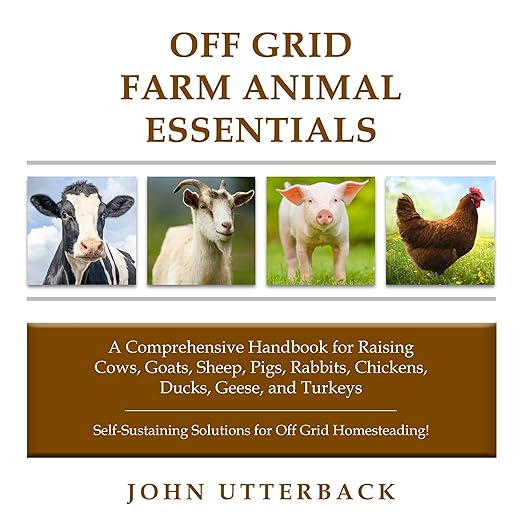
John Utterback covers a lot of territory in just over nine hours. The title promises a comprehensive handbook, and it largely delivers on that: cows, goats, sheep, pigs, rabbits, chickens, ducks, geese, and turkeys each receive dedicated treatment. The approach is systematically organized around utility, milk, meat, eggs, fiber, which makes the book feel more like a decision-support tool than a general survey. You are not reading about farm animals for their own sake. You are reading to figure out which ones earn a place on your property, and why.
Our Take on Off Grid Farm Animal Essentials
Utterback’s strongest material is in the productivity comparisons. When he walks through cost per pound of meat production, or the time-to-harvest for rabbits versus pigs, the specificity is genuinely useful. Reviewers praised the chicken breed section in particular, and that enthusiasm is warranted, the breakdown of laying breeds, dual-purpose breeds, and meat birds gives you a framework for making real decisions rather than just picking based on what looks good at the feed store. The discussion of hatching and brooding protocols is practical and grounded. This is not a theoretical text. Utterback writes as someone who has made these choices and learned from them.
Why Listen to Off Grid Farm Animal Essentials
The audiobook works better than you might expect for reference material, partly because Cuddington’s narration is clear and unhurried. He does not rush through the technical passages, and the structure of the book, organized by animal type with consistent sub-sections on feeding, breeding, healthcare, and housing, means you can easily re-listen to specific sections when you need a refresher. The companion PDF available through Audible is a genuine bonus; having a reference document alongside the audio is the right format for material this dense. Reviewers consistently noted that even experienced homesteaders found the book useful as a structured overview, not just as a beginner primer.
What to Watch For in Off Grid Farm Animal Essentials
One substantive criticism from readers deserves attention: the book’s coverage of electricity-free techniques is thin for something marketed as an off-grid guide. A reviewer who specifically hoped to learn how to keep chickens without a heat lamp or how to store eggs without refrigeration found those gaps frustrating. Utterback covers the standard agricultural approach to each animal, but the modifications required by genuinely off-grid conditions, limited refrigeration, no electric fencing, passive heating for coops, receive less attention than the title implies. If you already have solar infrastructure and your off-grid situation is largely about location rather than resource constraints, this is less of an issue. If you are planning a more austere setup, you will need to supplement this with more specialized material.
Who Should Listen to Off Grid Farm Animal Essentials
This is well suited to people in the early planning stages of a homestead who need a broad map of livestock options before they can narrow their focus. It is also a reasonable listen for suburban homesteaders expanding into backyard chickens or rabbits who want to understand what the larger picture looks like. Experienced farmers who already manage multiple species will likely find it too foundational. And anyone who specifically needs guidance on managing animals without electricity or refrigeration should treat this as a starting point rather than a complete answer, the off-grid framing is real but not the book’s deepest strength.
Frequently Asked Questions
Is this audiobook useful if I am only interested in chickens and not the full range of livestock?
Yes, though you will be listening through a fair amount of material before reaching the poultry sections. The chicken and egg content is among the most detailed in the book, covering breed selection, coop sizing, brooding, and production expectations. The chicken breed breakdown alone is worth the listen for poultry-focused homesteaders.
Does Donald Cuddington’s narration handle the technical and numerical content clearly?
Clearly enough for the format. He reads the statistics and breed names without stumbling, and his pace allows you to absorb the comparisons. This is not the kind of audiobook where narration is the main event, the value is in the content, but Cuddington serves the material competently.
The title says off-grid, but reviews mention a gap in electricity-free techniques. How significant is this?
It depends on your situation. The book assumes basic infrastructure and covers standard best practices for each animal. Genuinely low-tech, no-electricity approaches, particularly for poultry, are underrepresented. If power access is a primary constraint, plan to supplement this with more specialized resources.
Does the book cover how to generate income from livestock, or is it purely about self-sufficiency?
It touches on revenue potential, particularly for pigs and the question of harvest weight versus profit. The framing is primarily self-sufficiency rather than commercial operation, but there is enough economic context to help you think through which animals make financial sense for a working homestead.