Key Details
- Voice: Rob Brinkmann handles David Ewalt's blend of history and personal memoir naturally, giving the gaming anecdotes infectious energy without losing authority in the more journalistic sections.
- Big ideas: Gaming subculture and its formation, the invention of collaborative storytelling, how moral panics shape popular culture
- Atmosphere: Enthusiastic and warmly nostalgic, with flashes of serious cultural analysis
- Worth it?: An unexpectedly rich listen for anyone curious about how a basement wargame became a cultural institution, whether or not you have ever rolled a d20.
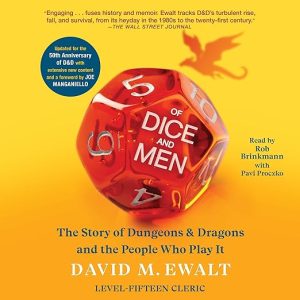
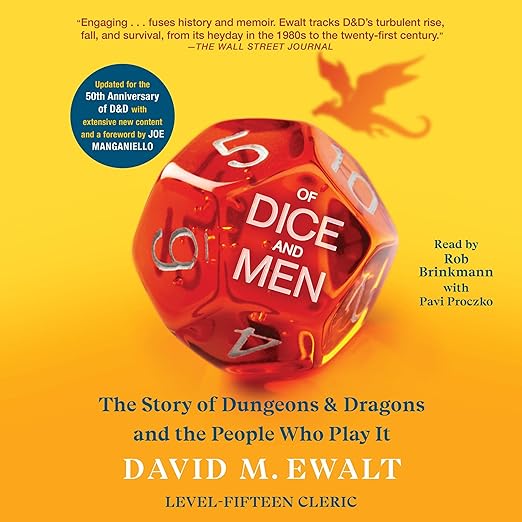
I came to Of Dice and Men with a specific gap in my experience. I grew up around Dungeons and Dragons without ever actually playing it, my older brother had the books, my school friends had the arguments about character alignment, but I always watched from the edges. When I picked up David Ewalt's history, now updated for the game's 50th anniversary with a new introduction by Joe Manganiello, I was partly looking for an explanation of why D&D had such persistent gravitational pull for so many people across so many decades. Ten hours later, I had more of an answer than I expected, and it turned out to be a genuinely interesting one.
Ewalt is an award-winning journalist and a lifelong player, which gives him a dual credibility that most books about gaming subcultures lack. He is not writing from the outside with anthropological detachment, nor is he writing from so deep inside the community that he forgets to explain it. He occupies a useful middle ground: someone who genuinely loves the game and can also interrogate it with a journalist's discipline.
Gygax, Arneson, and D&D's Moral Panic
The historical sections of the book are where Ewalt earns his journalist credentials most visibly. The story of how Gary Gygax and Dave Arneson developed Dungeons and Dragons from their shared background in military miniatures wargaming is one that even many dedicated players do not know in full detail, and Ewalt traces it with both rigor and narrative economy. The game's origins in ancient European battlefield recreations, the evolution of the dungeon crawl format, the mechanics of character progression, all of this is laid out clearly and without condescension to listeners who may be entirely new to the subject.
The cultural chapters are equally strong. The moral panic of the 1980s, when D&D was linked in the popular press to satanism and teen suicide, gets thorough treatment that reads today as both alarming and faintly absurd in retrospect. Ewalt keeps the tone balanced, he does not mock the people caught up in those controversies, but he is clear-eyed about the mechanisms of moral panic and how they operated in this particular case. His account of how the game survived near commercial collapse and went on to shape the entire video game industry is genuinely surprising, even for those who lived through the period.
Ewalt's Own Campaigns Ground the Cultural History
What makes Of Dice and Men distinctive among gaming histories is the way Ewalt weaves his own active campaigns into the narrative. Rather than interrupting the history, these sections, in which he plays with a regular group and reflects on what the game means to him as an adult, ground the more abstract cultural analysis in something concrete and affectionate. The Wall Street Journal called the book a tracking of D&D's turbulent rise, fall, and survival, and that description is accurate, but the personal dimension keeps it from feeling like a reference work in audio form.
One reviewer, a non-player approaching the book as a cultural curiosity, noted feeling as left out of the gaming culture as they do reading about Seattle Grunge, which is precisely the right response. Ewalt makes the world feel inviting rather than impenetrable. He describes D&D not merely as a game but as a technology for collaborative imagination, and that framing is genuinely illuminating for people who have never understood its appeal.
Brinkmann Steadies Ten Hours of Shifting Registers
Rob Brinkmann is a reliable narrator for nonfiction of this kind, and he brings the right qualities to a text that shifts frequently between academic history, cultural criticism, and enthusiastic personal anecdote. He reads the gaming sessions with a lightness that prevents them from feeling like detours from the main argument, and his pacing through the denser historical material is steady without being monotonous. At just over ten hours, the audiobook is a comfortable length for the ground it covers, and Brinkmann's consistency across the full runtime prevents the kind of listener fatigue that can afflict longer nonfiction listens.
The 50th anniversary edition's updated content and Joe Manganiello's introduction make this edition particularly worthwhile. Manganiello's affection for the game and his observations about its cultural resurgence in the Critical Role era add a contemporary dimension that the original 2013 publication could not have included.
Why Collaborative Imagination Outlasted the Stigma
The book also does something that gaming histories rarely attempt: it takes seriously the question of why D&D endured the social stigma attached to it in the 1980s rather than collapsing under the weight of that hostility. Ewalt's answer has to do with the depth of community the game creates, the fact that the campaign table is a space where collaborative imagination is taken seriously as an end in itself, which turns out to be unusually difficult to replace with anything else. That insight extends well beyond gaming, which is part of what makes this audiobook interesting to people who have never touched a polyhedral die in their lives.
Dedicated players will find it a satisfying chronicle of a game they love. Curious outsiders will find a genuine piece of pop-cultural history that explains far more than just D&D, it explains how communities form around shared imaginative practices, and why those communities endure through commercial failure and cultural condemnation. If you are interested in how subcultures develop, how moral panics work, or how collaborative storytelling became an industry, this audiobook has something substantive to offer. At $0.00 on Audible, it is a low-risk investment of curiosity.
Questions Listeners Ask
Does the 2024 audiobook edition include the 50th anniversary updates, and do they add meaningful content?
Yes, this March 2024 release is the updated 50th anniversary edition, which includes new content and an introduction by Joe Manganiello. The additions contextualize D&D's current cultural moment, including the Critical Role phenomenon and the game's mainstream resurgence, which the original 2013 edition could not have addressed.
How does Rob Brinkmann handle the sections where Ewalt narrates his own gaming sessions alongside the history?
Brinkmann brings a lighter register to the personal anecdotes without losing the text's journalistic authority. The shifts between history and memoir feel natural under his narration rather than jarring, which matters significantly over ten-plus hours.
Is Of Dice and Men available as a free audiobook on Audible?
Yes, it is currently listed at $0.00 on Audible. As with all free audiobook listings, availability and pricing may change, so check the Audible page directly before downloading.