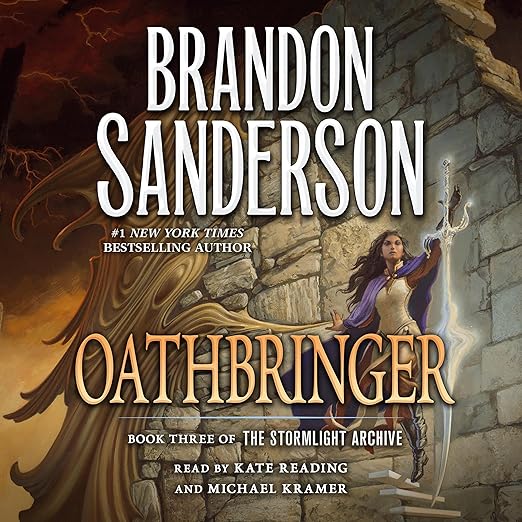
Fifty-five hours is a season of listening, not an evening. Oathbringer runs fifty-five hours and five minutes, which at an hour a day works out to most of two months, and any honest account of this audiobook has to begin with what that number asks of a person. The third Stormlight Archive volume is not something you slot into a gap in a schedule. It is something you arrange a stretch of your life around, and the only interesting question is whether it earns the arrangement.
Kaladin Wonders if the Parshmen's Anger Is Justified
Oathbringer's setup is the largest moral swerve the series has attempted. Dalinar Kholin's Alethi armies won a fleeting victory at terrible cost, the Parshendi summoned the violent Everstorm, and the storm's passage wakes the parshmen, a people described as once peaceful and subservient, to the horror of their millennia-long enslavement by humans. Kaladin Stormblessed, flying to warn his own family, has to come to grips with the possibility that this newly kindled anger is wholly justified. An epic fantasy that stops in the middle of its war to ask whether the enemy is right about us is doing something braver than the genre usually risks.
A five-star from December 2020 gives the fairest reading of where this volume sits in the sequence, describing major middle-book energy, conceding that it may lack the panache of the first two, and still reporting thorough enjoyment. That is a slightly deflating verdict and the one I would trust most. The same entry opens with a warning in capital letters that spoilers for the first two books follow, which is considerate of the writer and a hazard of the page: anybody browsing this listing before starting the series is one scroll from learning things they would rather meet in order.
Three Viewpoints Carry Fifty-Five Hours Without Losing You
Viewpoints carry the weight, three of them, and each gets a real arc. Shallan Davar investigates Urithiru, the tower city nestled in the mountains above the storms, and unearths what the description calls dark secrets lurking in its depths. Kaladin's chapters hold the moral center. Dalinar's are the reason the book exists at all, since the volume's true subject is a man discovering that his holy mission to unite Alethkar was drawn too narrowly, and that the obstacle to everything he wants is his own record. Fifty-five hours is a great deal of room, and none of the three is short-changed in it.
Length changes the nature of the task in audio, and this book is unusually well built for the change. A listener cannot flip back forty pages to check who somebody was, so a long fantasy either rotates its viewpoints often enough to keep names alive or it loses you by the third week. Oathbringer rotates. The structure that reads as a convention on the page turns into a memory aid in the ear, which is the quiet reason enormous fantasy works better as audio than its page count suggests it should.
Architecture is the other argument for committing. Everything in the description hangs on two conditions: whether the nations of Roshar can put aside Dalinar's blood-soaked past and stand together, and whether Dalinar can confront that past himself. One character's history is therefore the load-bearing element of a continental crisis, which collapses the book's emotional problem and its political problem into a single problem. Epic fantasy normally keeps those two in separate rooms and cuts between them.
Sizing Up a Hundred Hours Before Book Three
Entry cost is real and best stated in hours. One response, filed from Australia within two weeks of publication, frames the decision precisely as a buyer should: getting through the first three volumes means investing something like a hundred hours of reading, and the question is whether to do it. That entry answers yes without hesitating. It remains a hundred hours, and this listing is the third of them, so anybody arriving here first has walked up to the wrong door.
Nobody on this page can tell you how long the series will finally run. The fields do correctly place this at number three of The Stormlight Archive, which is more than most listings manage, and they say nothing whatever about the total, while the written column supplies two different answers to the same question and no authority standing behind either one. Anybody sizing up the commitment before starting is doing the arithmetic without the single figure that decides it.
Provenance arrives inside the warmest endorsement on the page. A November 2024 five-star argues that the scope of the series finally comes into full view here, that Roshar and its different peoples become legible for the first time, and that the mysteries of the past deepen well beyond the two earlier volumes, before naming the hardest technical problem in the book and measuring it at 1200 pages. The page field on this record is empty. A print measurement supplied by a reader, entries filed from four separate national marketplaces, and one average of 4.8 across seventy-four recorded grades covering all of it: this is a page-edition reception pooled onto an audio listing. Kate Reading holds the narrator credit, and nothing written here assesses it, which on a fifty-five-hour recording is the single thing a buyer would most want somebody to have said already.
Darker Than the First Two, Reviewers Agree
Series readers who have finished Words of Radiance need no argument at all, and a five-star written in French makes their case specifically, describing a third volume considerably darker than the two before it and noting that secondary characters step forward with viewpoints of their own. Anyone who felt the second book was crowded should find that development reassuring rather than alarming. Fifty-five hours suits one particular temperament too: the listener who wants a world to live inside for two months, rather than a story to finish across a weekend.
First-time listeners should not begin here under any circumstances, and the description says so without meaning to, since it opens on a victory whose cost only registers if you watched it being paid. Anyone with limited listening time should also be honest about the arithmetic, because fifty-five hours is four or five other books that will now go unheard. The person this rewards completely is the one who has already decided Roshar is worth the calendar, and for that person the middle-book verdict sitting in the column is a caution rather than a warning.