Quick Take
- Narration: Larry Nobles reads Marks’s argument with a clear, collegial tone that suits the book’s blend of technical rigor and conversational accessibility.
- Themes: The limits of computation, non-algorithmic human capabilities, AI capability claims versus mathematical reality
- Mood: Contrarian and confident, with an insider’s wry enjoyment of puncturing inflated claims
- Verdict: A mathematician’s case for why certain human capabilities are provably beyond what any algorithm can replicate, making a genuinely rigorous argument in accessible and often entertaining prose.
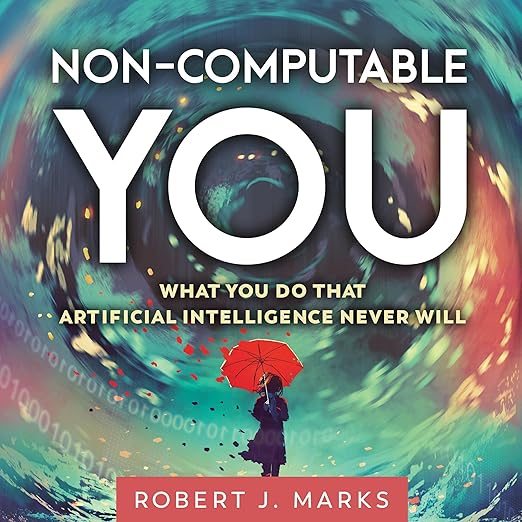
I was about twenty minutes into Non-Computable You when I realized I was listening to something unusual in the current AI conversation: a book making a precise mathematical claim rather than a rhetorical one. Robert Marks isn’t arguing that humans are special because of some emergent complexity that machines can’t capture. He’s arguing something stronger and more specific: that there are classes of problems that are mathematically non-computable, that no algorithm can solve them, and that human beings appear to operate in ways that involve those classes. That’s a different kind of argument, and it deserves a different kind of attention.
Marks is a Distinguished Professor of Electrical and Computer Engineering at Baylor University and a senior fellow at the Discovery Institute. His credentials in the technical field are unimpeachable: he has worked in machine learning and signal processing for decades and has the publication record to back his claims about what AI can and cannot do. That background gives Non-Computable You a grounding in actual computational theory that distinguishes it from the large category of AI-skeptic books written by humanists worried about machines.
What ‘Non-Computable’ Actually Means
Reviewer Loai Ghoraba’s summary is accurate and useful: the book’s main thesis is that computers can only execute algorithms, and therefore any task that is non-algorithmic cannot be performed by any computer, regardless of how powerful it becomes. Marks develops this through a tour of computational theory from Alan Turing through the halting problem to the specific capabilities that AI systems have claimed and not always delivered. The discussion of what language models are actually doing, pattern matching on statistical regularities in training data, versus what they are claimed to be doing, understanding, reasoning, creating, is technically precise in a way that popular AI commentary rarely achieves.
The book’s treatment of creativity, intuition, and genuine novelty as potentially non-computable phenomena is its most philosophically ambitious section. Marks is careful here in a way that matters: he argues that these capabilities appear to resist algorithmic formalization, not that they are definitely beyond computation in every possible sense. That precision prevents the argument from overreaching, which is a temptation in this territory.
The Insider’s Perspective on Inflated Claims
One of the book’s pleasures is its author’s obvious enjoyment of calling out overstated AI capability claims from inside the field. Marks has attended the conferences, read the papers, and watched the hype cycles with the combination of expertise and mild exasperation that comes from knowing what the demonstrations actually prove and what they don’t. The passages on AI researchers’ foibles and follies, mentioned in the synopsis, are genuinely funny in the way that insider skepticism can be when it’s accurate.
Larry Nobles handles this material cleanly. His narration is collegial and clear without being academic, which is the right register for a book that wants to be accessible to general readers while making technically precise claims. He doesn’t make Marks sound like a professor delivering a lecture, which is the main risk with this kind of writing in audio format.
The Ideological Context Listeners Should Know About
Marks’s affiliation with the Discovery Institute, which advocates for intelligent design, is relevant context that not all listeners will bring to the book. Non-Computable You does not advance creationist arguments directly, and the mathematical case it makes for non-computability is independent of those affiliations. But the argument that there are things humans can do that machines provably never will is used in some of Marks’s other work to support design-based conclusions. Listeners who are aware of this context can engage with the technical argument on its own merits, which are real, while remaining thoughtful about where the author’s broader commitments lie.
The reviews on the audiobook platform skew heavily positive and focus on the clarity of the technical explanation and the challenge to AI hype, which are legitimate reasons to value the book. At thirteen hours, it’s a commitment, but the material warrants the length: Marks takes his time building the mathematical foundation before applying it to current AI debates, which makes the argument more durable than those that skip the groundwork.
Who Should Listen, Who Should Skip
Listen if you want a technically grounded case for AI’s fundamental limitations, made by someone with genuine expertise in the field and a gift for accessible explanation. This is the rigorous counterpoint to AI capability maximalism that the current conversation needs more of.
Skip if you need the argument without the institutional context: Marks’s Discovery Institute affiliation shapes his broader intellectual commitments in ways that are worth knowing about even when they don’t directly compromise the mathematical argument he’s making here.
Frequently Asked Questions
Is the book’s argument religiously motivated, or is it a purely technical case?
The technical argument about computability is mathematically grounded and doesn’t require religious premises to evaluate. However, Marks is affiliated with the Discovery Institute, which advocates for intelligent design, and his interest in non-computable aspects of human nature is connected to those broader commitments. The mathematical content is separable from those commitments and worth evaluating on its own terms.
Does the book claim that AI will never become creative or sentient?
It claims that if creativity involves genuine novelty that cannot be derived algorithmically, then no computational system can replicate it by definition. The argument is conditional on the nature of creativity rather than a flat assertion. Marks is careful to distinguish between what appears to resist computation and what can be proven to be beyond it.
How does this compare to other AI-skeptic books like The Alignment Problem or Atlas of AI?
Those books approach AI limits from different angles: Crawford and Bender focus on social and political dimensions, while Marks focuses on mathematical foundations. Non-Computable You is more technically specific and less policy-oriented than those books. They’re not in competition; they address different aspects of the same broad question.
At thirteen hours, is the full runtime necessary, or does the book repeat itself?
The length is earned rather than padded. Marks builds the mathematical foundation before applying it to AI, which takes time but makes the eventual argument stronger. The book doesn’t loop back unnecessarily; it extends the argument progressively. That said, listeners who want just the core thesis could get it in a third of the runtime.