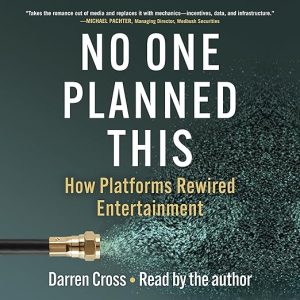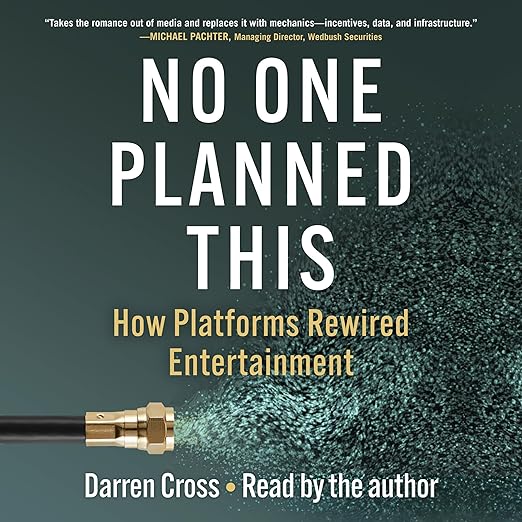
Darren Cross's No One Planned This: How Platforms Rewired Entertainment arrives as an audiobook at a moment when the argument it makes is both obvious and still insufficiently understood. The shift from studios and networks to feeds and algorithms has been discussed for a decade, but Cross is after something more specific and more unsettling than "streaming changed everything." His claim is structural: that platforms did not merely disrupt the entertainment industry but rewired the underlying logic by which cultural decisions get made, and that the rewiring was not a democratization but a consolidation of a different kind.
At five hours and ten minutes, this is a concise audiobook that does not overstay its argument. Cross self-narrates, and that choice matters in ways specific to this material. He is an entertainment business leader writing about the industry he works in, and his narration carries the specific register of someone who has been inside the rooms where these decisions were made. One reviewer described him as narrating from "the trenches of how traditional entertainment firms can, should and will act in the face of bigger technology platforms." That embodied knowledge is audible, and it changes how the analysis lands.
Cross's central argument unfolds in layers. The surface claim is that platforms like Netflix, YouTube, and the broader social feed ecosystem shifted the locus of discovery from curated editorial judgment to algorithmic ranking. That is familiar territory. What Cross adds is the mechanism: the way that algorithmic infrastructure specifically rewards sameness and punishes differentiation, because sameness is what optimization systems can measure and replicate. His phrase that "sameness scales, virality is engineered, and the rules change the moment you adapt to them" is not a metaphor but a systems description, and he spends the middle section of the book unpacking each component with concrete examples.
The Netflix streaming pivot and YouTube's industrialized creator model are the two extended case studies, and Cross chooses them carefully. Netflix's move from DVD mail rental to streaming was not simply a technological transition but a fundamental reorientation of what the company was optimizing for. YouTube's creator economy, presented to the public as a democratization of media production, is examined here as a large-scale experiment in extracting creative labor under conditions that systematically favor platform needs over creator sustainability. These are not original observations in isolation; Cross's contribution is to show how they are related symptoms of the same underlying infrastructure logic.
Cross Narrates What He Personally Observed
The audiobook format serves this content in specific ways. Cross's self-narration gives the systems analysis a practitioner's confidence: he is not explaining something he read about but something he observed directly, and the narration communicates that difference without his having to claim it explicitly. One reviewer in the entertainment industry described the book's tools and analysis as "useful today to try to predict how Hollywood will be in the future," which is the practical use case Cross seems to have designed for: a working framework rather than a historical autopsy.
Another reviewer characterized the book as covering "the last 25 years of media" and projecting forward to the next twenty-five, which captures the dual temporal frame Cross employs. The historical sections are grounded in specific platform decisions with traceable consequences; the forward-looking sections are more speculative but clearly flagged as such. Cross is careful not to overreach his evidence, which makes the book more useful as analysis and less satisfying as polemic. Listeners who want someone to be angrier about what platforms have done to culture will find Cross too measured. Listeners who want to understand the mechanics will find the measured tone productive.
Infinite Scroll Devalues Patience for Immediate Response
The section on infinite scroll and its relationship to content longevity is where Cross's argument gets most interesting and most challenging to sit with. He traces how the structural imperative toward engagement metrics systematically devalued content that rewarded patience or accumulated meaning over time, in favor of content that generated immediate response. That is a claim about what kinds of culture platforms structurally support, independent of the intentions of any platform employee, and it has implications that Cross draws out carefully rather than gesturing at dramatically.
Listeners who work in content creation, media distribution, or entertainment technology will find the book engages directly with decisions and pressures they recognize from their own experience. The book's relatively short runtime means some areas get compressed treatment: the podcast economy, the live-streaming ecosystem, and the specific dynamics of social commerce each deserve more space than Cross can give them in five hours. No One Planned This is a systems-level argument rather than an exhaustive survey, and it is most effective for listeners who already have some familiarity with the industry landscape Cross is analyzing.
Cross's Own Voice Carries His Professional Weight
Anyone working in entertainment, media, or content strategy will find this audiobook a useful framework for understanding the structural forces that shape their industry. Cross writes from the inside with analytical clarity, which makes the book more immediately applicable than academic media criticism without sacrificing rigor. The self-narration is worth emphasizing again as a feature: this is not a performance but a working professional's account of what he has seen and thought through.
General listeners curious about why streaming culture looks the way it does and why the creator economy produces the patterns it produces will find Cross's systems analysis more satisfying than most popular media commentary. Those who want a deep technical analysis of platform engineering or an exhaustive historical account of specific companies will need supplementary material. At five hours, No One Planned This makes a precise and well-constructed argument about infrastructure as cultural power, and it makes that argument in an audiobook format that lets Cross's own voice carry the weight of his professional experience.
- Read by: Darren Cross self-narrates with the authority of an entertainment industry insider, which lends the systems analysis a practitioner's credibility that an outside narrator could not replicate.
- At its heart: Platform infrastructure as cultural power, the creator economy as corporate test case, algorithmic control disguised as democratization
- Vibe: Clear-eyed and unsettling, with the texture of well-sourced industry analysis
- Short version: Cross builds an argument about platform control of entertainment that is more structurally rigorous than most media criticism, and his self-narration makes the insider perspective land with real weight.
A Few Questions About No One Planned This: How Platforms Rewired Entertainment
Do you need to work in entertainment to get value from this audiobook?
No, though industry insiders will recognize the specific pressures Cross describes. The book is written for anyone who wants to understand how platform infrastructure shapes cultural production, and the explanations of algorithmic systems and creator economics do not assume specialized knowledge.
Does this audiobook cover specific platforms like TikTok and Instagram alongside Netflix and YouTube?
Cross's primary extended case studies are Netflix and YouTube, but the broader argument covers the logic of algorithmic ranking and feed-based discovery that applies across platforms. The book is a systems argument rather than a platform-by-platform analysis.
Why does Darren Cross self-narrate this audiobook, and does that choice work?
Cross self-narrates because the material draws on his direct professional experience in entertainment. The narration carries the confidence and specific register of an insider account, which is audibly different from an outside narrator performing the same text. Reviewers with entertainment industry backgrounds describe it as adding credibility to the analysis.
Is this audiobook forward-looking enough to be useful for understanding current platform dynamics in 2025?
Yes. Cross designs the book as a framework for understanding platform logic rather than a historical survey of specific events, which means the structural analysis stays useful even as individual platforms evolve. The forward-looking sections are clearly framed as projection rather than prediction.