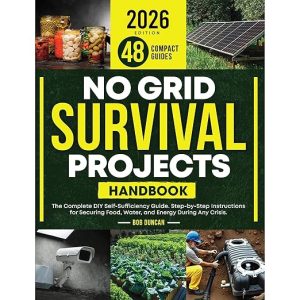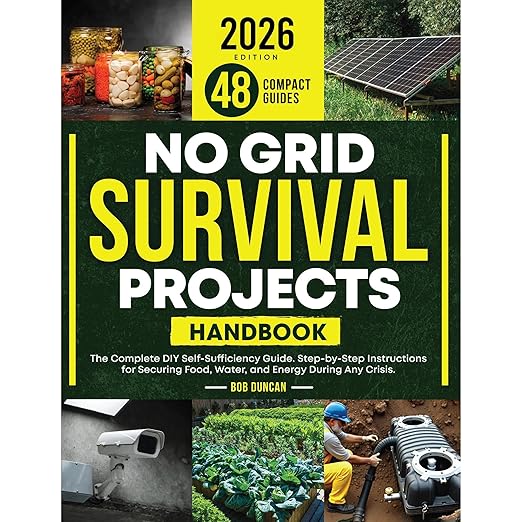
I picked up No Grid Survival Projects Handbook on a week when I had been thinking about emergency preparedness more than usual. A run of severe weather in the forecast, a conversation with a neighbor about their backup water system, and suddenly I found myself downloading a five-hour audiobook on off-grid survival. I was curious what 48 compact guides in audio form would actually sound like.
The answer is: functional, but better suited to the page than the earpiece. Bob Duncan's handbook covers a serious range of material, from rainwater harvesting and solar stills to food preservation, basic shelter construction, and alternative energy options. The scope is genuinely broad for a five-hour listen. The problem is that this is inherently visual, tactile content, and the audio format reveals that limitation fairly quickly once the projects get specific.
Prudent Self-Sufficiency Advice, Skipping the Bunker Panic
The content itself is solid beginner-to-intermediate material. Duncan's approach is accessible rather than alarmist, which is a real point in his favor. He is not trying to frighten you into purchasing a bunker or convince you that collapse is imminent. He is making the sensible case that practical self-sufficiency skills are useful in ordinary life as well as emergencies, and that building those skills before you need them is simply prudent adult behavior. One reviewer summarizes this as 'you can use this now,' and that framing captures exactly what Duncan is after.
Needs-Hierarchy Structure Backed by Concrete Steps
The hierarchy of needs structure, addressing air, water, shelter, clothing, and food in order of urgency, is a coherent organizing principle that prevents the book from feeling like a random collection of survival tips. Within each category, the book offers concrete steps rather than vague suggestions. The rainwater collection and purification section is particularly practical, walking through methods with enough specificity to be actionable by someone starting from no background. The food preservation guidance is similarly useful and grounded in real-world practice rather than theoretical extremity.
A reviewer who describes herself as having 'read her fair share of survival guides' notes that Duncan actually shows you how to do things rather than just describing what should be done. That distinction matters enormously in this genre, where hand-waving is common. The step-by-step commitment throughout is the book's genuine strength.
Flat but Clear, Virtual Voice Gets the Job Done
For listeners who already have some grounding in the subject and want an overview they can absorb passively, the audiobook works adequately. The AI narrator, listed as Virtual Voice, covers the material at a reasonable pace without stumbling over technical terms or creating the awkward rhythmic errors that can make AI narration difficult to tolerate. It is flat in affect, but it is clear and consistent across the full runtime.
The five-hour duration makes this a single-session listen for someone with a long commute or a day of manual work where they can absorb audio productively. If your goal is to get an orientation to the subject before investing in more detailed resources or the print version, this accomplishes that goal efficiently and without unnecessary padding.
Missing Illustrations Make Some Projects Hard to Follow
The product description references 48 compact guides with detailed illustrations, and those illustrations are simply absent in the audio format. For several sections, particularly the solar still construction and certain food preservation techniques, the verbal descriptions alone are not sufficient to actually execute the projects without access to the print version. This is not a flaw specific to this book; it is the inherent limitation of illustrated instructional content in audio form, and it is worth knowing before you commit to the audiobook over the print edition.
The AI narration is a meaningful consideration. For listeners accustomed to human narrators, Virtual Voice can feel clinical and fatiguing over five hours, particularly for practical content that benefits from a conversational and encouraging tone. Factor that into your format decision based on your own sensitivity to AI-generated voice.
Fine for Orientation, but Get Print to Build
Complete beginners to emergency preparedness who want a broad orientation to the subject will get real value here. This also works as background listening for someone already engaged in homesteading or off-grid projects who wants to check their knowledge against a structured overview. For anyone who plans to actually execute the projects described, the print version will serve considerably better than the audiobook. And those who are sensitive to AI narration should know upfront that this is a Virtual Voice production throughout.
Is the narration a human voice or an AI voice, and does it affect the listening experience?
This audiobook uses Amazon's Virtual Voice AI narration. The delivery is clear and functional but lacks the warmth of a human narrator. For five hours of instructional content, some listeners find it fatiguing. Consider the print edition if you plan to follow along with projects.
Can the projects in this audiobook actually be followed from audio alone, without the print version?
For simpler conceptual content, yes. For hands-on projects like solar still construction or food preservation techniques, the audio descriptions alone are not sufficient to execute safely. The book's print version includes detailed illustrations that are absent from the audio format.
Is this book aimed at complete beginners or people with existing survival and homesteading experience?
Duncan explicitly designed it for all experience levels, and the beginner-friendly tone reflects that. Experienced homesteaders may find some sections too introductory, but the breadth of topics means most listeners will encounter at least some material that is new or useful.