
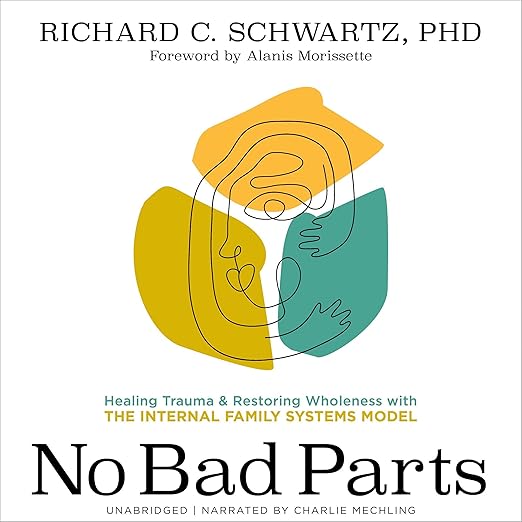
Filed under Career Success, this audiobook is a manual for talking to the parts of yourself you have spent years trying to shut up. Richard C. Schwartz built Internal Family Systems around a claim that sounds alarming in summary and turns out to be practical: you do not have one mind, you have many, and the ones you are ashamed of are not the enemy. Whoever shelved 8 hours and 10 minutes of trauma-recovery theory under business put it somewhere nobody will find it.
Five Stars Total 25, the Average Implies 23
Internal Family Systems has been reshaping psychotherapy for decades, and the description does not undersell what it is asking of you. Barbara Rogers, writing in July 2021, calls the approach captivating and deeply humane, then goes further: not just a model of psychotherapy but a way of life. That account describes entering your own inner world and caring for the pain and the struggles that haunt you, which is a fair summary of the method and a warning about its intensity.
Burdens is Schwartz's term for what happens when a part gets stuck in a childhood trauma or a cultural belief and starts behaving badly, and the whole book turns on it. The ego, the inner critic, the saboteur: each gets reframed as an ally carrying something it was never meant to carry. Unburden the part and it returns to what the copy calls its essential goodness. The argument is generous, and you can test it against your own experience rather than take it on trust.
Every graded response on the listing shows five stars, and the average above them reads 4.6. Over five votes that number can only come from a star total of 23, while the five visible grades total 25. Either the write-ups are not the five counted votes, or the average has not caught up with them. One of those five is a headline with no text beneath it, which leaves four usable accounts to work from.
A Therapeutic Register Suits Spoken Delivery
Sounds True released this in October 2021, and the material it had to work with is unusually first-person for a psychology title. Schwartz is quoted directly throughout the copy, addressing you as though the session had already started. That suits spoken delivery, where a therapeutic register lands more naturally than it does on the page, and it is the reason I would reach for this edition over a paperback if the exercises were not part of the bargain.
Accessibility is the quality the pool keeps returning to. Lindsay L. O'Connor, in an August 2023 five-star, arrived at the model through spiritual directors rather than clinicians and reports that the book works for people who are neither therapists nor psychologists. That account is now applying the paradigm to its own soul work and expects to bring it to others. Schwartz explaining how he began applying the ideas, rather than presenting a finished system, is what makes that possible.
Trauma recovery, addiction therapy and depression treatment are the three proving grounds the description names, and the framing is careful about what it claims. Nothing here promises a cure. What it offers is a different relationship with the voices you already hear, plus a route to what Schwartz calls the Self, the compassionate core he treats as the actual source of healing. Whether that vocabulary works for you is the entire purchase decision.
Mechling Reads It, and No Response Discusses It
Charlie Mechling is the credited reader, and not one response says a word about the reading. Stating that plainly beats working around it: on a book of exercises delivered in a therapist's voice, a reader is doing more than transmitting sentences, and the listing gives you nothing to go on. The preview is the only evidence available, so judge it on a passage where an exercise is being introduced rather than on the opening argument, which any competent reader can carry.
Career Success is the tag on this listing, and business-careers is the category. Both are wrong in a way that costs the book readers. Someone browsing for professional development will hit a chapter structure about childhood burdens and protectors, while the person who needs this material exactly will never think to look in the business aisle. Search the model by name instead, since Internal Family Systems is how every account here refers to it.
Guided exercises are the other structural catch. The description lists work on mapping your parts, accessing the Self, handling a challenging protector and identifying what sets each one off, and none of it arrives with a companion document. Sanah's October 2025 five-star calls the writing an excellent read, easy and explained in plain terms, which is exactly right and also the difficulty: instructions that clear are the ones you most want in front of your eyes.
A Genuinely Useful Idea in the Wrong Aisle
Therapists and coaches already circling this model will get the fastest return, but the audience that matters more is the one an October 2023 response from the United Arab Emirates storefront describes: somebody who came to the ideas through a podcast, found the parts language immediately usable, and began applying it to other people's behavior rather than only to their own. That account puts it simply, saying you stop fighting a person and start recognizing which part is doing the talking.
Pass if you want a business book, obviously. Look elsewhere for clinical protocol rather than a philosophy, because the exercises here are introductory by design and the description says so. And weigh the spiritual register before committing: the closing argument moves from loving your own parts to loving all people to healing the world, and that escalation will lose some listeners who were entirely with it one sentence earlier.
What survives all of that is a genuinely useful idea, refined over decades, sitting in the wrong aisle above a counter that does not add up. If the parts language does anything for you in the preview, buy it and ignore the shelving. If it does nothing, no amount of listening time will change that, and the four usable accounts on this listing all belong to people it landed on immediately.







