
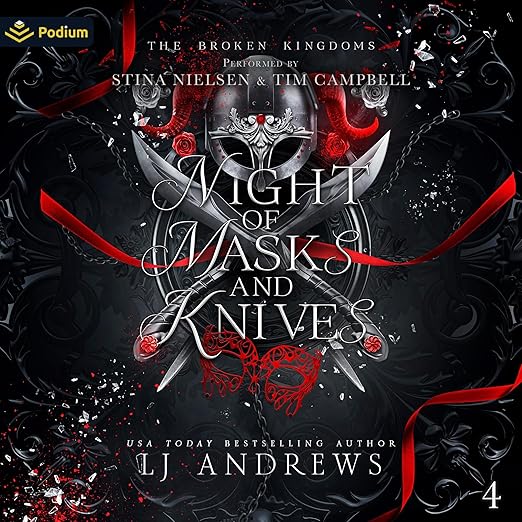
I listened to Night of Masks and Knives over two evenings in a row, which for an eleven-hour audiobook is as close to compulsive as I tend to get. LJ Andrews has been building the Broken Kingdoms world across multiple books, and this fourth entry shifts focus to a new sub-series within the Eastern Kingdom, new territory, new characters, but with the same underlying framework that has made her fantasy romance work.
The setup is operatic in the best sense: Malin Strom has spent years searching for Kase, the boy she loved as a child, who disappeared into the annual masquerade. When her brother is traded into the masquerade as punishment for using magic to conceal Malin's own gift, she is forced to enlist a criminal known as the Nightrender to save him. The Nightrender bears Kase's face. He is Kase, what years in the masquerade made of him, which is something unrecognizable and also, underneath it all, not.
The Verdict, Briefly
Andrews uses Malin's gift for stealing memories as more than a plot device. It becomes a central moral question: what is a person without their memories, and what happens when someone who can reach inside that absence chooses to do so? The magic system in this book is genuinely novel in a genre that has seen most iterations of power systems, and it creates narrative possibilities that the plot exploits thoughtfully rather than mechanically.
The Nightrender was briefly visible in the first Broken Kingdoms trilogy, and readers who came through those books arrived here with significant anticipation. Andrews delivers on it. Kase is written as a man shaped by what was done to him without being defined entirely by it. The boy Malin remembers is not gone; he has built armor over it. The romance works precisely because both characters are carrying versions of the same loss from different angles.
The Best Parts of Night of Masks and Knives
Stina Nielsen's narration is well-matched to the material. Andrews's prose in this book is darker than her earlier Broken Kingdoms entries, and Nielsen handles the tonal shift without making the book feel uniformly grim. The masquerade sequences in particular require her to hold multiple emotional registers simultaneously, threat, attraction, performance, grief, and she manages that without collapsing the distinctions.
At eleven hours and two minutes, the book is substantive enough to develop its world and its romance without feeling padded. The pacing starts deliberately, as multiple reviewers noted, but the escalation from the midpoint onward is sustained. Andrews earns the emotional climax through the attention she paid at the beginning.
Points to Consider
This book ends on a cliffhanger. Not a soft open ending but a genuine cliffhanger that will leave you looking immediately for the next book. Andrews acknowledges this in how the book is framed. It is the opening of a new sub-series within the Eastern Kingdom, and the ending is appropriate to that structure. But listeners who cannot tolerate waiting for resolution should have the next entry ready before starting.
The recommendation is to listen to the first Broken Kingdoms trilogy before this book. Andrews notes that Night of Masks and Knives can technically function as a standalone because of its new setting, but the emotional resonance of the Nightrender's character, the anticipation readers bring to him after glimpsing him in the earlier trilogy, is part of what makes this book land as hard as it does. Coming in cold means missing that setup.
Who Should Pick Up Night of Masks and Knives
Readers already inside the Broken Kingdoms world who have been waiting for Kase's story will find this the most satisfying entry in the series. New readers to LJ Andrews who are comfortable starting mid-world and building context through immersion can navigate this, but the better path is through the first trilogy first. Listeners who enjoy romantasy with dark world-building, morally complicated heroes, and magic that carries genuine narrative weight will feel at home here.
Key Details
- Narration: Stina Nielsen handles the darker emotional register of this book well, giving Malin's inner conflict and Kase's controlled menace distinct textures.
- Themes: Second-chance romance, the cost of survival, memory as both gift and wound
- Mood: Dark and immersive, with romance that earns its heat through accumulated grief and tension
- Verdict: A strong entry in LJ Andrews's expanding world that pays off the promise of the Nightrender character while ending in a cliffhanger that demands the next book immediately.
Questions Listeners Ask
What is Malin's memory-theft gift, and how does it affect the plot?
Malin can steal memories from other people, which she has used to extract secrets from those connected to the masquerade. The gift creates both her investigative ability and her vulnerability. Concealing it required her brother to use magic, which triggered the punishment that drives the plot. It is also central to the moral questions the romance raises.
How spicy is this compared to LJ Andrews's earlier Broken Kingdoms books?
Multiple reviewers noted this book is spicier than her first trilogy while describing the content as handled tastefully. It is not pure heat-forward romance, but the attraction between Malin and Kase is explicit enough that readers who prefer low-heat fantasy romance should be aware of the shift.
Does the cliffhanger ending resolve the central romantic arc or leave it entirely open?
The romantic tension reaches a point of significant emotional confrontation by the end, but the cliffhanger involves a painful betrayal that leaves core questions unresolved. The central arc between Malin and Kase continues into the next book. Listeners who need romantic resolution in a single volume should prepare for the wait.







