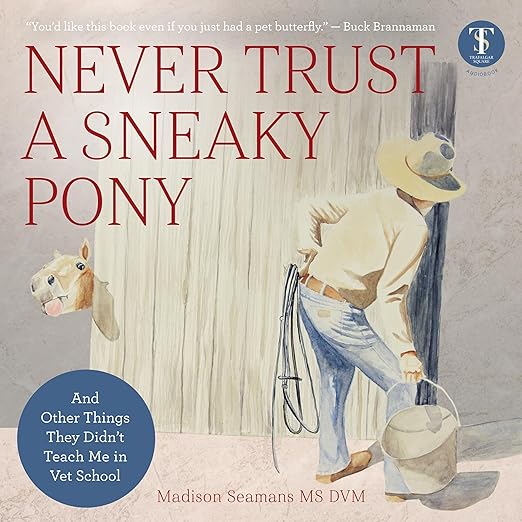
I discovered Never Trust a Sneaky Pony during a weekend when I needed something that would make me feel better about people. Not in a saccharine, everything-is-beautiful way, but in the way that good writing about animals and the humans who care for them tends to do, by reminding you that ordinary competence and genuine affection for living things are more common than the news cycle suggests. Dr. Madison Seamans, a large-animal vet in Texas, delivers both in quantity over twelve and a half hours of stories from decades on the road.
The James Herriot comparison in the synopsis is the right one, and it's not offered casually. Herriot's genius was for making veterinary medicine legible and comic without ever treating the animals or their owners as props for entertainment. The situations were genuinely funny and the professional knowledge was genuinely present. Seamans operates in that same tradition. The Jeff Foxworthy reference in the marketing copy is less apt, though I understand what it's reaching for. Seamans has the timing and the self-deprecation, but his stories are woven through with a precision about equine medicine that takes the material beyond humor into something more durable.
Seamans Varies the Register From Funny to Elegiac
The structure is episodic, as it would be in any rural vet memoir. Each story is more or less self-contained, and Seamans uses the episodic form with control, varying length and register so the collection doesn't go flat. Some stories are primarily funny. Some are primarily technical, explaining a diagnostic process or a treatment decision with enough specificity that you come out understanding something real about equine medicine. Some are primarily elegiac, about animals that didn't make it or owners who couldn't bear what the diagnosis meant. The shifts between registers are what give the book its texture.
One reviewer who describes no longer being afraid of thousand-pound horses but not yet ready to assist with a foaling puts it accurately. You learn real things from this book. Not at a level that would help you administer treatment, but at the level of understanding what a colic looks like and why it's serious, what a traveling vet's relationship with a client develops into over years of late-night calls, and why the sneaky pony of the title represents an entire category of equine personality that every horse owner will recognize immediately.
Seamans Narrates With a Vet's Practiced Timing
Seamans narrating his own stories is the right call and then some. This is one of those audiobooks where the narration is genuinely part of the work rather than a delivery mechanism for it. His timing is that of a man who has spent decades telling these stories to other vets, to clients, to anyone who would listen after a long day on the road. He knows where the pauses go. He knows when to let the absurdity sit before naming it. Several reviewers mention laughing out loud, and I can confirm that experience is real and specific: there are moments where the comic timing is so well-judged that the punch lands before you've consciously anticipated it.
The book also rewards listeners who have some equine background without excluding those who have none. The medical specificity assumes no prior knowledge. Seamans explains what he's looking for and why, and the explanations feel natural rather than pedagogical. Readers with their own horse experience will likely recognize more of the personalities and situations and have their own stories called up by his. Complete beginners will find the equine world opened up in a way that feels earned rather than simplified.
Twelve Hours Include Some Connective-Tissue Chapters
A twelve-and-a-half-hour runtime for an episodic memoir requires that the individual episodes earn their place, and a few of them are lighter than the surrounding material. The book has no real weak points but it does have some stories that function more as connective tissue between the standout pieces than as standouts themselves. This is a feature of the episodic memoir form rather than a problem specific to Seamans, but listeners who find episodic structure less satisfying than a sustained narrative arc should know what they're getting into.
The book also skews toward a particular listener profile. People who already care about horses or large-animal veterinary medicine will find the most resonance. The book is accessible without being about animals in a generic sense. It's specifically about horses, their physiology, their personalities, and the people who own and work with them. Those with no existing interest in the equine world may find that interest developing over the course of twelve hours, but that's a real investment to ask of someone who comes in completely cold.
Horse Owners and Herriot Fans Will Feel at Home
Horse owners, riders, and anyone who has ever wondered what the vet is thinking during a farm call will find this immediately satisfying. Fans of James Herriot's All Creatures Great and Small who want something in a contemporary American register will recognize the family resemblance and appreciate what Seamans does differently. Listeners who enjoy warm, funny professional memoirs from unusual fields, the kind of book that opens up a world you didn't know you wanted to be inside, will find this one delivers on that promise. Those who want a linear narrative with a sustained emotional arc rather than a collection of linked stories should look elsewhere. Those who are genuinely put off by animal medical descriptions, including some scenes involving difficult births, injuries, and euthanasia, should know that Seamans handles these with dignity but does not avoid them.
Questions Listeners Ask
Does the audiobook include difficult content like illness and death, and if so, how is it handled?
Yes, and Seamans doesn't avoid it. Some stories involve animals that couldn't be saved and owners who are devastated. He handles these with dignity and professional honesty rather than dwelling on them for effect. They give the funny stories their proper weight.
Is the twelve-and-a-half-hour runtime appropriate for the episodic format?
Mostly yes. The episodes vary enough in length and register to prevent the collection from feeling repetitive. A few stories function more as connective tissue than as standouts, but the collection's overall quality makes the runtime feel earned rather than padded.