
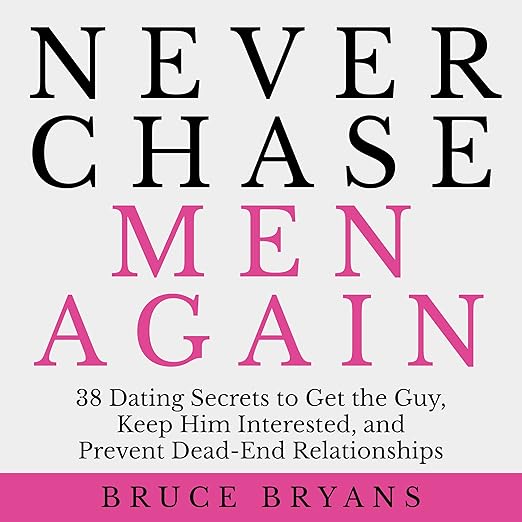
Self-published dating advice is a genre that lives or dies on how much you trust the person talking, and Never Chase Men Again asks for a specific kind of trust. The book positions itself as an explanation of how men appraise female behavior, written for the women being appraised. Two hours and nine minutes is all it takes, which puts this audiobook closer to a long briefing than to a book, and the compression is the whole design. Bryans is not building an argument so much as handing over a list of rules and expecting you to start applying them.
Is Never Chase Men Again Worth Your Time?
Nothing cushions the premise. If a man does not take a woman seriously, the book says, he may still happily have a good time with her until she works out she is being taken for a ride, or until he moves on to someone he actually wants. What a woman needs against that, per Bryans, is two things: a healthy amount of self-respect and a set of player-proof dating rules. That pairing is the entire thesis, and it is a slightly uneasy one, because self-respect and rule-following are not obviously the same project. The first is internal. The second is tactical, and tactics imply an opponent.
Where the book gets more interesting than its packaging is in the gap between those two halves. The tactical material is loud and quotable. The self-respect material is quieter and, frankly, better: the recurring instruction is to notice when someone's behavior does not match their words, and to leave rather than negotiate. Strip away the language of seduction secrets and what remains is a fairly old-fashioned position on standards, which is the part the response pool actually engages with. Not one of the five people who wrote in mentions the phrase that supposedly burns itself into a man's memory. What comes back instead is the language of perspective, and of mistakes not to repeat.
Naming behaviors is where the book does its real work. Its chapter promises are specific in a way generic relationship advice usually is not: the habit that makes high-quality men stop pursuing almost instantly, the one thing most women are afraid to do when they meet someone they like, a single phrase built to lodge in a man's memory. Whether or not you accept the underlying model of male psychology, that specificity gives a listener something concrete to test against her own experience. One four-star response, from someone recently divorced and out of practice after years off the market, described the book in exactly those terms: solid advice for people who need extra help.
Length is the strongest argument for the recording. Two hours is short enough to take in one sitting and short enough to repeat, and repetition is how rule-based advice actually gets absorbed. A long relationship book asks for a commitment most people abandon early. This one asks for an afternoon. If the framework works for you, running it again a month later costs almost nothing, which is a real advantage of the format over print when the material is this prescriptive.
Worth noticing too is who does the talking. Every part of this book speaks directly to "you," and that "you" is explicitly a woman navigating what the copy calls the treacherous territory of finding Mr. Right. The recording is credited to Dan Culhane, a reader separate from the author, so the second-person address reaches the listener through a third party rather than from whoever wrote it. That gap changes the register. Advice pitched as insider intelligence about men lands differently when someone uninvolved is saying it out loud, and a listener who bristles at being lectured may find the distance useful.
Before You Commit to Never Chase Men Again
Start with the arithmetic on the listing, because it does not resolve. The score reads 4.4 and the counter beside it says four ratings. Four whole-star votes can only land the average on a quarter-point step, so around that mark the ladder runs 4.0, 4.25, 4.5, 4.75, 5.0, displaying as 4.0, 4.3, 4.5, 4.8, and 5.0. A 4.4 is not a rung on it. Meanwhile five written responses sit under that counter, one more than the number of ratings it claims to be counting. None of this makes the book better or worse, but it does mean the headline score is not a figure you can reason backward from.
Tone is the bigger caution. This is a book built on the premise that a woman's behavior is under continuous assessment for her value as a romantic partner, and it teaches her to manage that assessment. Framed generously, that is realism about how attraction sometimes operates. Framed less generously, it accepts the scoreboard instead of questioning it, and a listener who objects to the scoreboard will be arguing with the book from the opening chapter. The capitalized promises in the description do not help; a phrase that burns into a man's memory and leaves him desperate to see you again is selling something other than self-respect.
The listing itself carries two flags worth knowing. This belongs to a series called Smart Dating Books for Women, but the series number field is empty, so nothing tells a listener where it sits in the sequence. And the categorization is odd: it is filed under health and wellness with a psychology and mental health tag, which sets up an expectation of clinical grounding the book never attempts. Nothing here is evidence-based in the research sense. It is one author's model of male behavior, delivered with conviction. Nobody in the response pool describes the recording either, so on questions of pace or clarity you are going in unadvised.
Should You Listen to Never Chase Men Again?
Wrong audience first: anyone looking for research, for nuance about the many ways people actually pair up, or for a framework that does not treat dating as a contest with rules. Also anyone who has met this argument before, since two hours leaves no room for a version you have not already encountered. Right audience: people re-entering dating after a long absence. The longest response on file comes from exactly that position, someone three years out of a marriage who entered the dating scene skeptical and unsure and came away with a clearer plan for approaching it. That is the honest use case. Treated as a short framework for examining your own patterns, the book earns its runtime; treated as a system for managing another person, it promises considerably more than two hours can deliver.
Good to Know
How long is this audiobook and who reads it?
Two hours and nine minutes, with Dan Culhane credited as the reader and Bruce Bryans listed as both author and publisher. The release date is July 27, 2015. That runtime puts it among the shortest titles in the dating advice category, closer to a briefing than to a full book.
Is this audiobook written specifically for women?
Yes, explicitly. The series name says so and the copy addresses a female listener throughout, explaining how men appraise female behavior and what that appraisal rewards. A man listening would be reading someone else's mail, which is arguably instructive, but the second-person address never turns toward him.
What does the audiobook mean by player-proof dating rules?
It is the book's term for a set of standards meant to filter out men who are not serious. The premise is that someone only passing time will behave in identifiable ways, and that a woman applying consistent rules will surface that behavior early rather than months later.







