Quick Take
- Narration: Peter Lerman reads Shepherd’s dense academic prose with careful pacing that makes the science more accessible than the text alone might be; a measured, professor-in-lecture-hall quality.
- Themes: Neuroscience of taste, retronasal smell, wine as cognitive experience
- Mood: Dense and intellectually demanding, but genuinely revelatory if you stay with it
- Verdict: Indispensable for serious wine enthusiasts willing to work through neuroscience; casual drinkers may find the anatomical detail more than they signed up for.
I opened Neuroenology expecting something like a science-inflected wine guide. What I got instead was a full-scale reckoning with how poorly most of us understand what is actually happening when we taste anything at all. I was about halfway through the section on retronasal olfaction when I paused the recording, put down my coffee, and sat with the realization that I had been mislocating flavor in my mouth for my entire life. That kind of cognitive disruption is exactly what this book is designed to produce.
Gordon Shepherd is a neuroscientist at Yale, not a sommelier, and that distinction shapes everything about Neuroenology. He came to wine through his research into the sensory systems, and the book reads like someone who discovered the subject later in life and found it a perfect laboratory for questions he had already been asking professionally for decades. The result is unlike anything else in the wine literature.
Our Take on Neuroenology
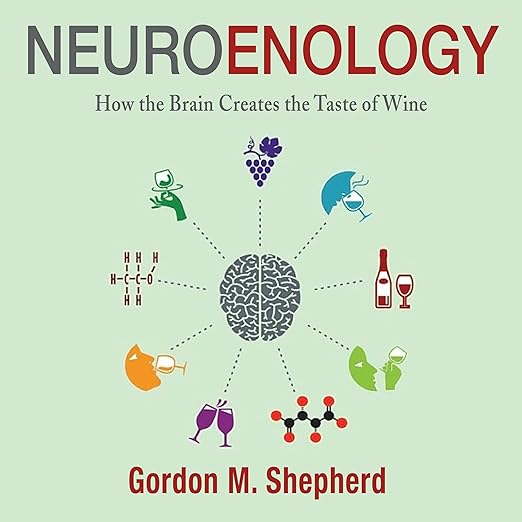
The book’s foundational claim is both simple and genuinely startling: the taste of wine does not exist in the bottle, or even in your mouth. It is constructed by your brain. Shepherd traces how this construction works, beginning with the mechanics of how wine moves through the oral cavity, continuing through the function of retronasal smell (the upward passage of aroma molecules into the nasal cavity during exhalation), and arriving at the cerebral cortex, where the final experience of flavor is assembled from sensory inputs that never exist simultaneously in any single organ.
The practical implication of this is that wine tasting is less a passive experience than an active one, that how you move wine around your mouth, when you breathe, and what language you use to describe what you are tasting all affect the actual experience of taste itself. This is not a metaphor. It is the neuroscience. Reviewer Carl S. Lau described the book’s single-page guide to tasting as “a mind opener and taste blowing experience,” and that response is common among readers who actually try the method Shepherd describes.
Why Listen to Neuroenology
The audiobook presents a specific challenge and a specific opportunity. The challenge is that Shepherd is working from a book published by Columbia University Press, which means the prose is academic and the anatomical detail is real. Peter Lerman narrates with a measured, deliberate pace that helps considerably, he treats the material as if it deserves comprehension rather than just forward momentum, and that calibration is correct for this book.
The opportunity is that audio strips away the impulse to skim. Shepherd’s argument builds chapter by chapter, and the habit of scanning ahead for conclusions, which print readers often indulge, is not available here. The final chapter, Shepherd’s account of tasting Bordeaux vintages with Jean-Claude Berrouet of Chateau Petrus and Dominus Estate, rewards the patience you have built up through the preceding science. It is one of the more unusual closing sequences I have encountered in a wine book: rigorous and human at once.
What to Watch For in Neuroenology
Reviewer S. Parsons wrote “Get ready to go back to Medical School on this one” and that is only a mild exaggeration. Shepherd does not simplify the anatomy, and passages on the cranial nerves involved in taste processing and the specific regions of the cerebral cortex that integrate flavor perception require real attention. The reviewer who called it a “dry, somewhat complex layperson’s summary” was being accurate, not unkind. If your patience for anatomical vocabulary is limited, you will feel that in the middle sections.
This is also a book that is easier to absorb in shorter sessions than in marathon listening. The neuroscience deserves reflection time. Trying to move through it quickly in the way you might move through a thriller will leave you with less than you deserve from the material.
Who Should Listen to Neuroenology
This is for serious oenophiles who want a deeper account of what is actually happening when they taste, and for anyone with an interest in sensory neuroscience who happens to enjoy wine as a context for the science. It is also genuinely useful for aspiring sommeliers who want a scientific foundation for the tasting language their training already uses. It is not for casual wine drinkers looking for pairing suggestions or varietal guides, that is simply a different book. The Financial Review called it “clear, concise and highly readable,” which is accurate relative to its academic origins; it is not light reading by general standards.
Frequently Asked Questions
Do you need a science background to follow Neuroenology?
Not a formal one, but you need patience with anatomical vocabulary. Shepherd writes for a broad audience and defines his terms, but the detail is real. The Financial Review described it as clear and concise for its level of technical content, and that is an accurate gauge, accessible to a motivated non-specialist, but not effortless.
Is this primarily about wine, or is the science the main focus?
Both, but the science is the lens. Shepherd is a neuroscientist who became interested in wine because it presented an extraordinary case study for sensory processing. If the neuroscience of taste is not inherently interesting to you, the wine framing alone will not sustain attention. If it is interesting, the wine context makes it concrete and sensory in ways that pure neuroscience often is not.
Does the book include practical tasting guidance, or is it purely theoretical?
There is a practical tasting section that several reviewers identified as the most immediately applicable content. The book describes a specific method for tasting wine that follows from the neuroscience, involving oral movement, retronasal breathing, and deliberate attention to different sensory streams. Reviewer Carl S. Lau described it as a transformative experience to try.
How does Neuroenology differ from other wine education books?
Most wine books approach taste from the outside, varietal characteristics, regional styles, pairing principles. Neuroenology approaches from the inside, asking what is biologically occurring during the experience of tasting. It is the only book on wine tasting by a neuroscientist, and its contribution is explaining the mechanism rather than the output of taste.