Quick Take
- Narration: Kim Bretton brings reliability and pacing to AJ Bailey’s underwater world, though no reviews are available to assess listener response to the casting.
- Themes: Underwater mystery and archaeological discovery, colonial-era treasure, the weight of unsolved cold cases
- Mood: Propulsive and sun-drenched, with a genuinely intriguing historical puzzle
- Verdict: A polished Caribbean mystery adventure that delivers exactly what the AJ Bailey series promises, with a 34-year cold case to anchor the dive sequences.
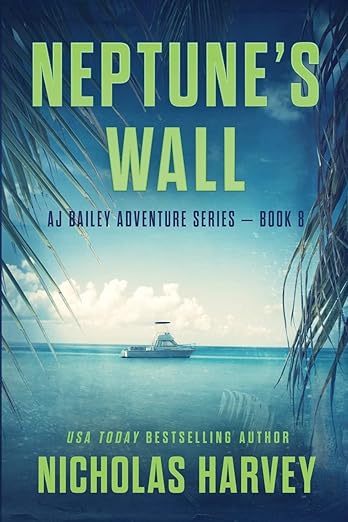
I have a weakness for mysteries set in places where the geography does actual work in the plot, not just as atmosphere but as a structural element that shapes what is possible and what is not. Neptune’s Wall qualifies on that front. Nicholas Harvey has built the eighth AJ Bailey book around a premise that only makes sense in Grand Cayman, a sunken cavern revealed by an earthquake, a 34-year unsolved police case, and the intersection of a 16th century explorer’s trail with treasure hunters from the 1980s. The Caribbean setting is not decorative. It is load-bearing.
AJ Bailey is a dive operator on Grand Cayman, and her underwater world has been the staging ground for the series since its first volume. Harvey is good at making the diving sequences feel technically credible without losing narrative momentum, which is harder than it sounds. The mechanical details of reef exploration need to be present enough to feel real, but not so dominant that they stop the story. Book eight has had seven volumes of practice at this balance, and it shows. The cavern discovery that opens the plot is set up efficiently, and the transition from geological event to investigative mystery happens quickly enough that the book earns its thriller credentials early.
Our Take on Neptune’s Wall
The structural ambition here is notable: Harvey is running three timelines simultaneously, the present-day investigation, the 1980s treasure hunting operation whose activities AJ’s discovery connects to, and the historical thread of a 16th century explorer whose route through the Caribbean left evidence in the reef. Series mysteries that attempt historical layering often struggle to make all three temporal threads feel equally necessary, but the setup Harvey provides is specific enough that each era earns its space in the narrative. The 34-year gap between the original disappearance and AJ’s discovery is not coincidental. Harvey uses the cold case structure to withhold information the reader wants in ways that feel earned rather than arbitrary.
Why Listen to Neptune’s Wall
Kim Bretton handles the narration with the consistency you want from a series audiobook. Long-running series build listener attachment through recurring characters, and narrator stability is part of that contract. The book works as a standalone, per Harvey’s own note, but readers who have followed AJ through previous volumes will recognize the supporting cast and the particular rhythm of how cases unfold in her world. The humor Harvey has built into the series is present here too, described in series marketing as a sprinkling of humor, which is accurate. This is not comedic mystery in the mode of Janet Evanovich. The wit is drier and more situational.
What to Watch For in Neptune’s Wall
There are no listener reviews available to draw on for this audiobook, which makes it harder to report on how the book landed with actual readers. The 4.9 rating from 17 listeners suggests strong satisfaction among those who have engaged with it, but the sample is small. The book is listed without series attribution in the audiobook metadata, despite being the eighth AJ Bailey novel. New listeners who pick this up should know that context exists, even if the novel does not require it. Harvey’s note that books can be read in any order or as standalones is genuine, but series entry points always carry some accumulated texture that newcomers do not have immediate access to.
Who Should Listen to Neptune’s Wall
Listen to this if you enjoy mystery with geographic specificity and you want the Caribbean setting to do real plot work rather than serve as vacation backdrop. Listen if you are already a series reader and want to follow AJ Bailey into another underwater case. If you are new to the series, this is a workable entry point, though you may want to start earlier to get the full benefit of the recurring cast. Skip this if you prefer psychological interiority over procedural investigation, or if underwater settings hold no appeal. Harvey writes adventure mystery grounded in place, and Neptune’s Wall is a confident installment in that tradition.
Frequently Asked Questions
Is Neptune’s Wall accessible as a series entry point, or should new listeners start from Book 1?
Harvey explicitly notes that the books work as standalones, and the plot of Neptune’s Wall is self-contained. That said, the recurring cast and the texture of AJ’s world will carry more weight for listeners who have followed the series.
How prominent are the diving and underwater sequences in the narrative?
They are central to the plot rather than incidental. The underwater cavern discovery is the inciting event, and subsequent dives carry real investigative stakes. Harvey keeps the technical detail present but does not let it stop the story.
Does the historical thread about the 16th century explorer require prior knowledge of Caribbean history?
No. Harvey provides the relevant historical context within the narrative. The explorer thread is more adventure hook than scholarly exercise, and it is explained clearly enough for listeners with no background in the period.
How does Kim Bretton’s narration serve the Grand Cayman setting and AJ Bailey’s character?
Bretton is a reliable series narrator whose consistency is valuable for listener engagement across multiple volumes. Without available listener reviews for this specific book, it is difficult to assess how this particular performance was received beyond the strong aggregate rating.