
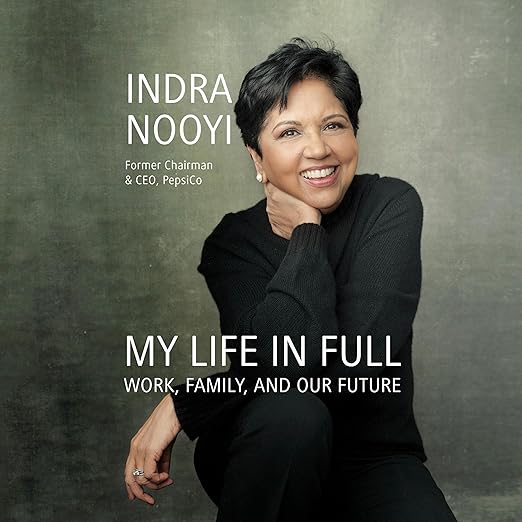
My Life in Full is that specific kind of leadership memoir that earns the right to its ambitions. Indra Nooyi spent twelve years as CEO of PepsiCo, a run that involved transforming the company's product portfolio toward healthier options, overhauling its environmental profile, and doing all of that while navigating a corporate environment that had no established template for someone who looked like her in that role. The audiobook version, narrated by Nooyi herself, adds a dimension that no hired narrator could replicate , the weight of self-examination in real time, the pause before a difficult admission, the cadence of someone who has told parts of this story before but is now committing the full version to record.
How My Life in Full Holds Up
Nooyi structures her memoir in roughly three registers. The first covers her childhood and early education in 1960s India, her family's expectations, and the specific kind of intellectual hunger that eventually carried her to Yale's School of Management. These passages are the warmest in the book , Nooyi clearly draws profound meaning from her multigenerational family structure, and the portrayal of how that structure shaped her values feels genuine rather than performed. The second register covers her ascent through corporate America: the consulting years, her entry into PepsiCo, the strategy work that defined her reputation, and her eventual appointment as the first woman of color and immigrant to run a Fortune 50 company. Here the memoir shifts into case study mode in the best sense , Nooyi is a strategic thinker, and her account of how she guided PepsiCo's Performance with Purpose initiative through institutional resistance is detailed and insightful. The third register is where My Life in Full distinguishes itself from standard business biography: the frank accounting of what the career cost, the family trade-offs that couldn't be undone, and Nooyi's clear-eyed argument that the current model of corporate leadership systematically sacrifices the people who are primary caregivers , disproportionately women.
The self-narration is the defining choice and the right one. Nooyi's vocal presence carries the authority of someone who spent decades being one of the most powerful business leaders in the world, but it also carries the vulnerability of someone who is, in audio, genuinely confessing to things she regrets. The passages about her daughters , moments she wasn't there for, the toll of the schedule on her family life , land differently when you hear them in her voice than when you read them on a page. Reviewers from multiple professional backgrounds have noted how accessible the book is: a young Black executive quoted in reviews found frameworks for navigating large organizations that were immediately applicable; a more senior reader found validation for the slow, long-game approach to institutional change. At just over 10 hours, the length is well-calibrated , this is not a padded memoir. Nooyi covers her arc without lingering in any single period longer than the material warrants.
Weak Spots in My Life in Full
The most original section of the memoir is its closing argument about the care ecosystem. Nooyi makes a specific, data-informed case that paid leave, work flexibility, and community support infrastructure for young families are not soft social goods but hard economic necessities , and that businesses and governments have systematically underinvested in them to the detriment of the broader economy. This is policy advocacy embedded in personal memoir, and it works precisely because Nooyi has lived the argument from inside a Fortune 50 company. She is not an outside observer making recommendations; she is someone who spent twelve years in an institution that required her to make impossible trade-offs, and who is now naming the structural conditions that made those trade-offs inevitable. Listeners who come to this expecting inspirational business memoir will get that, but they should expect to have the inspiration complicated by a more uncomfortable institutional critique. The PepsiCo strategy sections, particularly the resistance Nooyi faced in steering the company toward healthier products despite strong short-term financial pressure from investors, are some of the most instructive sections for anyone trying to understand how strategic change actually gets made in large organizations.
The comparison that comes to mind most naturally is not another CEO memoir but Sheryl Sandberg's Lean In, which covered adjacent terrain from a different position. Nooyi's book is more personal and less prescriptive. Where Sandberg offered advice, Nooyi offers testimony, and the distinction matters. My Life in Full doesn't tell you what to do; it tells you what it cost, which is in some ways a more honest gift to readers who are navigating similar terrain. The care infrastructure argument in the final chapters also occupies different ground than Lean In's individual focus, pushing the frame outward from personal strategy to structural policy. That expansion feels earned precisely because Nooyi has spent the preceding nine hours establishing what those structural failures looked like from inside a Fortune 50 company.
The Right Listener for My Life in Full
Business leaders and aspiring executives will find both the strategic content and the cultural navigation strategies directly applicable. Women in corporate environments , at any level , will recognize dynamics Nooyi describes with precision. Listeners who want to understand how immigrant identity shapes ambition and institutional navigation in American corporate culture will find more nuance here than in most memoirs that touch on this theme. Young professionals from any background who are playing a long game inside large organizations will find Nooyi's framework for influencing change without losing themselves useful and specific. Skip it if you want uncomplicated success narrative , this book is honest about failure, regret, and the things that cannot be recovered. That honesty is its primary asset.
Frequently Asked Questions
Does Indra Nooyi narrating her own audiobook make a meaningful difference compared to a professional narrator?
Significantly, yes. The self-narration gives the difficult personal passages , family trade-offs, moments of institutional discrimination, the emotional cost of her career schedule , an authenticity that a hired voice could not replicate. Her executive cadence in the strategic sections and her genuine vulnerability in the family sections are both more credible because they come from her directly.
Is this audiobook primarily a business biography or does it work as a personal memoir?
Both, and that dual register is what makes it distinctive. The PepsiCo strategic narrative is substantive enough for business readers, while the personal sections , family in India, the immigrant experience, the cost of executive life on family relationships , carry genuine memoir weight. Nooyi moves between the two registers without losing coherence in either.
How does this audiobook compare to other CEO memoirs in terms of candor about personal cost?
More candid than most. Nooyi discusses specific moments of family failure , being absent for key events, the impact of her schedule on her daughters , without softening them into lessons-learned bullet points. The honesty about regret is genuine rather than performative, which distinguishes My Life in Full from the category of memoir that is primarily interested in cementing a legacy.







