
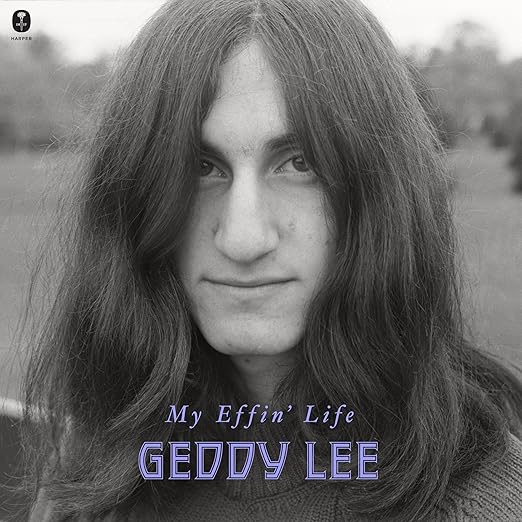
Geddy Lee narrating his own memoir is not a neutral creative decision. For a man who spent decades as one of rock's most recognizable voices, choosing to read My Effin' Life himself is an act of ownership that shapes the entire audiobook experience. Lee's speaking voice carries the same cadences as his singing: precise, slightly formal, with sudden warmth breaking through. Across 17 hours and 10 minutes, that voice becomes the vessel for a story that covers far more than the obvious territory of Rush's five-decade career.
Reviewers and fans went in expecting a Rush biography and discovered instead a family memoir that uses the music as its spine rather than its subject. Lee begins not with a concert but with inheritance: with his grandfather, murdered in the Holocaust, whose name he carries in its Anglicized form. The transformation from Gershon Eliezer Weinrib to Geddy Lee is not merely a stage name story. It is a story about what gets carried forward and what gets buried, and Lee approaches it with a care that signals the kind of memoir this is going to be from the first chapter.
Grief for Peart That Refuses to Resolve
The early chapters on Lee's family history are, by multiple listener accounts, the most affecting portions of the book. His parents survived the war as teenagers, and Lee does not sensationalize their experiences but reconstructs them with the precise, loving attention of a son who has spent a lifetime trying to understand what his parents carried. This is where My Effin' Life distinguishes itself from standard rock memoirs: the music is present, but it exists in the context of a family that shaped Lee long before Rush existed.
The Rush chapters are rewarding for fans but not alienating for newcomers. Lee traces the band's arc from early struggles to the accumulation of gold and platinum records that put them behind only the Beatles and Rolling Stones in consecutive runs, but the emphasis is consistently on the human relationships within the band rather than the commercial trajectory. His portraits of Alex Lifeson and the late Neil Peart are particular highlights. The grief over Peart's passing in 2020 runs through the book not as a chapter but as a current, surfacing in unexpected moments throughout Lee's reflections on the band's history and refusing to be resolved into a tidy eulogy.
Lee Narrates Two Songs No Reader Could Add
The audiobook format adds two exclusive songs recorded by Lee specifically for this release. For Rush fans and Lee devotees, that inclusion alone is a meaningful reason to choose audio over print. But beyond the bonus tracks, hearing Lee read his own words changes the texture of the content in ways that are difficult to articulate but easy to experience. When he discusses his parents, the restraint in his voice is different from any professional narrator's restraint. When he describes Peart, the pauses carry their own weight. One reviewer noted that the memoir is utterly approachable despite its complexity, and that quality comes through in the audio delivery: Lee is not performing emotion, he is recalling it.
At 17 hours and 10 minutes, the runtime is substantial. Listeners who come for Rush and stay for the family history will find the longer passages on the Weinrib family, the Holocaust's shadow, and Lee's parents' resilience to be the memoir's emotional core rather than its preamble. The book earns its length because Lee refuses to skip the parts that are hardest to describe, and because the self-narration gives every passage the particular weight of first-person truth rather than interpreted text.
Fans Told Their Favorite Band Didn't Count
Lee is candid about his obsessions and his limitations. The memoir is honest about the costs of five decades on the road, the particular difficulties of balancing a music career with family, and the ways that Rush's underground reputation for most of its career shaped the band's relationship with mainstream recognition. Lee does not position himself as a victim of industry neglect; he is too self-aware for that. But the history of Rush's critical reception is part of the story he tells, with appropriate wryness about what it meant to accumulate devoted fans who were regularly told by critics that their favorite band did not count.
The book also carries genuine humor throughout. Lee's description of his various non-musical obsessions, baseball, wine, bass guitars, and other collecting passions, provides levity between the more emotionally demanding sections. The mix of comedy and loss that reviewers have noted is not a structural accident but a reflection of how Lee actually talks about his life: as someone who finds both things equally real and equally worth attention.
More Interested in Parents Than Platinum
Rush fans will want this audiobook, and they should choose it specifically in audio form for the exclusive tracks and Lee's own narration. Listeners interested in musician memoirs that take family and history seriously alongside career narrative will find My Effin' Life stands out in its genre. Anyone drawn to stories of resilience across generations, particularly stories that engage honestly with the Holocaust's long shadow on survivor families, will find more here than a rock biography typically offers.
Listeners who want a straightforward concert-by-concert career chronicle may find the memoir's emphases surprising. Lee is more interested in his parents than his platinum records, more interested in friendship than fame. That is precisely what makes it worth 17 hours of your time, and why readers who do not already love Rush have found themselves more affected than they anticipated.
In Brief
- Narration: Geddy Lee reading his own life story across 17 hours and 10 minutes is the only way this memoir should exist. His voice carries the weight of history and the humor of someone who has earned the right to reflect without performing.
- Themes: Family, trauma, and resilience across generations; the cost and joy of a life in music; friendship, loss, and grief
- Mood: Rich and ruminative, with flashes of genuine warmth and unexpected sorrow
- Verdict: My Effin' Life earns its runtime. Lee's memoir is candid, specific, and emotionally complete in ways that most rock biographies are not, and hearing it in his own voice makes it something else entirely.
Questions Listeners Ask
Does Geddy Lee narrate the My Effin' Life audiobook himself?
Yes. Lee reads the entire memoir himself across 17 hours and 10 minutes. His narration is intimate rather than theatrical, and the combination of his recognizable voice with deeply personal material gives the audiobook a character that a professional narrator could not replicate.
What are the two exclusive songs mentioned for the audiobook version?
Geddy Lee recorded two new songs specifically for the My Effin' Life audiobook, available only in this format. Details about the songs' content are not disclosed in the book's advance materials, making them a genuine surprise for listeners who choose the audio version over print.
How much of this audiobook focuses on Rush versus Lee's personal and family life?
The memoir balances both, but Lee's family history, particularly his parents' experiences as Holocaust survivors and their influence on who he became, forms the emotional core of the early sections. The Rush chapters are substantial but integrated into a broader life narrative rather than dominating it.
Is My Effin' Life worth listening to for people who are not Rush fans?
Yes, with some caveats. The memoir's engagement with Holocaust family history, the costs of sustained friendship, and grief over Neil Peart's death give it emotional substance independent of Rush's catalog. Readers with no background in the band's music will miss some contextual resonance, but the family narrative stands on its own as a compelling story of survival and inheritance.







