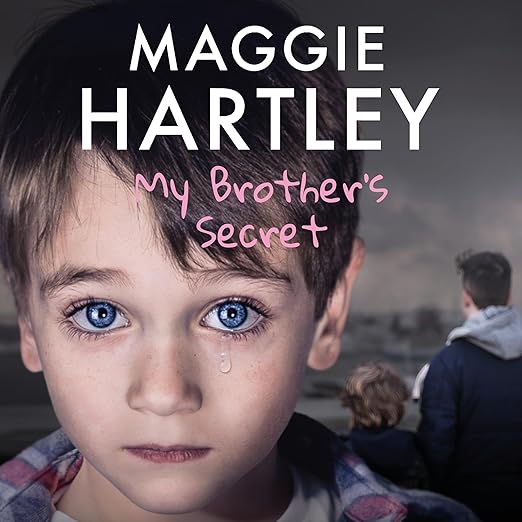
I finished My Brother's Secret late on a weeknight when I had intended to listen for thirty minutes before sleep and found myself still in the dark an hour past when I should have stopped. Maggie Hartley has a quality that is harder to achieve than it looks: she makes the most difficult aspects of child welfare not merely bearable to listen to but genuinely compelling, without ever prettifying what her foster children have been through or what they continue to carry. This entry in her ongoing memoir series is among the more emotionally demanding ones she has written, and Penelope McDonald's narration handles its emotional geography with real skill and care.
The premise involves three brothers: four-year-old Billy, eleven-year-old Keegan, and teenager Cooper, whose behavior has been escalating toward school expulsion. Their father has abandoned them after their mother's earlier death, and they arrive at Maggie's home carrying all the grief, rage, and learned behavior that kind of sequential loss inevitably produces. Hartley establishes the brothers' distinct personalities quickly and precisely, Billy as the delight who somehow maintains his capacity for joy, Keegan as the quiet one who concerns her most precisely because of that quietness, and Cooper as the problem she is most visibly failing to reach through conventional approaches.
Cooper's Behavior Is a Mystery to Solve
The book's most effective move is making Cooper the mystery rather than the villain of the narrative. Hartley is too experienced a foster carer to write off a teenager's destructive behavior as simple bad character, and the story's tension comes largely from her mounting sense that something is seriously wrong beneath the surface of what Cooper is performing. His aggression at school, his resistance to her attempts to connect, his fierce protectiveness toward his younger brothers, all of these add up to a picture that does not quite cohere, and Hartley's narration of her own confusion feels authentic rather than retrospectively tidied into shape.
The shocking discovery that shifts the entire narrative, teased by the synopsis but appropriately withheld here, reframes the first half of the book in a way that is emotionally satisfying without feeling manipulative. It is the kind of revelation that works because Hartley has laid the groundwork honestly rather than withholding clues unfairly. When you look back at Cooper's behavior after the fact, the explanation feels earned rather than convenient. That is good storytelling of the kind this genre does not always manage.
Three Emotional Frequencies Across One Household
One of the sustained pleasures of Hartley's writing at its best is her ability to hold multiple children's needs simultaneously without flattening them into a collective unit. In My Brother's Secret, the contrast between Billy's relative stability, Keegan's internalized distress, and Cooper's externalized crisis gives the narrative three different emotional frequencies to attend to across the book's runtime. Reviewers consistently note Hartley's patience and compassion as the work's defining qualities, and these are visible most clearly in how she tracks the brothers' differences without ranking their suffering or deciding in advance whose story matters most.
Keegan is the quiet emotional center of the book. Withdrawn and watchful in a way Hartley identifies as both a coping mechanism and a warning sign, his arc toward the end of the narrative has a different quality from Cooper's more dramatic story, smaller in outward scale, more internal, and in some ways more affecting precisely for that quietness.
Penelope McDonald's Steadiness Without Sentimentality
Narrating true accounts of child welfare requires a specific kind of restraint, the temptation toward emotional signaling and emphatic narration must be resisted in favor of allowing the events to carry their own weight. McDonald understands this. She reads the more distressing passages with a steadiness that prevents them from becoming uncomfortable to listen to without diminishing their impact or suggesting that their difficulty should be softened. Her voice for Hartley carries warmth without sentimentality, which is exactly what the material requires from beginning to end.
At 5 hours and 29 minutes, this is a relatively compact audiobook for the emotional territory it covers, but Hartley has always written economically, and the compression serves the narrative well. The ending arrives with appropriate force, which multiple reviewers have flagged as a genuine payoff after a book that had been difficult to sit with in the best possible way.
Real Placements, With Identifying Details Changed
One thing worth flagging for prospective listeners: Hartley's books are based on real placements, with identifying details changed to protect the children involved. She is careful to note this, and it adds a particular weight to the listening experience, these are not constructed narratives but accounts of real children in real crisis situations. That reality shapes everything from how McDonald approaches the narration to how Hartley calibrates the level of detail she provides. The book respects the dignity of its subjects in ways that many true accounts of child welfare do not always manage to sustain.
If you have listened to other books in Hartley's series, My Brother's Secret fits comfortably into the pattern while presenting a genuinely distinct story. If you are new to her work, this is a representative entry: emotionally demanding, rigorously honest about what foster caring can and cannot accomplish, and ultimately affirmative of the difference that consistent presence makes to children in crisis. Listeners who want difficulty without payoff will find it hard going. Everyone else will find the discomfort worth sitting with.
The Short Version
- Read by: Penelope McDonald delivers a grounded, emotionally present performance that keeps the more distressing material from tipping into misery-lit territory.
- At its heart: Foster care and sibling bonds, the long shadow of sequential parental loss, institutional limits and individual resilience
- Vibe: Warm and quietly unsettling in equal measure, with an emotional payoff in the final stretch
- Short version: Readers already invested in Maggie Hartley's ongoing series will find this one of the more emotionally complex entries; newcomers will discover a foster care memoir that takes its young characters' interior lives seriously.