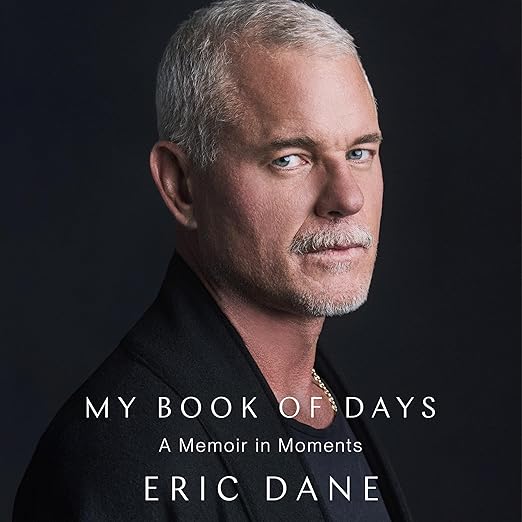
Counting Days Instead of Projects and Seasons
Eric Dane's audiobook memoir is one of the more quietly urgent books to arrive in recent years, and the urgency is not manufactured. Dane was diagnosed with ALS while still working, still parenting, still orienting his life toward the future he assumed he had. What he produced in response to that diagnosis is a structured reflection on time itself: not on a career, not on celebrity, but on the individual days that accumulate into a life, and what it means to finally see them clearly.
'My Book of Days' frames this reckoning through a series of defined 'days,' each illuminating a particular defining experience or emotional truth. That structural choice is more than organizational: it mirrors the book's central argument. Most of us do not think in days. We think in projects, seasons, and goals. Dane's diagnosis disrupted that frame completely, forcing him to account for individual days as the actual unit of a life rather than the incidental medium through which longer narratives unfold. The format enacts what the book is trying to say, which is a more difficult writerly achievement than it first appears.
No Narrator Credited for Such a Personal Memoir
This particular audiobook's own listing names no narrator anywhere, which is a significant detail worth investigating before purchasing. Whether Dane reads this himself or another voice carries his words makes a meaningful difference to how the memoir lands. If this is a self-narrated audiobook, the intimacy of hearing Dane speak his own reflections on ALS, on his daughters' futures, on the unexpected permanence of the McSteamy character, carries a weight that third-party narration cannot replicate. If it is narrated by someone else, the question becomes whether that narrator can sustain the vulnerability the material requires across seven hours. Listeners should verify the narration format directly before committing, since a memoir this personal lands very differently depending on whose voice is actually delivering it.
The seven-hour runtime gives 'My Book of Days' space to be genuinely reflective rather than compressed. That length allows the 'days' structure to breathe, to feel like a real collection of moments rather than a highlight reel. Dane's career trajectory from early Hollywood struggle through the unexpected longevity of Dr. Mark Sloan on 'Grey's Anatomy,' through 'The Last Ship,' through 'Euphoria,' provides a conventional memoir framework, but the ALS diagnosis reorients all of it. The career is not the point. The days within it are.
Letters to His Daughters Anchor the Memoir
Readers who come to this book expecting a standard Hollywood memoir, the rise-and-struggle story of how a man became McSteamy, will find that the ALS diagnosis reframes everything that precedes it. The career passages are present and honestly recounted, but they function as context for the deeper argument about presence, time, and what it means to be conscious of your own days. That reframing is what distinguishes this from a straightforward celebrity memoir and what gives it its specific weight.
Dane's career provides the memoir's chronological spine, but 'My Book of Days' is not organized chronologically in the conventional sense. The 'days' format allows him to move between the early Hollywood grind, the unexpected weight of becoming McSteamy, the quiet satisfactions of sobriety, and the letters written for his daughters, without subordinating any of them to a single narrative arc. Each day stands on its own while connecting to the others through the book's central preoccupation: what these days actually meant, seen from the perspective of a man who can no longer assume he has more of them than he can count. That perspective is what makes the memoir different from a standard celebrity memoir, and different from a standard illness narrative. It is something more genuinely original than either.
The sobriety material is handled with what the synopsis describes as 'hard-won peace.' That phrasing suggests candor rather than triumphalism, which is the appropriate register. Addiction and recovery narratives can tip into inspirational arc too easily; the suggestion here is that Dane is more interested in honest accounting than in producing a redemption story with clean edges. The peace sounds genuinely earned rather than performed.
The 'future days' sections, letters written for his daughters about a future Dane will not share, are structurally distinct from the rest of the memoir and are likely the passages that will stay with listeners longest. They represent the book's central emotional gamble: that the most meaningful thing a person facing death can offer is not wisdom about the past but genuine presence in the imagined future. Letters written across a time boundary that the writer knows they will not cross are among the most affecting forms of writing we have, and Dane's version of them is the heart of this audiobook.
A Companion for Listeners Who've Faced Serious Illness
This audiobook will resonate most with listeners who have navigated serious illness themselves or alongside someone they love, readers drawn to memoirs that use a personal crisis as a lens for broader reflection on time and meaning, and fans of Dane's work who want to understand the person behind the roles. It is not a book for those seeking comfort in easy resolution: ALS is not cured here, and the memoir does not pretend toward that kind of ending. The emotional honesty is the point, and the point is not comfortable.
For listeners who prefer memoirs with clear narrative momentum and a satisfying conventional arc, the 'days' structure may feel diffuse. The book is organized by emotional truth rather than chronology, which is a deliberate choice requiring a reader willing to follow that rhythm rather than a linear story. Those who come primarily for the 'Grey's Anatomy' career material will find it present but not primary. Dane's frame is larger and more serious than any single role, however beloved.
Quick Take
- Big ideas: Terminal illness, celebrity memoir, the weight of individual days, letters to the future
- Atmosphere: Reflective and spare, with genuine emotional weight beneath the prose
- Worth it?: A memoir that refuses easy comfort and earns its emotional power through structural honesty about what time actually means.
Does this audiobook cover Eric Dane's acting career as well as his ALS diagnosis?
Yes, both are present. The career material, from early Hollywood years through 'Grey's Anatomy,' 'The Last Ship,' and 'Euphoria,' is part of the memoir's 'days' structure. The ALS diagnosis reframes that career material rather than replacing it.
Is 'My Book of Days' a self-narrated audiobook, and does that affect how it should be heard?
This particular listing doesn't specify a narrator one way or the other. Whether Dane reads his own memoir makes a significant difference to the listening experience, particularly for the letters he wrote to his daughters about their futures. Listeners should verify the narration format before purchasing.
How does this audiobook handle the ALS diagnosis: is it medically focused or more personal and reflective?
Based on the synopsis and the 'days' structure, the focus is personal and philosophical rather than clinical. Dane uses the diagnosis as a lens for reflection on what each day means, not as the subject of a medical narrative.