Key Details
- Voice: Angela Dawe's measured, clear delivery suits the gravity of the material and handles the trial sequences with appropriate weight.
- Big ideas: Privilege and crime, the psychology of premeditated murder, capital punishment debate
- Atmosphere: Unsettling and rigorously researched, restrained rather than sensational
- Worth it?: A sharp, primary-source-grounded account of one of America's most notorious crimes, handled with the seriousness the subject demands.
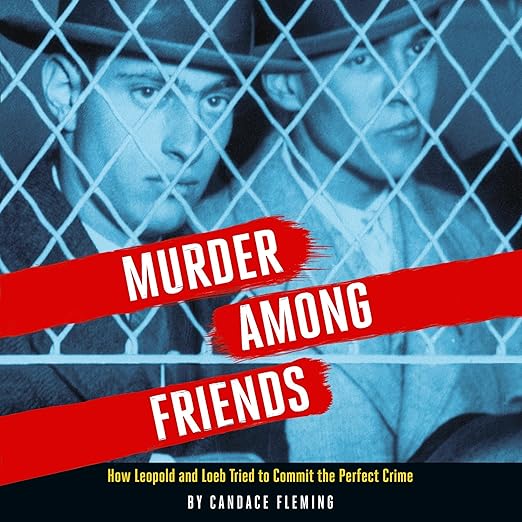
Nathan Leopold and Richard Loeb were eighteen years old, brilliantly educated, and wealthy enough to believe they could commit the perfect crime. I picked up this audiobook after finishing a more conventional true-crime title, expecting the Nathan-and-Richard story to be familiar territory. What Candace Fleming delivers in this audiobook is something far more disquieting than a rehearsal of known facts: it is a patient, precisely constructed account of how two young men reasoned themselves into murdering a fourteen-year-old child they both knew, and what happened when the single mistake that undid them turned out to be a pair of dropped eyeglasses.
Fleming is the author of The Rise and Fall of Charles Lindbergh and The Family Romanov, and her command of narrative nonfiction for younger audiences is evident from the first chapter. She does not talk down to her readers. She does not sanitize. She presents the 1924 kidnapping and murder of Bobby Franks as the historical record holds it: brutal in its planning, clinical in its execution, and genuinely difficult to reconcile with the ordinary-seeming lives the perpetrators had led.
What Candace Fleming Delivers
Angela Dawe's narration is the right instrument for this material. Her voice has a quality that suits narrative nonfiction: measured, clear, capable of carrying the weight of the more disturbing passages without leaning into sensationalism. The trial sequences, which hinge on Clarence Darrow's famous twelve-hour closing argument against the death penalty, benefit particularly from her steady pacing. Darrow's rhetoric was theatrical and she captures its cadences without letting them tip into performance.
Fleming structures the book around four threads: the planning and execution of the crime, the investigation, the confession, and the trial. Moving between them, she keeps the focus on the question the synopsis makes explicit: not merely what Leopold and Loeb did, but why. The answer she assembles from primary sources is uncomfortable and refuses easy resolution. These were not disadvantaged young men acting from desperation. They acted from a distorted sense of intellectual superiority, shaped partly by a misreading of Nietzsche, partly by the dynamics of their own relationship with each other.
What Candace Fleming Gets Right
The case for the audiobook format here is strong. Dawe's measured delivery keeps the material from tipping into the sensationalism that lesser true-crime productions court. The listener can sit with the weight of each development without the pacing being goosed for effect. Fleming's prose, which reviewers have called 'crisp,' rewards this kind of careful, unhurried listening.
Reviewer Diane, who specifically recommended the book for 'older and mature teens' as an entry into true crime, notes the way Fleming treats its young audience: background information is provided without condescension, and the darker material is handled with seriousness rather than exploitation. That calibration is precisely right for this subject matter, and it is maintained throughout. A reviewer who noted finding the material 'incredibly interesting yet disturbing' pointed out that Fleming drew heavily on primary sources, which gives the reconstruction of events a granularity that feels trustworthy rather than invented.
Where Candace Fleming Loses Some Ground
This is a true-crime account aimed at teen and older-YA readers, which means it engages seriously with violence without dwelling on gore. The murder itself is not described in graphic physical detail; the horror is in the planning and the emotional vacancy of the perpetrators, which is arguably more disturbing. Listeners coming to this expecting the sensory detail of adult true-crime podcasts may find Fleming's restraint a deliberate choice rather than a gap.
Clarence Darrow's role in keeping Leopold and Loeb from the death penalty is central to the final third of the audiobook. Depending on where a listener stands on capital punishment and on Darrow as a historical figure, the material will land differently. Fleming presents his argument and its consequences without editorializing heavily, which one reviewer found admirable and another found unsatisfying. That productive ambiguity is, I think, part of the book's design.
The Leopold and Loeb case has attracted writers and dramatists for a century, from the play Rope to the 1959 film Compulsion to more recent podcast treatments. What distinguishes Fleming's version is the audience she is addressing and the discipline that requires. She cannot rely on a reader's prior knowledge of the case; she has to build the full context from scratch while keeping the pacing of a narrative that competes with the true-crime content young readers already consume across other platforms. The fact that she succeeds, that the reviews consistently describe the material as compelling and appropriately paced rather than remedial, is a genuine achievement in a genre where condescension toward younger readers is the most common failure mode.
Dawe's narration sustains the gravity of the material across the full runtime without making it feel relentlessly heavy. The trial section, which hinges on Clarence Darrow's arguments against executing two young men who confessed to the murder of a child they knew, requires a narrator who can let the complexity of the legal and moral terrain register without editorializing. Dawe walks that line consistently, and her performance is a significant reason this audiobook works as well as it does.
Who Should Pick Up Murder Among Friends
Mature teen listeners and adult readers with an interest in legal history, criminal psychology, and 1920s America will find this one of the more carefully researched true-crime audiobooks aimed at a YA crossover audience. It pairs well with Fleming's other historical nonfiction titles. Listeners who want explicit crime detail or a more prosecutorial narrative tone may find the balance shifts more toward legal drama and psychological portraiture than they prefer. Anyone interested in Clarence Darrow, in the history of capital punishment debate, or in the sociology of privilege and crime will find the trial section alone worth the runtime.
Is this audiobook appropriate for younger teen listeners?
Murder Among Friends is aimed at mature or older teens. The murder of Bobby Franks is treated seriously rather than graphically, but the subject matter is genuinely dark. Reviewers specifically recommend it for older teens as an introduction to true crime rather than for younger adolescent audiences.
How does Angela Dawe's narration handle the more disturbing sections of this audiobook?
Dawe maintains an even, measured tone throughout, which keeps the material from tipping into sensationalism. The trial sequences in particular benefit from her steady pacing, and the closing argument passages are delivered with appropriate rhetorical weight.
How does this audiobook compare to other Candace Fleming nonfiction titles?
Fleming's prior books, including The Rise and Fall of Charles Lindbergh and The Family Romanov, established her command of narrative nonfiction for young readers. Murder Among Friends applies the same approach to a criminal rather than political or royal subject, with the same primary-source density and the same refusal to condescend to its audience.