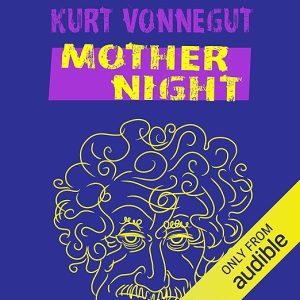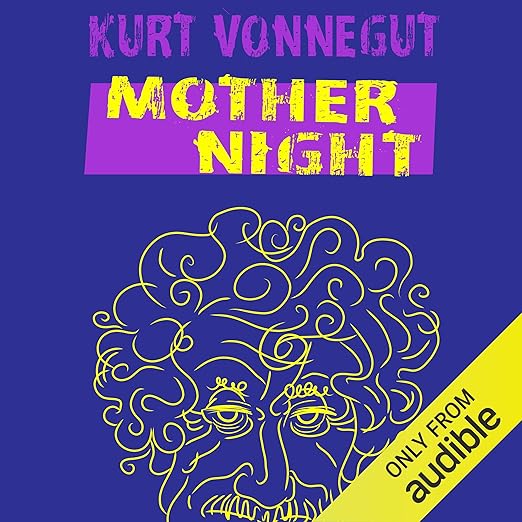
I listened to Mother Night over two evenings, and I spent most of the second evening not doing anything else. At five hours and forty-seven minutes it is the shortest novel in Vonnegut's major work, but it is the densest. The premise is almost too neat for satire: Howard W. Campbell Jr., an American who spent World War Two broadcasting Nazi propaganda under Goebbels, is writing his memoirs in an Israeli prison while awaiting trial for war crimes. He was also a spy for American military intelligence. Does that make him guilty or not guilty? Vonnegut is not going to answer that question for you, and the novel's moral power is entirely dependent on your willingness to sit with the fact that it cannot be answered.
Vonnegut announces his thesis in the editor's introduction that opens the book: we are what we pretend to be, so we must be careful about what we pretend to be. This is not a novel that hides its intentions. What it does is construct a situation in which that thesis is tested until it collapses into tragedy. Howard pretended to be a Nazi propagandist while secretly serving the Allied cause. By the time the war ends, the pretense has become indistinguishable from the reality. The people around him, former Nazis, neo-Nazis, confused nationalists, cannot tell the difference, and eventually neither can Howard.
A Closer Look at Mother Night
One reviewer made the connection to Slaughterhouse-Five, noting that Vonnegut begins Mother Night with a brief autobiographical account of his own imprisonment in Dresden during the Allied firebombing, a trauma that generated the mindset underlying all his major work. That context matters here more than in some of his other novels because Mother Night is Vonnegut at his least comic, or rather at his most uncomfortable with his own comedy. The satirical distance that makes Slaughterhouse-Five survivable is narrower here. Howard's situation is absurd in the Vonnegut register, but it is also genuinely tragic, and the novel does not flinch from that.
The cast of characters surrounding Howard in the final section of the book, old Nazis, unlikely allies, a man who claims to be the actual Adolf Eichmann, is drawn with Vonnegut's characteristic economy. He can establish a character's entire moral universe in three sentences. The danger of reading this in 2026 is that it feels specifically relevant: a man whose words served evil regardless of his intentions, a world that cannot agree on what guilt requires, an institution built to administer justice that has no category for Howard's particular situation.
What Makes Mother Night Worth Hearing
Victor Bevine's narration is the element that makes this particular audiobook worthwhile. Howard is writing a confession, the novel is explicitly framed as his memoir, and Bevine understands that the voice should sound like someone telling the truth about himself without being entirely certain what that truth is. He is not performing guilt or performing innocence. He reads the text with a quality of careful, exhausted honesty that matches the book's moral position: this is someone who has thought about what he did for a very long time and still cannot produce a verdict.
The novel's brevity suits the audio format. At under six hours it is completable in a day, which gives Mother Night the concentrated impact it deserves. This is not a novel that benefits from being stretched across weeks of commuting; it wants to be heard in proximity to itself.
Things to Know Before Starting Mother Night
Readers coming to Mother Night expecting the anarchic energy of Slaughterhouse-Five or the comic extravagance of Cat's Cradle will find a quieter, stranger book. The humor is present but it operates at a lower temperature, jokes that make you recognize something true rather than laugh. The ending is abrupt in the way of all Vonnegut endings, and here it is specifically devastating. If you have never read Vonnegut before, this is not the place to start, its force is partly derived from understanding the register Vonnegut usually operates in and recognizing when he is choosing not to use it.
The novel is short enough that its ideas are not fully elaborated, Vonnegut states his thesis and trusts the story to demonstrate it rather than argue it. Readers who want the philosophical content unpacked at length will find the book ends before it has said everything it might have said. That compression is a choice, and it is the right one.
Who Kurt Vonnegut Is Writing For
Vonnegut readers who have not yet read Mother Night should make this a priority, it is routinely underrated relative to Slaughterhouse-Five and Cat's Cradle, and it may be the novel where his moral seriousness is most nakedly on display. Listeners interested in World War Two fiction from an interior, morally ambiguous perspective, fans of Sebastian Faulks or Pat Barker's approach to war, will find Vonnegut's shorter register refreshing. Those looking for a straightforward war narrative or a clean moral resolution should look elsewhere entirely.
Quick Take
- Performance: Victor Bevine gives Howard Campbell the right combination of detachment and suppressed anguish, this is a man writing his confession and Bevine never lets you forget it.
- What it covers: Identity as performance and its moral consequences, the impossibility of innocence in wartime, guilt without clear verdict
- Feel: Darkly absurdist, philosophically restless, with a gallows humor that makes the tragedy land harder
- Our call: One of Vonnegut's most morally serious novels, and Victor Bevine's narration makes the confession format sing, compact and devastating at under six hours.
Frequently Asked Questions
The novel is framed as a confession, how does Victor Bevine handle the memoir structure?
Very well. Bevine reads the text as someone transcribing his own experience with exhausted clarity rather than dramatic guilt. The confession format is taken seriously rather than performed, which suits Howard's character and Vonnegut's tone.
Does Mother Night come down clearly on whether Howard Campbell is guilty?
No, and that is the entire point. Vonnegut presents the case and the evidence and leaves the verdict to the reader. The novel's thesis, we are what we pretend to be, is the closest thing to a verdict, and it is deliberately unsatisfying as a legal or moral framework.
How does the historical context of the Israeli war crimes trials feature in the novel?
Howard is awaiting trial in an Israeli prison, and the Eichmann trial is occurring in parallel, a real historical event that Vonnegut uses as the frame for Howard's own uncertain guilt. The juxtaposition between Eichmann's actual documented crimes and Howard's genuinely ambiguous case is one of the novel's most uncomfortable structural choices.