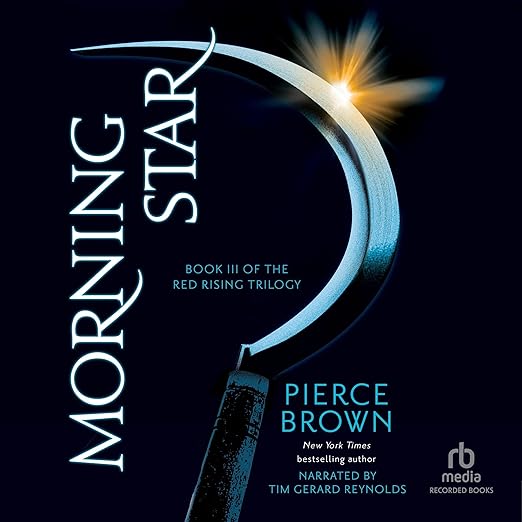
Darrow's revolution, three books in the making, finally ignites in Morning Star, Pierce Brown's conclusion to the Red Rising trilogy, and Tim Gerard Reynolds brings it home with a performance that has earned its reputation among audiobook fans of the genre. I came into this audiobook having powered through Red Rising and Golden Son in the preceding two weeks, and Brown does not ease you back in gently. The book opens with consequences already in motion, with Darrow captured, broken, and awaiting a fate the Society intends to make permanent. Reynolds pitches his Darrow at the lowest we have heard him, and that choice to begin from genuine defeat rather than manufactured tension makes everything that follows feel costly in a way that series conclusions too rarely manage.
Brown has always written action with unusual physical specificity, and in Morning Star that quality intensifies. Reynolds navigates the battle sequences with a clarity that keeps the geography legible even when the tactical situation is chaotic. Brown is equally specific about the political maneuvering that surrounds the revolution, and Reynolds differentiates the returning cast with enough tonal precision that you track who holds power in any given scene without needing chapter breaks to reset. Sevro gets some of the book's best material and Reynolds leans into the character's particular brand of feral loyalty without softening it into comedy. The tension between Sevro's methods and Darrow's ideals is one of the novel's recurring pressure points, and Reynolds renders it with genuine ambiguity rather than easy resolution.
Multiple reviewers have called this their favorite entry in the trilogy, and the structural reason for that is worth examining. Red Rising establishes a world. Golden Son opens that world into something planetary in scale. Morning Star asks what the cost of winning actually looks like, and some of those costs land harder than the battles themselves. Brown writes betrayal and loyalty with the same economy of language, and Reynolds' instinct is always to underplay the emotional payload rather than oversell it. The result is that the gut-punch moments hit when you least expect them, which is exactly how Brown designed them to hit.
Reynolds Closes the Trilogy Without Sentimentality
Reynolds' work across this trilogy represents one of the more sustained narrator-series partnerships in contemporary science fiction audiobooks. He has developed a full internal map of Brown's cast over the three volumes, and in Morning Star that accumulated familiarity pays off. Characters who have been present since the beginning carry the weight of that history in Reynolds' voice without any external signaling required. New characters are introduced efficiently and given enough tonal distinctness that they do not blur into the existing ensemble. At 21 hours and 50 minutes this is a long listen, but the pacing does not flag. Brown plots with genuine momentum, and Reynolds paces himself across the runtime in a way that suggests he understood exactly where the emotional peak of each act falls.
The final act in particular earns the investment of two prior volumes. Brown ties threads from Red Rising forward in ways that reward patient listeners, and Reynolds plays the finale with a restraint that proves he trusts the material. The emotional weight of the conclusion is allowed to accumulate rather than being pointed at. For listeners who have followed this series across all three entries, Morning Star delivers closure without sentimentality, which is a rare achievement in series conclusions of this scale.
Lyria Widens a Cast Already the Trilogy's Best
The novel's central tension, between Darrow's belief that the revolution requires him to become something he despises and the humanity he keeps trying to protect, runs through every strategic decision he makes. Reynolds voices this internal conflict with a quietness that makes the moments when it breaks through feel genuine rather than performed. Brown writes Darrow as a character who understands his own contradictions without being able to resolve them, and that honesty about the cost of leadership gives the book more moral complexity than its genre usually accommodates.
The cast around Darrow is the best in the trilogy. Lyria and several other new perspectives expand the story's emotional range without diluting the core narrative drive. Reynolds handles the multiple-perspective sections with tonal flexibility, shifting register enough to signal the change of viewpoint without creating jarring discontinuities. The world-building, which Brown has been deepening across all three volumes, reaches its fullest expression here. The societal architecture of the Color system pays off in the revolution's specifics, and those specifics matter more in this audiobook than they have in either predecessor.
Brown's prose in Morning Star carries a different texture than it did in the first two volumes. Red Rising had the compressed urgency of a debut, and Golden Son the slightly overcrowded ambition of a writer expanding his canvas. Morning Star is the work of a writer who knows his world completely and has earned the right to slow down in it occasionally. The scenes of political maneuvering and alliance-building are given more room to breathe, and Reynolds responds to that breathing room with a quality of attention that distinguishes his performance here from his work on the earlier volumes. Listeners who felt that Golden Son's political complexity sometimes outpaced the emotional core of the story will find Morning Star better balanced.
Absolutely No Entry Point, Only the Payoff
This audiobook is absolutely not an entry point to the Red Rising saga. Listeners unfamiliar with the first two volumes will lose the accumulated weight of every significant character moment from the first page. Those who have finished Golden Son and need to know whether the finale justifies the commitment: it does. Fans of Tim Gerard Reynolds' narration who have not yet encountered this series will find three volumes of his best sustained work waiting. Science fiction readers who gravitate toward the intersection of political complexity and high-stakes action will find Brown operating at peak capacity here. Anyone who bounced off Golden Son's expanded cast should know that Morning Star tightens its focus considerably while still paying out every thread it has built.
Common Questions
Can Morning Star be listened to as a standalone audiobook?
No. The novel is the third volume of the Red Rising trilogy and relies on two books of accumulated character and world-building to achieve its impact. Start with Red Rising.
Does Tim Gerard Reynolds narrate all three Red Rising audiobooks?
Yes. Reynolds narrates the entire original trilogy, and his accumulated familiarity with the cast is one of the production's significant assets. The consistency across three volumes rewards marathon listening.
Is this audiobook suitable for listeners new to science fiction?
The Red Rising trilogy is more accessible than much of the genre because its emotional core is character-driven rather than concept-driven. That said, Morning Star's impact depends on investment built across two prior volumes, so beginning with Red Rising is strongly recommended.