Quick Take
- Narration: Reiko Gomez narrates her own work with professional assurance and genuine warmth, which helps the more experiential sections feel guided rather than clinical.
- Themes: home as identity expression, feng shui psychology, intentional living
- Mood: Practical and quietly transformative
- Verdict: A home design guide that takes the interior life as seriously as the interior decor, with enough concrete method to justify the philosophical framing.
I am not the natural audience for this kind of book. My relationship with home decor has historically been functional over intentional, and feng shui has always struck me as something that lives adjacent to the self-help genre in ways I find difficult to fully engage with. I mention this because the reviews for More Than Just a Pretty Space made me curious enough to put skepticism aside for four hours, and I came out with a more nuanced view than I expected.
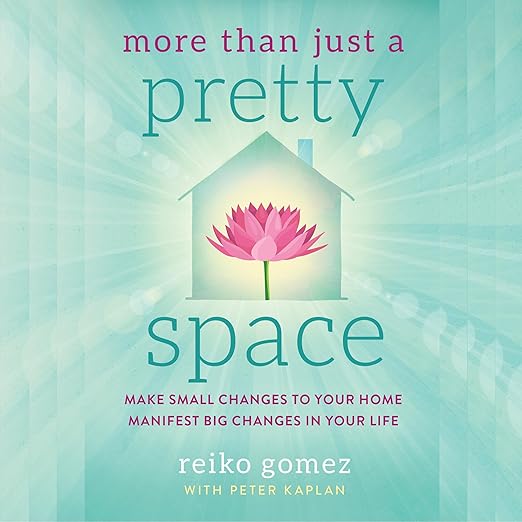
Reiko Gomez is a professional interior designer with twenty-three years of experience, a degree from the Parsons School of Design, and certification from the American Feng Shui Institute. That combination of credentials matters here, because the book does not simply offer spiritual advice or pure design tips. It does both simultaneously through what Gomez calls her Dream Design Process, a structured method for connecting your living space to your sense of self.
Our Take on More Than Just a Pretty Space
The book’s most interesting claim is that the choices you make about your home are not just aesthetic preferences but identity statements, and that examining them honestly can surface things about how you see yourself that pure introspection might miss. Reviewer Eric D. described it as a revelation that goes far beyond feng shui advice into deep questions of identity and self-perception. Reviewer John K. made an observation that struck me as particularly precise: looking at his home through the Dream Design Process made him reconsider not just his furniture choices but his self-perception. That is a more substantial claim than most design books make, and Gomez’s framework is structured enough that it does not feel like pure aspiration.
The celebrity endorsement from Kimora Lee Simmons in the synopsis, calling Gomez part psychic, part psychiatrist, part feng shui expert, is the kind of marketing language that can make a thoughtful reader wary. The book itself is more grounded than that blurb suggests. Gomez works through concrete categories: design identity types, decluttering as psychological release, plants and natural elements, lighting, materials, and furniture styles. Each section connects the practical to the personal in a way that feels earned rather than forced.
Why Listen to More Than Just a Pretty Space
The author-narrated format works in this book’s favor. Gomez reads with the confidence of someone who has explained these concepts to clients many times over, and the warmth in her delivery makes the more vulnerable sections, particularly the ones about confronting why you hold onto objects or spaces that no longer serve you, feel like guidance rather than instruction. Reviewer Sara compared it to Atomic Habits for your home, one room at a time, and that comparison points to something real: the book works incrementally, which makes it feel manageable rather than overwhelming.
At four hours, this is a comfortable listen that earns replay value. Several reviewers mentioned purchasing a physical copy alongside the audiobook to be able to make notes, which is a reasonable instinct given how much of the content is designed to be applied rather than simply absorbed.
What to Watch For in More Than Just a Pretty Space
Listeners who approach the subject from a purely materialist perspective may find the feng shui framework requires more suspension of disbelief than they want to give it. Gomez integrates feng shui principles with Western design and psychological research, but she does not argue for or against the spiritual dimensions of the practice. She presents them as tools, and whether you find that framing sufficient or unsatisfying will depend on what you bring to it.
The book is also explicitly transformative in its aspirations, which means it asks more of the listener than a standard design guide. Reviewer bmore_brooklyn noted that it asks you to have dreams at a stage of life where many adults have become wary of that vulnerability. That invitation is genuine and the book treats it with care, but it is worth knowing the emotional register you are entering.
Who Should Listen to More Than Just a Pretty Space
This audiobook is well-suited for anyone at a point of transition, moving into a new home, emerging from a difficult period, or simply feeling that their environment no longer reflects who they want to be. It will also appeal to listeners who already have some connection to feng shui or mindful living practices and want a structured approach to applying those ideas. Pure design enthusiasts who want visual inspiration without the psychological component should look elsewhere. The book requires and rewards genuine engagement with its questions.
Frequently Asked Questions
Does this book require any prior knowledge of feng shui?
No. Reiko Gomez introduces her principles from the ground up through her Dream Design Process, which integrates feng shui with Western design theory and psychological research. Readers with no prior exposure to feng shui can follow and apply the material without feeling lost.
Is this primarily a practical design guide or more of a self-help book?
Genuinely both, and the combination is the book’s core strength. It covers concrete design categories including lighting, materials, furniture, flooring, and color, but consistently connects those practical choices to questions of identity and psychological well-being. If you want one without the other, this may feel imbalanced.
Can I get full value from the audiobook or do I need the print version?
Multiple reviewers bought both after starting the audiobook, and Gomez’s narration works well for the experiential and philosophical sections. For the more structured exercises and specific design advice, having a physical copy for annotation may add value, but the audiobook stands on its own.
What makes Reiko Gomez’s approach different from standard home organization or decor books?
The core distinction is the Dream Design Process, which begins with identity rather than aesthetics. Rather than starting with what looks good, Gomez starts with who you are and what you want your life to feel like, then works backward to the design choices that support that. It draws on her twenty-three years of professional design work, feng shui certification from the American Feng Shui Institute, and her Parsons School of Design training.