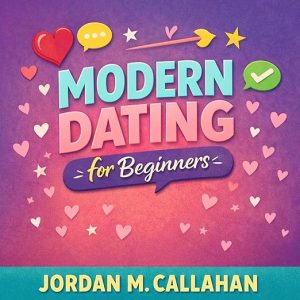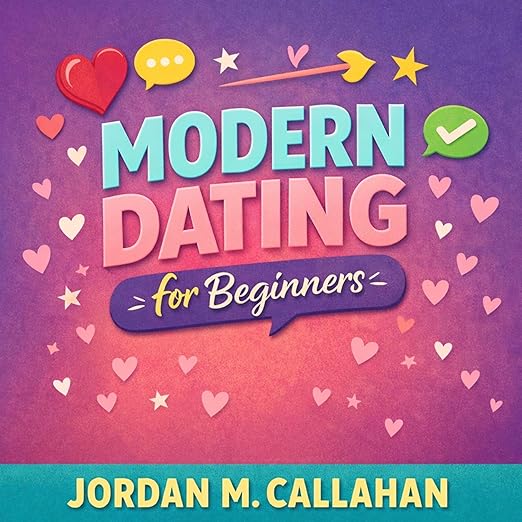
I spent some time earlier this year talking with readers who had come back to dating after long relationships ended, and the thing I kept hearing was not that dating felt hard. It felt unreadable. The rules had changed while they were not watching. Apps, texting etiquette, the particular social silence of being ghosted, the ambiguity of what counts as a date versus a hangout: these are not small confusions. They represent a genuinely different set of expectations than what most people in their thirties and forties grew up with. Jordan Callahan's Modern Dating for Beginners addresses exactly this disorientation, and it does so without condescension, without gimmicks, and without the vague spiritual language that can make books like this feel more like affirmations than guidance.
At three and a half hours, this is a compact audiobook by any measure. That brevity is both a feature and a constraint. Callahan has organized the content to walk through the stages of modern dating in sequence: building an authentic online profile, establishing personal boundaries before you need them, recognizing early warning signs, communicating with clarity, and forming connections that have some chance of being meaningful. The scope is practical rather than theoretical, which is the right call for its intended audience.
Emotional Safety Comes Before Successful Dating
What Callahan gets right is the emotional realism of the approach. The book does not promise that following its advice will lead to a relationship; it promises that applying the frameworks will help listeners date with more self-awareness and less reactivity. That is a more honest and ultimately more useful promise. The emphasis on emotional safety as a precondition for successful dating, rather than a byproduct of it, is a perspective that is often missing from books in this space. Too much dating advice front-loads tactical instructions about profiles and messages while underplaying the internal preparation that makes any of those instructions actually work. Callahan's ordering of priorities here is one of the things that distinguishes this guide from more superficial entries in the category.
Fike's Conversational Tone Fits a Long Walk
Narrator B Fike keeps the tone light without being flippant, which is the right balance for material that addresses genuinely vulnerable territory. The listening experience is conversational in the best sense. The book feels like it is talking with you rather than lecturing at you. At 3.5 hours, it fits comfortably into a long afternoon walk or a couple of commutes, and the compact format means listeners can absorb the whole arc without losing momentum between sessions. There is something to be said for a guide that respects your time enough not to pad itself to a more imposing length.
No Gimmicks, Just an Honest Introduction
Because this title was released in early 2026, there is no substantial listener review record to draw on yet. That means evaluating it requires more reliance on the source material itself. The synopsis is explicit that the book avoids gimmicks, tricks, and unrealistic promises, which is an encouraging signal; guides that feel the need to make that disclaimer tend to have actually thought about why so much dating advice relies on manipulation rather than maturity. Listeners expecting depth comparable to longer works in the relationship self-help space should calibrate for the runtime: at 3.5 hours, this presents itself honestly as an introduction rather than an encyclopedic treatment. What it covers, it covers clearly.
Solid Ground for Daters Starting Over
This title is most useful for two distinct groups: people who are genuinely new to dating as an adult activity, and people who are returning to dating after a significant gap and feel disoriented by how much the landscape has changed. Both audiences will find the practical framing and the stage-by-stage structure useful for understanding expectations they did not realize had shifted. Listeners who have already done significant reading in the relationship self-help space may find the content familiar, and experienced daters who feel confident in their approach are probably not the target. But for its intended audience, it is a solid, warmly delivered starting point that does not overreach.
- Voice: B Fike's performance is clean and approachable, well calibrated for the practical, down-to-earth tone the material calls for.
- Big ideas: Digital dating literacy, emotional self-awareness, healthy boundary-setting in modern relationships
- Atmosphere: Warm and direct, like advice from a thoughtful friend who has done the reading and wants you to feel steadier
- Worth it?: A genuinely practical entry point for anyone navigating dating apps and modern relationship dynamics for the first time or after a long break.
Common Questions
Is Modern Dating for Beginners focused specifically on dating apps, or does it cover in-person dating too?
The synopsis explicitly frames the book around today's digital dating world, including apps, texting dynamics, and online profiles, but the core principles around boundary-setting, communication, and recognizing red flags apply equally to in-person dating. The digital context is the framing rather than the entire content.
At only 3.5 hours, how substantive is the content?
The runtime is short for the genre, and the book presents itself as an introduction rather than a comprehensive guide. It covers the main stages of dating in a practical, accessible way. Listeners wanting deeper psychological or theoretical grounding will want to supplement with longer works.
Does the book address ghosting and other specific modern dating behaviors?
The synopsis specifically names ghosting alongside apps, texting rules, and mixed signals as part of the landscape the book addresses. These are treated as real phenomena that require practical frameworks rather than just emotional resilience, which is one of the book's more useful orientations.