Before You Press Play
- Narration: Wendy Tremont King navigates Lindsay's technical vocabulary and frequent transitions between mathematical abstraction and biological detail with a clarity that keeps the dense material accessible without simplifying it.
- Themes: Mathematics as neuroscientific language, the history of brain modeling, the gap between elegant theory and messy biological reality
- Mood: Rigorously curious and refreshingly honest about uncertainty
- Verdict: Grace Lindsay's audiobook is the best account currently available of how mathematical models transformed neuroscience - specific, historically grounded, and honest about where the field remains unfinished.
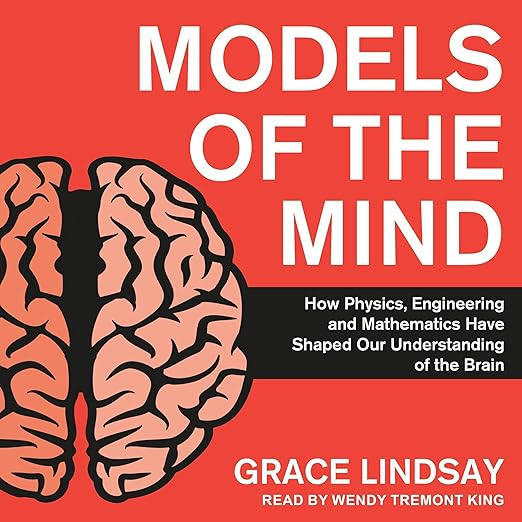
Grace Lindsay begins Models of the Mind from a premise that most brain science books avoid: that the neurons themselves are not the whole story. With 85 billion neurons and over 100 trillion synapses, the brain is a system of staggering complexity, and the history Lindsay traces in this audiobook - narrated by Wendy Tremont King across thirteen hours - is the history of how mathematicians and neuroscientists developed a language capable of describing what all that complexity actually does. Lindsay is a computational neuroscientist herself, and that professional standing shows in the specificity and honesty she brings to a field that has often been oversimplified for popular audiences.
The audiobook arrived in my listening queue during a period when I was working through several neuroscience titles back-to-back, and Models of the Mind distinguished itself immediately by refusing the genre's usual reassurance. Reviewer Doug D. opened his review with a direct statement of the book's intellectual honesty: "No one should start reading this book thinking there will be a final equation at the end that explains everything. This field is very much a work in progress." That calibration is unusual and valuable, and it sets the right expectation for what follows.
What Lindsay has written is both a history of computational neuroscience and an argument for why mathematics was the right language to bring to the problem. The argument proceeds historically, tracing how different mathematical frameworks were applied to different brain functions: statistical mechanics to neural populations, information theory to sensory processing, dynamical systems to the timing of neural activity, and reinforcement learning to decision-making. Each chapter introduces the mathematical approach, identifies the neuroscientists who developed or applied it, and then honestly assesses what the model explains and what it fails to capture.
That honesty about failure is one of the audiobook's most distinctive qualities. Reviewer Gordon Silverman, noting his own technical objections to some omissions, still described it as "a very readable discussion of the cosmic issues confronting our understanding of the mind." Reviewer GIDMEISTER, who called the author "a very clear writer," noted that she "almost avoids writing down a single equation" - a significant achievement in a book whose entire subject is mathematical modeling. Lindsay has learned what Stewart did in cosmology: the mathematical reasoning can be conveyed through structure and analogy without the notation, and the audiobook format is actually better suited to this kind of mathematics-without-symbols presentation than the print edition.
Why Listen to Models of the Mind
Wendy Tremont King's narration across thirteen hours maintains the technical precision the material requires without falling into the monotone that can affect science audiobooks with high terminology density. Lindsay's prose is clear but not simple - she is writing for an educated general audience, not for undergraduates - and King finds the appropriate register between accessibility and rigor. The frequent transitions between historical narrative (who developed this approach and why), technical explanation (how the model works), and critical assessment (where it succeeds and fails) each have different tonal requirements, and King navigates them without the awkwardness that can signal a narrator working beyond their comfort zone.
The thirteen-hour runtime is appropriate for the scope of what Lindsay covers. The book is not padded - each chapter occupies the time its subject requires - and the historical structure creates sufficient narrative momentum to sustain listening across multiple sessions. For listeners with some background in biology, statistics, or computer science, the conceptual density will feel appropriately challenging rather than inaccessible. For listeners approaching from a pure humanities background, some chapters will require more patience, but Lindsay's prose consistently prioritizes conceptual clarity over technical completeness.
What to Watch For in Models of the Mind
The audiobook covers a span from early twentieth-century mathematical neuroscience through developments in the 2010s, which means it is current enough to include work on deep learning's relationship to neural circuits while also providing the historical foundation that contextualizes those recent developments. Lindsay is clear about where the models have succeeded - the Hodgkin-Huxley equations for the action potential, Hopfield networks for memory, reinforcement learning models for dopamine signaling - and equally clear about where the field remains unresolved and contested.
One aspect Lindsay discusses that reviewer Doug D. highlighted as particularly valuable is the distinction between a model that fits the data and a model that explains the biology. Many mathematical models in neuroscience are predictively accurate without being biologically realistic - they work, but for the wrong reasons - and Lindsay treats this gap between predictive success and explanatory satisfaction as one of the central ongoing tensions in the field. That distinction is not commonly foregrounded in popular neuroscience writing, and it makes the audiobook more honest and more useful than treatments that present successful models as settled understanding.
Who Should Listen to Models of the Mind
Listeners with a background in biology, mathematics, statistics, or cognitive science will find this the most thorough and honest popular account of computational neuroscience available in audio. People interested in the history and philosophy of science - specifically how a new mathematical language was developed to describe biological processes - will find the historical framework illuminating. Neuroscience students looking for a complement to their coursework will benefit from Lindsay's perspective as a working researcher on what the models actually achieve.
Listeners who want a conventional "how your brain works" narrative will find Models of the Mind more technically demanding than that framing suggests. The audiobook is about the mathematics used to describe the brain, not about the brain's functions in the popular sense. And anyone hoping for a confident unified theory of mind will find Lindsay's honest uncertainty frustrating. But for anyone seriously interested in where neuroscience actually stands as a field, and why mathematics was both necessary and insufficient for getting it there, this thirteen-hour audiobook is the best starting point available.
Does this audiobook require a background in mathematics or neuroscience to follow?
A background helps but is not required. Lindsay deliberately avoids formal equations and relies on conceptual explanation and analogy. Reviewers with mathematical research backgrounds and those without both describe the material as followable, though the latter group will find some chapters more demanding.
How does Wendy Tremont King's narration handle the audiobook's frequent transitions between history, technical explanation, and critical assessment?
With clarity and appropriate tonal variation. The three modes - historical narrative, technical explanation, and critical evaluation - have different rhythms, and King distinguishes between them without overstating the transitions. At thirteen hours, her consistency is a significant asset.