Quick Take
- Narration: Tim Bruce gives the book’s philosophical passages and its practical farming sequences equal weight, which matches Perrine Hervé-Gruyer’s insistence that the two cannot be separated.
- Themes: Post-carbon farming and its possibilities, the transformation of identity through land stewardship, small-scale intensive agriculture as political act
- Mood: Quietly radical, warm without sentimentality, grounded in both data and lived texture
- Verdict: One of the most thoughtful farming memoirs in the permaculture tradition, with genuine scientific credibility behind its utopian premise.
I found this one on a Saturday morning when I was looking for something to accompany a long walk, something with substance but not the sustained intellectual demand of the political science titles I’d been listening to all week. What I got instead was one of the more quietly persuasive books I’ve encountered about what it means to live differently, and I found myself stopping to take notes during sections that I hadn’t expected to need a pen for.
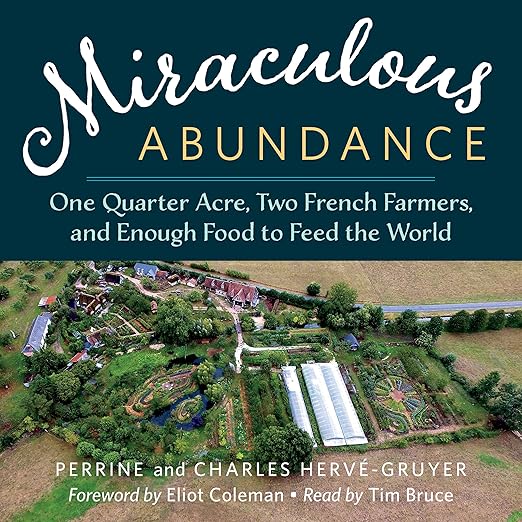
Miraculous Abundance is the memoir of Charles and Perrine Hervé-Gruyer and the creation of Le Ferme du Bec Hellouin, their farm in a historic Normandy village. Neither of them came to farming from farming. Charles had spent years circumnavigating the globe by sail, running an educational program that taught students about ecology and indigenous cultures. Perrine had been an international lawyer based in Japan. They each returned to France at roughly the same time and separately and then together arrived at the question of how to grow food. The book follows that journey from absolute inexperience to a farm that has become a genuine model of ecological agriculture in Europe, connected to national and international food security organizations and featured in the documentary Demain.
Our Take on Miraculous Abundance
The book’s central argument is that small-scale, hand-tool, bio-intensive farming on a quarter of an acre can be economically viable and ecologically transformative. This sounds like wishful thinking, which is why Perrine’s legal training turns out to be such an asset to the book. She is rigorous about evidence. The research the farm has supported, examining how much food a quarter acre of intensively farmed land can actually produce, is presented with the same care she would have given a legal brief. Numbers are cited. Methodologies are explained. The claim that a single farmer can produce a viable income from a fraction of the land that industrial agriculture considers economically irrelevant is not taken on faith.
One reviewer captures the book’s tension well: they came looking for practical ‘hows’ and found themselves initially frustrated by the ‘whys,’ but then found the ‘whys’ were backed by genuine science and forced a re-evaluation of their initial hopelessness about food systems. That arc is built into the book deliberately. Perrine doesn’t separate the philosophical vision from the agronomic practice because she doesn’t believe they can be separated. The vision is why the practice works at the scale and intensity it does. That’s an unusual argument for a farming book, and it’s central to what makes this one different from a permaculture manual.
Why Listen to Miraculous Abundance
Tim Bruce’s narration serves the material well. The book moves between several registers: personal memoir, philosophical reflection, technical farming instruction, and data presentation, and Bruce handles each without losing the thread of the whole. The French proper nouns and place names are handled with enough care to avoid the slight awkwardness that sometimes comes with English narrators working through French material.
At 8 hours and 32 minutes, the book is long enough to develop its argument fully but not so long that it loses its memoir texture. The Chelsea Green Publishing edition, which has championed ecological farming literature for decades, brings credibility to the production. The book belongs to a tradition that includes Gene Logsdon, Wes Jackson, and Wendell Berry, though Perrine’s French context and legal precision give it a distinct voice within that tradition.
What to Watch For in Miraculous Abundance
Listeners who come expecting a practical how-to farming guide will need to adjust expectations. The book is inspirational and argumentative before it is instructional. The specific techniques of bio-intensive farming, permaculture design, and the four-season growing methods the Hervé-Gruyers use are described but not systematically taught. Readers who want actionable cultivation instructions should supplement this with Eliot Coleman’s The New Organic Grower or Jean-Martin Fortier’s The Market Gardener.
The book’s vision of a post-carbon food future is also explicitly utopian in the sense that it describes a world transformed by widespread adoption of what Le Ferme du Bec Hellouin demonstrates is possible. Readers who want to understand whether that transformation is realistic at scale will find the book energizing but not fully satisfying on that question. Perrine is honest about the limits of what demonstration farms prove, which is part of why the book is trustworthy. But the systemic transition question remains open.
Who Should Listen to Miraculous Abundance
This is ideal for listeners interested in sustainable agriculture, food systems, and the intersection of ecological science with personal transformation. It works equally well for people actively considering farming or market gardening who want context and inspiration alongside technical resources, and for readers who care about food security and localization without any intention of farming themselves. If you’ve already read The One-Straw Revolution by Masanobu Fukuoka or Gabe Brown’s Dirt to Soil, this is a natural companion. If you haven’t, it works as a standalone introduction to the idea that small-scale farming done intensively can be more productive and more sustainable than its scale suggests.
Frequently Asked Questions
Is Miraculous Abundance primarily a practical farming guide or a memoir and manifesto?
Primarily the latter. The book is memoir and argument first. Farming techniques are described but not systematically taught. Readers who want actionable growing instructions should supplement this with more technical resources like Eliot Coleman’s or Jean-Martin Fortier’s books. Miraculous Abundance provides the philosophical and scientific case; other books provide the step-by-step.
What is Le Ferme du Bec Hellouin, and why has it become significant in European sustainable agriculture?
It’s a farm in Normandy, France, started by Charles and Perrine Hervé-Gruyer that has become a model of bio-intensive, permaculture-based ecological farming. It has connections to national and international food security research, has been featured in the documentary Demain, and has become a training ground for sustainable agriculture practitioners across Europe.
Does the book address whether small-scale intensive farming can actually replace industrial agriculture at any meaningful scale?
Perrine addresses this honestly and doesn’t overclaim. The farm demonstrates what’s possible on a small intensively worked plot, and the research it has supported shows genuine economic viability at that scale. The book is more modest about what systemic transformation would require and when it might arrive, which is part of why reviewers trust its data.
Is prior farming knowledge required to follow the technical sections of the book?
No. The book is accessible to complete novices, and many reviewers came to it without farming experience. Perrine and Charles themselves began without any, and the book follows the learning curve of that process. Technical concepts are introduced in context rather than assumed.