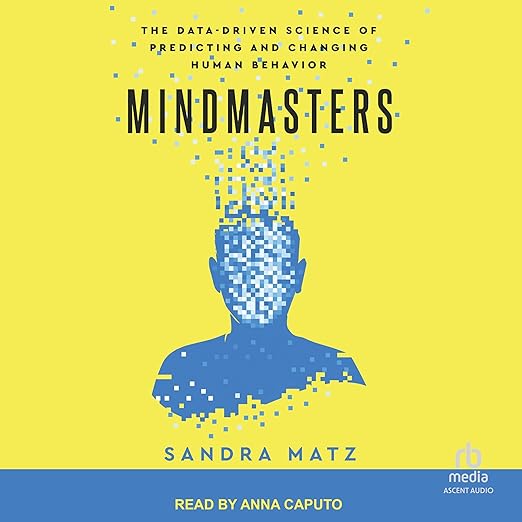
Quick Take
- Narration: Anna Caputo brings warmth and precision to Matz’s academic material, keeping the pace steady without flattening the book’s more unsettling passages.
- Themes: Psychological targeting, data ethics, digital manipulation vs. personal benefit
- Mood: Thought-provoking and occasionally disquieting, but never alarmist
- Verdict: Readers who want a balanced, research-grounded look at how big data shapes human behavior will find this more substantive than most tech-anxiety titles.
I came to Mindmasters during a stretch of weeks when I had been thinking a lot about the recommendation engines that seem to know what I want before I do. I was skeptical of another book about algorithms and manipulation, partly because the genre has a tendency to either catastrophize or shrug. Sandra Matz, a Columbia Business School professor who has spent her career studying psychographics, does neither. She sits in the uncomfortable middle ground and refuses to leave it.
The accompanying PDF is available in your Audible Library, which matters here because Matz deals in data visualizations and case study details that occasionally require a second pass. Anna Caputo’s narration, composed and authoritative without feeling cold, makes the audio version genuinely worth choosing over print for a first encounter with the material.
The Cambridge Analytica Frame, and What Comes After It
Matz opens with the case most listeners will already know: Cambridge Analytica, the British political consulting firm that harvested Facebook data to build psychological profiles for targeted political advertising. It is the right place to start because it grounds the book’s central argument in something real and documented. But Matz is careful not to let that scandal do all the heavy lifting. She uses it as a gateway into a much larger system, one in which our likes, our search histories, our pace of typing, and the language patterns in our posts produce personality profiles accurate enough to predict our behavior better than our own friends can.
What makes the book genuinely valuable is that Matz resists the easy conclusion that psychological targeting is categorically sinister. She spends considerable time on cases where the same techniques have been used for mental health interventions, financial literacy outreach aimed at people showing early signs of financial distress, and social media experiments designed to reduce polarization by serving users content outside their echo chambers. The dual-use problem is the actual subject of the book, and Matz handles it with the rigor you would expect from a researcher rather than a journalist.
When the Science Gets Personal
The chapters on the mechanics of psychographic modeling are where Matz’s academic background becomes most visible. She explains the OCEAN model of personality, the five-factor framework that underpins much of this research, in terms that are clear without being dumbed down. Caputo’s narration earns its keep here. Technical exposition has a way of collapsing in audio when a narrator cannot modulate between explanatory passages and illustrative examples, and Caputo navigates that transition cleanly throughout.
One reviewer called the book’s ability to make complex topics feel accessible its central achievement, and that is fair. But I would add that what Matz is really doing is teaching you to notice the game being played around you. After finishing Mindmasters, I found myself looking differently at the Facebook ads that appeared in my feed, at the timing of promotional emails, at the language choices in political content. That shift in awareness is exactly what a book in this space should produce.
The Redesign Question
The final third of the book is where Matz moves from diagnosis to prescription, and this is also where she is most careful. She does not offer a simple fix. Instead, she argues for transparency at the design level, for regulatory frameworks that require disclosure of targeting criteria, and for individual strategies to introduce friction into your own data footprint. The section on echo chamber disruption is particularly interesting: she describes experiments in which algorithmic intervention actually moved participants toward more nuanced political views. It is a rare piece of evidence that the technology can be pointed in the other direction.
At six hours and eight minutes, Mindmasters does not overstay its welcome. It is the rare tech-ethics book that respects your time while still leaving you with enough to think about. The PDF companion is worth downloading before you start listening if you prefer to read alongside the audio on denser passages.
Who Should Listen and Who Should Skip
Listen if you work in tech, marketing, public policy, or mental health and want a research-grounded framework for thinking about psychological data. Listen if you have ever wondered how Cambridge Analytica actually worked, or why your social media feed feels like it understands you better than it should. Skip if you are looking for either a full-throated condemnation of surveillance capitalism or a tech-optimist celebration of personalization. Matz’s nuanced middle position may frustrate readers who came to have their existing views confirmed.
Frequently Asked Questions
Is Mindmasters primarily about political manipulation or does it cover commercial uses of psychological targeting as well?
Both, and that breadth is one of the book’s strengths. Matz uses Cambridge Analytica as a starting point but spends substantial time on commercial advertising, mental health interventions, and financial behavior nudges. The political angle is the hook, not the whole story.
Does Anna Caputo’s narration work for this kind of academic nonfiction?
Yes. Caputo maintains a composed, measured pace that suits the research-heavy material. She does not dramatize the more alarming passages, which actually makes them land harder.
Is the accompanying PDF essential for following the audiobook, or can you skip it?
For most listeners, the audio stands on its own. The PDF companion contains charts and supplementary data that reinforce the text, so it is worth downloading if you plan to revisit specific sections or use the book professionally.
How does Mindmasters compare to other books on surveillance capitalism, like Shoshana Zuboff’s work?
Matz is more concise and considerably more measured. Zuboff’s The Age of Surveillance Capitalism is a structural critique of an entire economic system; Mindmasters is focused on the psychological mechanisms of targeting and offers more explicit guidance on what individuals and institutions can do about it.