Quick Take
- Narration: Joel Richards brings a calm, instructional tone that suits the Dummies series format well, though listeners will benefit from pausing to absorb the step-by-step guidance.
- Themes: Low-code business intelligence, Power Platform ecosystem, enterprise automation
- Mood: Accessible and methodical, with a consultant’s patience
- Verdict: A solid quick-start guide for Power Platform newcomers, best suited to listeners who want conceptual orientation before diving into hands-on work.
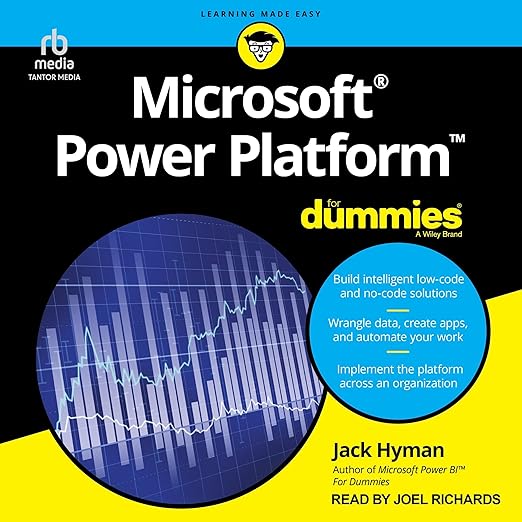
I finished this one on a Friday afternoon after a week of fielding questions from a colleague who had just been handed a Power Platform implementation project and had no real background in Microsoft’s BI ecosystem. She wanted one resource that would orient her before the vendor calls started, and Microsoft Power Platform for Dummies was what I pointed her toward. Jack Hyman’s author credentials here are specific enough to matter: this is someone who has worked inside large organizations helping them actually adopt these tools, not an academic who surveyed the landscape from a distance.
At just under thirteen hours, this is on the longer end for a Dummies-series audiobook, which typically prioritize accessibility over depth. The length reflects the breadth of what Power Platform actually covers: Power BI for data management and reporting, Power Apps for no-code application building, Power Pages for web properties, and Power Automate for workflow automation. That’s four distinct tools under one umbrella, and Hyman moves through each with appropriate but not excessive attention.
The Consultant’s Perspective as a Differentiator
What separates this from a documentation read-through is Hyman’s consistent attention to the organizational context in which these tools get adopted. He is not just explaining how to build a Power Apps canvas app; he is explaining why organizations choose to build one, what the governance questions look like before you go live, and what the current best practices are for launching Power Platform in a way that doesn’t create a compliance problem six months later. That perspective is the reason a business consultant wrote this rather than a technical writer, and it shows throughout the narration.
The reviewer who noted it is “more conceptual than most Dummies books” is accurate, and that is not a criticism. Pure step-by-step tutorials are poorly suited to audio because the listener cannot follow along with a screen. Hyman’s tendency toward conceptual framing is exactly what makes this version listenable. You understand what Power Automate is trying to accomplish and where it fits in a modern enterprise workflow before you hear about the specific interface steps, which means the technical details land with context rather than floating free.
Where the Audio Format Adds and Subtracts
Joel Richards narrates with a reliable professionalism that I associate with instructional technical content. He does not dramatize, which is appropriate for the material. The Dummies series has a characteristic register, a deliberate non-condescension toward beginners that Hyman writes in and Richards delivers without over-performing it.
The format works well for the conceptual and strategic sections and less well for the most granular interface guidance. Hyman does include step-by-step instructions for navigating the interface and setting up tools, as the synopsis promises, and those sections will send most audio listeners to a laptop or tablet to follow along. That is not a failure of the book; it is just the reality of technical instruction in audio form. Listeners who treat this as a conceptual orientation rather than a hands-on tutorial will have the best experience.
Sixteen Reviews and What They Signal
The low review count of 16 is worth noting because it limits the signal value of the 4.6 rating, but what the reviews say is consistent. The reviewer who flagged it as a “fantastic resource for functional analysts, citizen developers, and tech enthusiasts” is describing the precise audience Hyman wrote for. These are not deep-stack developers; they are the people in organizations who end up owning these tools because they’re technically confident enough to use them but not engineering-trained. Power Platform’s explicit mission is to serve that population, and this book meets them where they are.
The print-quality criticism in one review reflects a separate physical edition issue that is irrelevant to the audio experience. The audio production quality is clean throughout.
Scope and Shelf Life
Power Platform changes frequently, and Hyman’s treatment of current best practices will have some shelf life considerations. The conceptual framework, the logic of why low-code tools matter and how they fit into enterprise BI strategy, will remain relevant longer than specific interface screenshots or feature descriptions. Listeners building a mental model of the Power Platform ecosystem will find this useful even after specific details have shifted in subsequent product updates.
Listen if you are a functional analyst, project manager, or business stakeholder who needs to understand Power Platform before your organization commits to it or expands its use. Skip this one if you need hands-on certification prep or deep technical documentation for a specific tool; that work requires a screen alongside you regardless of which learning resource you choose.
Frequently Asked Questions
Does this audiobook cover all four Power Platform tools, or does it focus on Power BI?
The book covers all four major components: Power BI for data and reporting, Power Apps for no-code app development, Power Pages for web properties, and Power Automate for task automation. Hyman gives each meaningful attention, though the depth per tool is necessarily shallower than a single-tool deep-dive would be.
Is this suitable for someone with no Microsoft 365 background at all?
Yes, broadly. Hyman is a business consultant who has worked with large organizations adopting these tools, and he writes with the awareness that his readers are entering from varied technical backgrounds. The conceptual framing accommodates genuine beginners, though listeners will benefit from having access to a Power Platform trial environment to follow along with the hands-on sections.
How does Joel Richards’ narration handle the Microsoft-specific technical terminology?
Richards delivers the technical vocabulary cleanly and without awkwardness, which matters for terms like Dataverse, canvas apps, and cloud flows that appear throughout. The narration is clear and professional without being dry to the point of disengagement.
Will the content be outdated given how rapidly Power Platform evolves?
Some specific interface details and feature names will have changed since publication. The strategic and conceptual content, why organizations adopt these tools, how to govern them effectively, and how they relate to each other, remains durable. Treat this as an orientation and complement it with Microsoft’s own documentation for current feature specifics.