
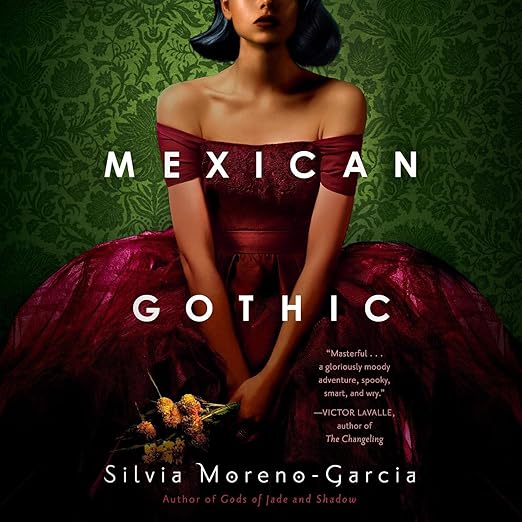
The Short Version
- Narrator: Frankie Corzo's performance is well-matched to Silvia Moreno-Garcia's prose, grounding Noemí's voice in a period-appropriate Mexico City register before the narrative pulls her into the mansion's disturbing atmosphere.
- Subjects: Colonial violence and its biological persistence, the seductive danger of gothic spaces, a woman's will against systems designed to contain her
- Tone: Slow-burn and atmospheric, building into something genuinely strange and unsettling
- Bottom line: A landmark of contemporary gothic fiction that rewards patient listening and leaves a mark long after it ends.
I listened to Mexican Gothic over three evenings in late autumn, which was exactly the right conditions. Silvia Moreno-Garcia's novel needs a certain quality of attention, the kind that comes when the house is quiet and you are not multitasking. The first third is all atmosphere and setup, and if you try to rush it, you miss the way the dread accumulates before you realize it has accumulated. By the time the novel reaches its genuinely strange middle and final sections, the unease has been so carefully constructed that it does not feel like a shock so much as an arrival at a destination the story has been building toward all along.
Noemí Taboada is a glamorous Mexico City socialite, comfortable in cocktail parties and designer gowns, who travels to High Place, a decaying English mansion in the Mexican countryside, to rescue her newly-wed cousin from a letter that sounds increasingly desperate. The Doyle family, English settlers whose mining wealth has rotted into something darker over generations, is watching Noemí from the moment she arrives. The patriarch is fascinated by her. The charismatic son is menacing. And the youngest, Francis, wants to help but seems paralyzed by something he cannot name.
The Guardian's summary, "Lovecraft meets the Brontes in Latin America," is accurate as far as it goes, but it undersells what Moreno-Garcia adds to both reference points. The Lovecraftian elements, fungal horror, psychic contamination, the slow corruption of boundaries between self and environment, are reframed here through a lens that implicates colonialism directly. The house is not simply haunted; it is the architectural expression of a specific historical violence, and the family that built it carries that violence in their bodies. This is a more precise argument than most genre horror bothers to make.
One reviewer describes feeling an "immediate pang" upon finishing, missing the novel's world despite its horror. That response is the most accurate description of what Moreno-Garcia achieves: she makes you want to remain inside something genuinely disturbing, which is one of the oldest effects gothic fiction aims for and one of the hardest to pull off in contemporary form. The Nerdist quote in the synopsis, calling it "hypnotic and engaging," matches my own experience across two listens.
Why Mexican Gothic Works as an Audiobook
Frankie Corzo's narration is a strong match for the material. Noemí is rendered as fully present in her own glamour and intelligence before the house begins its work on her, which is essential: the arc only lands if we have a vivid sense of who Noemí is before she starts to be worn down. Corzo captures the period register of 1950s Mexican high society without affectation, and her voice in the later sections, when Noemí is genuinely frightened and increasingly uncertain of her own perceptions, earns that shift because of how solidly she established the baseline character.
At just under eleven hours, the pacing rewards audio listening specifically. Moreno-Garcia's prose has a quality that is absorbed rather than consumed: sentences that reward hearing rather than scanning. The descriptions of the house, the gardens, the wallpaper, the dream sequences, all of these are rendered with a sensory specificity that Corzo delivers without over-performing. It is a restrained performance in service of atmospheric material, and that restraint is exactly right.
Weak Spots in Mexican Gothic
The slow-burn opening is not for everyone. Multiple reviews acknowledge that the first quarter of the novel moves deliberately, prioritizing atmosphere over event. Listeners conditioned by fast-opening contemporary thrillers may find the setup extended. This is the cost of the experience Moreno-Garcia is building, and it is worth paying, but knowing it in advance helps calibrate what the first two hours are actually doing and why.
The horror elements in the final third are genuinely strange and, for some listeners, unsettling enough to affect sleep. One reviewer mentions being reminded of Stranger Things and notes she avoids horror for this reason. Mexican Gothic is not a cozy gothic; it goes somewhere dark and stays there. Readers who came for historical fiction with a gothic tinge and were not expecting full horror should be prepared for the genre's more disturbing registers.
The Right Listener for Mexican Gothic
Readers of gothic fiction, particularly those who came through Shirley Jackson, Daphne du Maurier, or contemporary authors like Paul Tremblay, will find this essential. It also works for listeners interested in postcolonial historical fiction who are willing to engage with horror as the vehicle for that critique. Those wanting fast-paced thriller mechanics or romance-forward gothic should look elsewhere. This is for patient listeners who want an experience that lingers for days after the final chapter.
Questions Listeners Ask
Is Frankie Corzo's narration appropriate for a protagonist who is glamorous and sophisticated rather than ingenue-like?
Yes. Multiple listeners praise Corzo's ability to establish Noemí as fully realized in her own confidence before the house begins to erode her. The narration avoids the wide-eyed ingenue register that would undermine Noemí's character throughout the novel.
Does Mexican Gothic have a sequel or companion novel?
As of this writing, Mexican Gothic is a standalone novel. Moreno-Garcia has written other books set in Mexico with supernatural elements, including Gods of Jade and Shadow, but they are separate stories rather than direct continuations.







