Quick Take
- Narration: Gary Dana delivers Finkelstein’s dense, citation-heavy prose with clarity and appropriate gravity; he does not editorialize, which is the right call for material this charged.
- Themes: Gaza blockade, Israeli military strategy, international accountability mechanisms
- Mood: Measured and prosecutorial, cool in register even when the subject matter is not
- Verdict: A tightly argued, relentlessly sourced analysis of three Israeli military operations against Gaza that is more useful as a policy analysis than as a standalone introduction to the conflict.
I was partway through a long commute when I put on this one, and by the end of the first chapter I had pulled over to take notes on my phone. Norman Finkelstein writes with the precision of someone who has spent decades anticipating every possible counter-argument, and the effect in audio is unusually concentrated. At just under four hours, this is among the shortest audiobooks I have reviewed in this category, and the brevity is not a concession to accessibility. It reflects a decision to do one thing and do it completely.
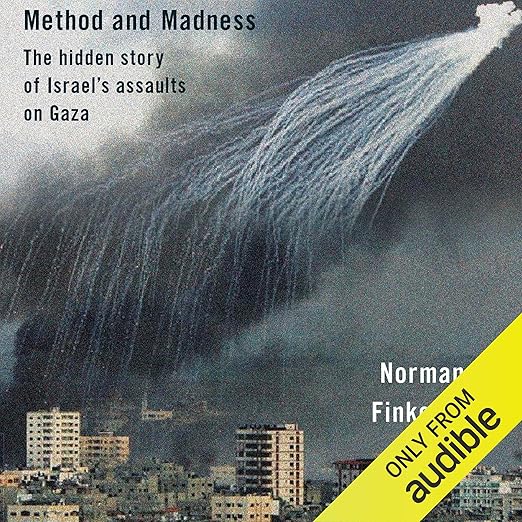
The book’s subject is the three major Israeli military operations against Gaza between 2008 and 2014: Cast Lead, Pillar of Defense, and Protective Edge. Finkelstein’s argument, developed with characteristic methodological care, is that these operations were not the product of irrational aggression, despite Israeli officials occasionally framing them that way, but rather the product of a coherent if brutal strategic logic aimed at preventing a viable peace compromise from emerging.
The Rational Actor Argument and Why It Unsettles
The most provocative move in the book is Finkelstein’s insistence on reading Israeli military policy as rational. Most critics of the operations focus on disproportionality and civilian casualty figures, and Finkelstein covers that ground, but his distinctive contribution is the structural analysis: he argues that a state whose leadership openly courts the perception of unpredictability and excessive force is not acting pathologically. It is acting strategically, calibrating violence to achieve political ends that diplomacy could not.
The Tzipi Livni quote that opens this section of the book, in which Israel’s then-foreign minister boasted about demonstrating real hooliganism during Cast Lead, is one of those moments where primary source material does more work than any secondary analysis could. Finkelstein is at his best when he steps back and lets the record speak, then provides just enough analytical scaffolding to show what the record actually demonstrates. The ratio of quotation to interpretation here is higher than in his longer works, and in audio that balance is particularly effective: you hear the evidence before you hear the conclusion.
The Goldstone Report and the Accountability Gap
A substantial section of the book examines the 2009 UN-sponsored Goldstone report and its aftermath, including Justice Goldstone’s later partial retraction of some of his findings. Finkelstein’s handling of this episode is careful and, for listeners sympathetic to his broader argument, will feel important: he documents in some detail how international accountability mechanisms were navigated, stalled, or selectively invoked in ways that effectively insulated conduct from meaningful legal consequences.
The Turkey-flotilla section, covering the killing of Turkish citizens in the 2010 attack on the Gaza freedom flotilla, is shorter but follows the same structure: incident, international response, outcome, structural explanation for why the outcome took the form it did. Finkelstein is not producing a polemic in the pejorative sense. He is producing an argument that moves through evidence methodically and arrives at conclusions that the evidence, as he presents it, supports.
The reviewer on this platform who noted that Finkelstein misses the angle of Gaza’s offshore natural gas reserves was raising a legitimate gap. Finkelstein’s framework is primarily political and strategic; the economic dimension of the blockade, including control over resource development, is not integrated into his analysis here, and some listeners will find that omission meaningful.
The Final Chapter: Nonviolent Strategy as Prescription
The book ends with a brief but substantive argument that mass nonviolent protest offers more viable prospects for Palestinian political advancement than military resistance. This prescription is more tentative than the analytical sections that precede it, and Finkelstein is careful to frame it as a strategic rather than a moral claim. The logic is essentially game-theoretic: nonviolent mass action forecloses certain response options that armed resistance does not, and shifts the calculus of international opinion in ways that matter for accountability mechanisms.
Whether listeners find this conclusion satisfying will depend partly on their prior assumptions about what political change in this context is actually achievable. Finkelstein is honest about the limits of the argument. He does not promise outcomes, only probabilities.
It is worth noting what the book deliberately excludes. Finkelstein is not writing a comprehensive history of the conflict or of Gaza’s population. He is not humanizing the individuals caught inside the operations he analyzes, which is a choice some listeners will find clinically cold. Journalists like Rami Khouri or scholars like Sara Roy have produced work that brings the human dimension of the blockade into focus in ways that Finkelstein, operating in a different register, does not attempt. The two bodies of work are complementary rather than competing, and listeners who find this book’s prosecutorial mode compelling would do well to read Finkelstein alongside accounts that keep individual lives in the foreground.
Who This Book Is and Isn’t For
This is well suited for readers already familiar with the Israeli-Palestinian conflict who want a precise structural analysis of the 2008-2014 operations; policy researchers interested in how international accountability frameworks perform under pressure; and listeners who appreciate dense, citation-driven argumentation rather than narrative journalism. It is less well suited for listeners approaching the conflict without substantial background, who will lack the contextual knowledge to evaluate the argument’s premises, or for readers looking for humanizing storytelling alongside the analysis. Gary Dana’s clear, unadorned delivery serves the material well throughout, making the four-hour runtime feel concentrated rather than rushed.
Frequently Asked Questions
Does the book require prior knowledge of the Israeli-Palestinian conflict to follow the argument?
A working familiarity with the basic geography and political background is helpful. Finkelstein assumes the listener knows what the Gaza blockade is, who the major political actors are, and what the Goldstone report was. Listeners without that foundation may find the first chapter disorienting before the argument becomes clear.
How does Finkelstein handle the Goldstone report’s partial retraction in the 2009 aftermath?
He documents it carefully and treats it as evidence of the political pressures bearing on international accountability mechanisms rather than as a factual recalibration of the underlying events. He separates what Goldstone walked back from what the report originally established and argues that the retraction was strategically significant beyond its factual content.
Is the book’s argument that Israeli operations were ‘rational’ an endorsement of those operations?
Finkelstein is explicit that rational strategy and moral justifiability are separate questions. His claim is analytical: that the operations followed a coherent logic aimed at foreclosing peace compromise, not that this logic was defensible. The Livni quote he foregrounds is used to illustrate Israeli self-framing, not to endorse it.
At under four hours, does the audio feel rushed or incomplete?
It is dense rather than rushed. Finkelstein has deliberately constrained the scope to three operations and their immediate international aftermath. The brevity reflects editorial discipline rather than thinness of argument. Listeners wanting broader historical context for the conflict will need to supplement this with other material.