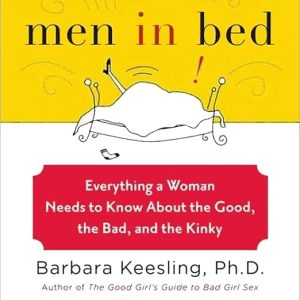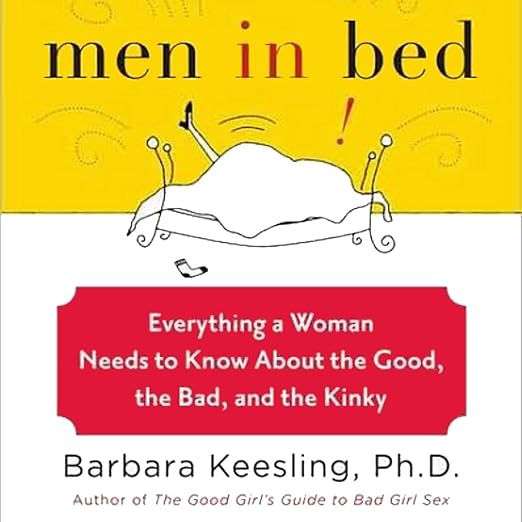
Barbara Keesling earned a PhD in health psychology after a career as a sexual surrogate partner, which gives her a biographical claim to expertise that most sex education authors cannot match. Men in Bed, narrated by Judith West, represents that accumulated knowledge in audiobook form: a practical guide to the physical and psychological causes of common male sexual difficulties, addressed to women who want to understand and navigate these realities in their own relationships. At 8 hours and 49 minutes, it is a substantial listen that covers considerably more territory than most titles in this category manage.
The core premise is direct. Women today, as Keesling notes in the opening, have on average more sexual partners and experiences than their mothers' generation, yet they are just as likely to encounter confusion, insecurity, and surprise about what actually happens in a sexual relationship. The gap between media representations of sex and the reality of human bodies behaving imperfectly is the problem Keesling spends the book addressing. The audiobook's value is proportional to how squarely it faces that gap rather than pretending it does not exist.
Judith West Threads Clinical and Suggestive Tones
Judith West's narration is a significant asset here. Sex education content is notoriously difficult to narrate well. A tone that is too clinical risks making the material feel cold and academic. A tone that leans toward the suggestive undermines the educational intent. West threads this needle effectively, reading Keesling's anecdotes and technical explanations with the same warm pragmatism that characterizes the best health education writing. Over nearly nine hours, maintaining that register consistently is not trivial, and West does it without audible strain. Her delivery also contributes meaningfully to the book's accessibility: the subject requires a narrator who can treat the physiological and the emotional as equally legitimate, and West accomplishes this throughout without a single section feeling like an awkward gear change.
Keesling's approach throughout is to treat sexual function as exactly what it is: a physiological and psychological system with specific failure modes and specific remedies. The book covers erectile difficulties, premature ejaculation, and the emotional dimensions of sexual self-consciousness with equal practical attention, offering both explanatory frameworks and hands-on techniques. Reviewers describe the author as "insightful and fun," which is an accurate summary of the tone: serious enough to be useful, warm enough to be readable. One reviewer specifically notes its value for presenting different perspectives, which is a fair characterization of the anecdote-heavy approach Keesling uses throughout.
Practical Advice Grounded in Real Clinical Experience
The case for this audiobook rests on Keesling's genuine clinical experience combined with her ability to write for a general audience without condescending to it. The anecdotes drawn from her years as a sex educator and therapist give the abstract advice grounding in actual human behavior, and the advice on how to have effective conversations with a partner about sexual needs and difficulties is as valuable as any of the specific techniques she describes.
The comprehensive coverage of male sexual issues means there is likely something here for most women who pick it up, regardless of whether their specific concern is addressed in the title. The advice on positions, techniques, and communication strategies is practical and specific rather than vague and theoretical. At 8 hours and 49 minutes, the length allows Keesling to address topics that shorter guides must either skip or treat superficially, and the audiobook is structured so that chapters can be revisited selectively as circumstances warrant.
From Surrogate Work to a PhD in Practice
The format also has a practical advantage for this kind of content: audio is easier to engage with privately than print, and a subject this personal benefits from that lower barrier to access. West's narration makes it comfortable to listen to while doing other things, which is a meaningful quality-of-life factor for an educational text you might return to more than once. The detail that Keesling earned her credentials by starting as a sexual surrogate partner before completing a PhD in health psychology also matters here: this is someone who has approached the subject from both the experiential and the academic direction, and that double foundation gives the material a texture that purely academic sex education writing tends to lack.
Written for Novices, Framed for Heterosexual Couples
One reviewer notes explicitly that the book is written for a novice, and that characterization is worth taking seriously before committing to a nine-hour listen. Keesling covers a lot of ground at an introductory level. For listeners with existing knowledge of sexual health and physiology, the early chapters may cover familiar terrain. The book is most valuable to readers approaching the subject for the first time or returning to it after a long gap, and less targeted to those with substantial prior reading in this area.
The framing is also consistently addressed to a heterosexual female reader whose partner is male. The advice is applicable beyond this context in many places, but the book does not make systematic effort to address same-sex relationships or non-binary experiences. Readers whose circumstances differ from the default frame will need to do some interpretive work.
Best for Women New to Sexual Health Education
This audiobook is for women who want a clear, evidence-grounded understanding of male sexual function and the practical tools to navigate difficulties with a partner. It is most valuable for readers who are approaching this subject without prior formal education in sexual health, and for anyone whose relationship has encountered the specific challenges Keesling addresses. Those with existing knowledge of sexual psychology and physiology may find the foundational sections cover ground they already know well. The audiobook is explicit in content and frank in language, and is intended for adult listeners who are looking for practical education rather than light entertainment.
Key Details
- Narration: Judith West delivers Barbara Keesling's clinical-friendly sex education material with warmth and directness, a voice that conveys competence and accessibility in equal measure across nearly nine hours of detailed content.
- Themes: male sexual dysfunction, female sexual satisfaction, couples communication
- Mood: Informative and frank, practical rather than sensational
- Verdict: Barbara Keesling's audiobook brings genuine expertise to a subject often handled superficially, though experienced listeners may find the foundational chapters cover familiar ground.
Is this audiobook suitable for someone with no prior reading on sexual health or psychology?
Yes, and that is Keesling's intended audience. The book is structured for readers approaching the subject for the first time or returning to it with limited formal background. The explanations are thorough and do not assume prior knowledge of physiology or sexual psychology.
How explicit is this audiobook, and is it primarily educational or erotic?
The content is explicit in that it describes sexual anatomy, techniques, and dysfunction in direct language, but the framing is consistently educational throughout. Barbara Keesling writes from a clinical and therapeutic background, and Judith West's narration maintains that professional register across the full length. This is a sex education title, not erotica.
Does the audiobook address communication strategies between partners, or only physical techniques?
Both. Keesling explicitly includes guidance on how to have effective conversations with a partner about sexual needs, difficulties, and desired changes. The communication chapter is considered one of the book's stronger sections by reviewers who describe it as a practical toolkit for conversations that many couples find difficult to initiate.
At nearly nine hours, is there enough new information throughout to hold interest, or does it become repetitive?
The length is a function of comprehensive coverage rather than repetition. Keesling addresses distinct topics across the full runtime, and the anecdote-heavy approach means even familiar subjects are illustrated with varied examples. That said, one reviewer notes the book is aimed at novices, so experienced readers may find the introductory level a pacing concern in the earlier chapters.