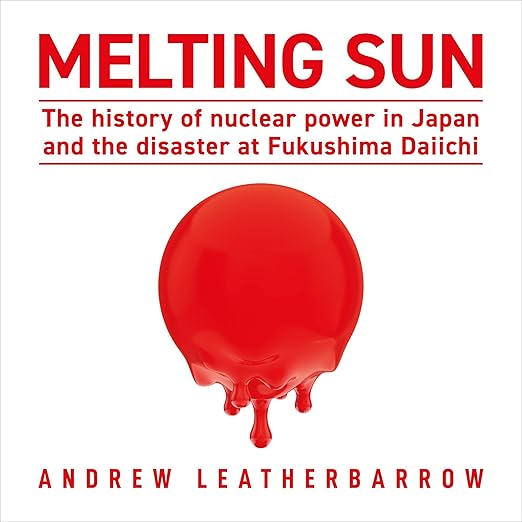
Quick Take
- Narration: Nick Gallagher handles the book’s dual registers, technical nuclear history and human catastrophe, with a steady, unflashy competence that lets the material carry its own weight.
- Themes: nuclear risk, institutional failure, Japan’s complicated relationship with atomic energy
- Mood: Methodical and quietly harrowing, building dread across 150 years before arriving at three melting reactor cores
- Verdict: Leatherbarrow’s Fukushima account is the rarest kind of disaster history: one that actually explains how a disaster becomes possible before it shows you one happening.
I was in Paris when the Fukushima disaster unfolded in March 2011. I remember watching the footage on a small television in a rented apartment, the helicopter shots of the reactor buildings going dark, the incomprehensible scale of the tsunami, the sense that the world was watching something unfold in slow motion that would have consequences nobody could fully calculate yet. I returned to that week many times while listening to Melting Sun, Andrew Leatherbarrow’s sixteen-hour account of how Japan got to that moment and what it meant afterward. It is a different experience to understand something than to merely witness it.
Leatherbarrow’s previous book, Chernobyl 01:23:40, established him as a writer willing to put in the archival work that disaster history requires without letting the data swallow the human stakes. Melting Sun takes a more panoramic approach: 150 years of Japanese nuclear history rather than the tight focus on a single night. This is a more ambitious project, and it mostly succeeds.
How Japan Became Nuclear’s True Believer
The historical arc that Leatherbarrow constructs before he arrives at 2011 is the book’s most original contribution. Japan is, as the synopsis notes, the only nation to have suffered atomic attack. How a country goes from Hiroshima and Nagasaki to becoming one of the world’s most enthusiastic adopters of nuclear power is a story that requires genuine explanation, not just assertion. Leatherbarrow traces the political, economic, and cultural mechanisms of this transformation with careful attention to the interests that shaped public perception, including the role of government promotion, media management, and deliberate suppression of safety concerns.
The nuclear ship sequence, a vessel that leaked radiation on its maiden voyage and was stranded at sea while the country decided what to do with it, functions as an early warning that the book argues was structurally ignored. Leatherbarrow is not writing a conspiracy theory; he’s writing an institutional history, and the distinction matters. The failure at Fukushima was not caused by villains but by a system of incentives, regulatory capture, overconfidence, and what he calls collusion that made catastrophic failure not just possible but, in retrospect, almost inevitable.
The Sixteen-Hour Structure and How It Earns Its Length
At sixteen hours and three minutes, Melting Sun is a significant time commitment. The question any audiobook of this length has to answer is whether the scope is justified. I think it is, though with a caveat. The historical chapters covering Japan’s pre-Fukushima nuclear relationship are slow to build, and listeners who came specifically for the 2011 disaster account may find the first third testing their patience. Those who stay with it will find that the payoff is genuine: by the time Unit 1 explodes and shards of irradiated concrete knife through the air, Leatherbarrow has built the context that makes the explosion feel like a consequence rather than a random catastrophe.
Nick Gallagher’s narration is well-suited to the material’s demands. He never sensationalizes, which is the right call for a book that is making a structural argument about institutional failure. The opening passage, describing the explosion with precise physical detail, is handled with a restraint that makes it more disturbing than theatrical delivery would. Gallagher’s pacing is measured throughout, which occasionally feels slow during the densest historical passages but proves itself when the timeline accelerates toward March 2011.
The Human Cost at the Book’s Core
One of the most affecting threads in Melting Sun involves two men who received extreme radiation exposure during the disaster response. Leatherbarrow handles their final days with care, resisting both clinical detachment and exploitation. It is the most difficult section of the book to listen to, and the most important. The men who worked inside Fukushima Daiichi during and after the meltdown were not abstractions. They were fire crews with shredded hoses, plant workers making decisions without adequate information, people operating in a situation their training had not genuinely prepared them for because their institutions had not genuinely prepared their training.
The comparison to Chernobyl is made explicit in the synopsis and is worth examining. The two disasters share a family resemblance: both involve institutional overconfidence, both involve systems that were defended as safe past the point of honest assessment, and both involve the gap between what official communications said and what was actually happening. But Leatherbarrow is careful to preserve the specificity of each. Fukushima is not Chernobyl in a different country. It is a product of Japan’s particular relationship with nuclear energy, its regulatory structures, and its cultural norms around acknowledging institutional failure.
Who This Book Rewards Most
Melting Sun is essential listening for anyone who wants to understand nuclear risk not as a technical problem but as a human and institutional one. It will be slower going for listeners who want a straight disaster narrative. The depth of historical context that makes the book’s argument coherent is also what makes it demanding. Reviewer Tanner and Hayley call it “superbly researched, highly detailed, and yet very accessible,” which captures the balance Leatherbarrow achieves. It is not always comfortable listening. That is the point.
Frequently Asked Questions
Does Melting Sun require scientific knowledge about nuclear power to follow?
No. Leatherbarrow explains the relevant technical concepts accessibly throughout. The book’s argument is more about institutional and governance failure than nuclear physics, so a general listener will follow the core claims without difficulty.
How does Melting Sun compare to Leatherbarrow’s Chernobyl book?
Melting Sun is more historically ambitious, spanning 150 years rather than focusing on a single event night. Readers who loved the tight, clock-driven structure of Chernobyl 01:23:40 may find the broader scope here less immediately gripping, but ultimately more illuminating as an argument about how nuclear disasters become possible.
Is Nick Gallagher’s narration appropriate for the emotional weight of the disaster sequences?
Gallagher’s approach is measured and restrained, which suits the book’s analytical register. He does not perform grief or horror theatrically. Some listeners may want more emotional expressiveness during the human-cost sections, but his control prevents the narration from tipping into exploitation.
Does the book take a clear position on nuclear power, or does it present the debate as open?
Leatherbarrow is documenting failure, not making a broad argument against nuclear energy. The book is critical of the specific institutional arrangements that made Fukushima possible, particularly regulatory capture and the suppression of safety concerns, without rendering a verdict on nuclear power as a technology.