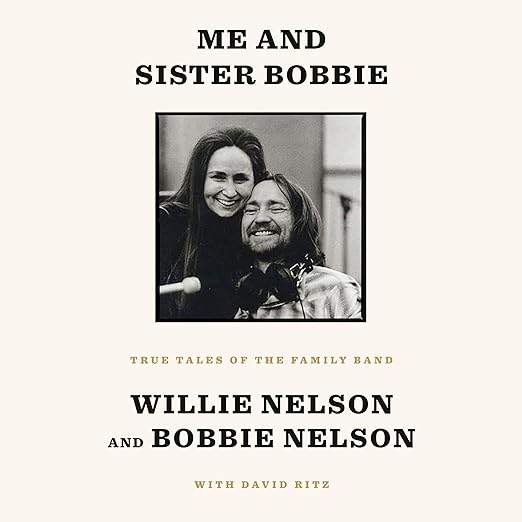
Two people take turns telling the same childhood, and the gap between their versions is the reason this audiobook exists. Willie and Bobbie Nelson were abandoned by their parents as toddlers and raised by their grandparents in a small Texas town, where music found them almost immediately. The memoir alternates chapters between the two of them, the same years seen from two seats, and the description is careful to note that this is Bobbie's only memoir. That detail matters more than it looks. One of these two has been telling his story in public for most of his adult life, and the other has not.
How Me and Sister Bobbie Holds Up
Alternating chapters do something a single-voice memoir cannot. A shared event arrives twice, and the second pass keeps adjusting the first, so the book accumulates its meaning by revision and never by climax. A five-star filed in January 2021 puts a finger on exactly that, saying the pleasure came from the format itself, Willie writing and then Bobbie telling her side, and calling the beginnings humble and sad and the journey afterward hard to believe. That is not a small compliment for a book with almost nine decades to cover in under seven hours.
What keeps it from turning into a lap of honor is how much of the running time belongs to Bobbie. The description says her chapters take on her personal relationships, her life as a mother, and a musical career that only took off once attitudes toward women in Texas began to shift. It also records that her technical ability at the keyboard exceeds her brother's, by his own admission. A celebrity memoir that hands its best musician the quieter half of the book is doing something more interesting than a victory lap.
The voice on it belongs to Willie Nelson, and the pairing is obvious enough that it barely needs defending: the cadence that made the songs is the cadence the prose was written in. Six hours and fifty-six minutes of it, from Random House Audio in September 2020. What the credit does not settle is the question underneath the whole structure, which the caveats section below has to take up.
Why Me and Sister Bobbie Works as an Audiobook
Press quoted on the page runs unusually consistent for a musician's memoir. The New Yorker called it tender and intimate; the New York Journal of Books called it poignant, beautiful and heartfelt; Rolling Stone and Kirkus Reviews both put it among the best music books of their year. Those are all reactions to register, not to revelation, which tells you what kind of book this is. Nobody is promising scandal. They are promising that two people who have been through a great deal will describe it without raising their voices.
A five-star from November 2021 makes the same point from the other end, praising the way the pair tell one story from two perspectives and finding all of it positive in spirit. A four-star from October 2020 is the most useful entry on the page, because instead of adjectives it copies out a line from the book itself, the explanation behind the name of Willie's ranch: when you are here you are in Luck, and when you are not, you are out of Luck. That is the exact register of the thing, a joke told slowly by somebody who has earned the right to tell it.
And the emotional weight is real. Both of them supported each other through personal heartbreak the copy declines to soften, and the through-line the publisher chooses, that family always finds the way, gets tested hard enough over nine decades to mean something by the end. Under seven hours is a merciful length for that material. It moves.
Weak Spots in Me and Sister Bobbie
Start with the numbers, because they do not hold together. The badge shows 4.8 and the counter beside it records one rating. Meanwhile five written responses are visible, graded five, five, five, four and five, and those add to twenty-four, which divided by five is exactly 4.8. So the displayed average is the mean of a column of five while the counter insists only one person voted. One of those two fields is wrong, and a buyer has no way to know which.
This column has a second problem. Its most recent five-star is headlined as wonderful service and spends its entire body on delivery, praising a parcel that reached New Zealand from America inside a week. That is a compliment to a courier. Nothing in it can be verified by anyone downloading a file, and it is carrying the same weight as every other grade in the column.
Then the structural question. This is a dual memoir with alternating first-person chapters, half of them belonging to Bobbie, and the reader slot on this record names one person. Either a second voice is present and goes uncredited, or one narrator delivers both siblings, and the page never says which. For a book whose entire architecture depends on two people sounding different from each other, that is the single most useful fact the listing withholds.
The Right Listener for Me and Sister Bobbie
Country music listeners are the obvious constituency, though the book is less about songwriting than about the household the songwriting came out of. Anyone drawn to sibling stories, to Depression-era Texas childhoods, or to memoirs where two accounts of the same afternoon refuse to match will find plenty here. It also works as a gentler entry point for listeners who have avoided musician memoirs because they expect tour anecdotes and grievance.
Anyone hunting for a discography walkthrough or a settling of scores should look elsewhere, and so should listeners who need a memoir to build toward something. This one circles instead, revisiting the same decades from two chairs. What it offers is a pair of voices in a room, one of which has never had a book to itself before, and that turns out to be worth the seven hours.
Before You Listen
How is the Me and Sister Bobbie audiobook structured?
As alternating chapters. Willie takes one, Bobbie takes the next, and both cover the same stretch of years from their own side. The description confirms this is Bobbie's only memoir, so her chapters carry material that has never appeared under her name before.
How long is the recording and who released it?
Just under seven hours, and Random House Audio put it out in September 2020. That is brisk for a life spanning almost nine decades, and the pace shows: each chapter hands off to the other sibling before it can settle into anything.
Does this audiobook cover Willie Nelson's music career?
Partly, though the family is the subject. The copy tracks their earliest public performances, his songwriting years, and her double life raising children while playing professionally, a career the publisher ties to a shift in how Texas regarded women.
How was the book received when it appeared?
Warmly, on the evidence quoted. Two outlets, Rolling Stone and Kirkus Reviews, named it among the year's best music books, and the notices picked out by the publisher settle on words like intimate and heartfelt. Every verdict reproduced there answers the manner of the telling, and not one of them promises disclosures.