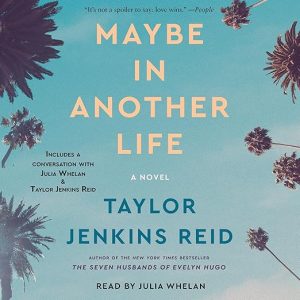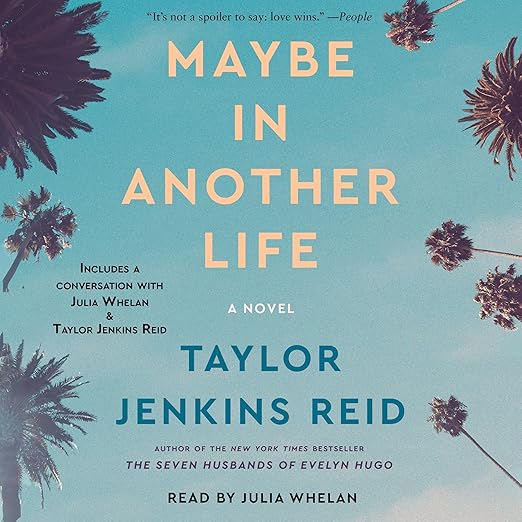
- Narration: Julia Whelan is one of the best narrators working in contemporary women's fiction, and her instinct for TJR's emotional rhythms makes the parallel structure here feel genuinely seamless.
- Themes: Fate versus choice, the myth of the soul mate, how different versions of a life can lead to the same essential self
- Mood: Warm and surprisingly thoughtful for its beach-read surface, with real emotional weight in the back half
- Verdict: Taylor Jenkins Reid working in a lighter register than her later books, but with the same care for character, and Whelan's narration makes the dual-timeline structure work better in audio than it does on the page.
I listened to Maybe in Another Life during a stretch when I had been reading almost exclusively heavy nonfiction and needed something that would not demand that I hold complex arguments in my head across multiple sessions. Reid's earlier novel, this predates The Seven Husbands of Evelyn Hugo by two years, has a premise that sounds like a thought experiment: what happens if Hannah, 29 and adrift, leaves a bar with her best friend Gabby instead of staying with her ex Ethan? Both timelines run in parallel, and we follow Hannah through radically different versions of her life depending on that one late-night decision.
Julia Whelan narrates, and if you know Whelan's work, you already know why that matters. She has a particular gift for characters like Hannah, smart, self-aware women who are nonetheless making emotional mistakes they can see themselves making, and she brings that gift fully to bear here.
Reid's genius in this book is structural rather than dramatic. The two timelines develop genuine momentum independently, which means that around the midpoint you stop comparing them and simply invest in both Hannahs. The novel resists the obvious move of making one timeline clearly preferable to the other, which is the choice that separates it from lesser parallel-timeline romances. One reviewer compared it favorably to Sliding Doors, and that reference is apt, like the film, Maybe in Another Life is interested in the ways character persists across circumstance, which is a more interesting question than which choice was the right one.
The book was Reid's third novel, and it shows the development of instincts that would fully flower in Evelyn Hugo and Daisy Jones. The prose is looser and the stakes feel smaller, but the emotional precision Reid is known for is already present. She understands that the real question her characters are circling is not whether Hannah ends up with the right man but whether Hannah becomes someone she can recognize and respect, and that question drives both timelines to satisfying places.
Why It Works in Audio
The dual-timeline structure is particularly well-served by audio. Whelan handles the transitions between parallel Hannahs with subtle vocal adjustments that mark the shift without being heavy-handed about it. The bonus conversation between Whelan and Reid that was recorded exclusively for this edition adds genuine value, they talk about the experience of developing the parallel structure and what Reid was trying to do with the soul mate question, and hearing them think together about the book illuminates things that are present in the text but might not be fully visible on a single listen.
Hannah is a character who inspires genuine affection in readers, and Whelan is a significant reason why. She finds the humor in Hannah's self-analysis without undercutting the stakes, which is a difficult balance to maintain across nearly nine and a half hours.
What to Watch For in Maybe in Another Life
Readers coming to this after Evelyn Hugo or Daisy Jones and the Six should calibrate their expectations. This is Reid in a lighter mode, with a smaller canvas and a more conventional emotional arc. The writing is less maximalist, the secondary characters less fully developed, and the thematic ambition more modest. That is not a criticism, a well-executed beach read is its own achievement, but readers expecting the density of her later work will feel the difference.
The book's treatment of the soul mate concept is more nuanced than the synopsis suggests. Reid does not land on a simple yes or no; she is more interested in what the idea of a soul mate does to the person who holds it than in whether the concept is metaphysically defensible, and that distinction is what gives the ending its particular resonance.
Who Will Get the Most From It
Taylor Jenkins Reid fans working through her backlist will find this essential and will see the building blocks of her later ambitions clearly. Listeners who enjoy dual-timeline narratives and want something emotionally satisfying without being emotionally punishing will find it an excellent choice. Those who require significant narrative complexity or are looking for literary fiction that pushes at formal limits should look to Reid's later work instead.
Before You Listen
Does Maybe in Another Life make clear which of Hannah's two timelines is the real or main one, or do they carry equal weight throughout?
They carry equal weight. Reid does not privilege one timeline over the other, and the book is structured so that both versions of Hannah's life develop genuine emotional stakes independently. The resolution addresses this balance rather than collapsing it.
The edition on Audible includes a bonus conversation between Julia Whelan and Taylor Jenkins Reid, is it worth listening to after finishing the book?
Yes, particularly for listeners interested in how Reid constructed the parallel structure and what she was trying to say about fate and choice. It runs separately from the main text and adds meaningful context without spoiling anything.
Does this book contain explicit content, or is it on the cleaner end of contemporary romance?
It is on the cleaner end. There are romantic and intimate elements, but they are not graphically described. The book is accessible to readers who enjoy emotional romance without explicit content.
Is Maybe in Another Life a good entry point to Taylor Jenkins Reid's work, or is it better to start with her later novels?
It works as an entry point but shows Reid in an earlier, less fully realized form. Those who discover her through Evelyn Hugo or Daisy Jones and come back to this will see her development clearly. Starting here means you get the pleasure of watching her grow across the backlist.