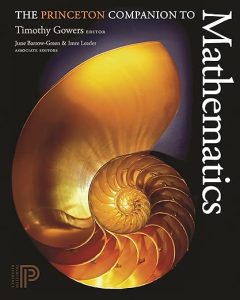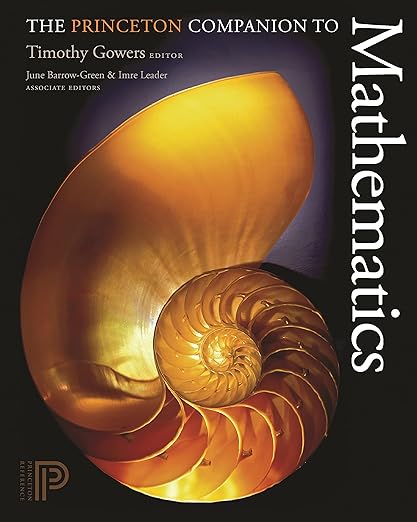
The Princeton Companion to Mathematics presents a specific challenge for audiobook format review: it is a reference work of nearly a thousand pages in print, designed to be read selectively and returned to repeatedly across years of use. Craig Jessen narrates a five-hour audio condensation of that material, which means the relationship between this audiobook and the print edition is less adaptation than encounter. What you get in five hours is an orientation to the landscape of modern mathematics, narrated with competence and care, that will serve some listeners well and leave others wishing for more.
The work is edited by Timothy Gowers, a Fields Medal recipient, and its nearly 200 entries were written by some of the most eminent mathematicians of the current era, including Terence Tao, Sir Michael Atiyah, and Alain Connes, among dozens of others. The scope is genuinely encyclopedic: pure mathematics from number theory through algebra, analysis, geometry, logic, and probability; the history of mathematical development; biographical portraits of influential mathematicians; and the applications of mathematical thinking to biology, finance, music, and other disciplines. The audio version necessarily takes a different approach to this material than the print encyclopedia does.
How Mathematics Holds Up
Reviewer Justin Archer, in his print edition review, identified the book's particular strength as its ability to paint a compelling picture of the modern mathematics landscape, one that is both thorough and motivating for people who want to understand what contemporary mathematical research actually looks like. That strength translates to audio in the conceptual sections, where the ideas can be developed verbally without losing their essential character. What it cannot translate well is the material that depends on notation, on the ability to look at a mathematical object on the page and follow its properties through a symbolic argument.
Craig Jessen narrates with clean enunciation and a pacing that suits expository mathematical prose. He does not attempt to dramatize material that resists dramatization, which is the right call. The mathematical writing in this book, even in its more accessible sections, has a precision that a narrator serves best by presenting clearly rather than interpretively. Reviewer Miriam F. Banash, a physical scientist who uses the print companion regularly as a reference, described its value as covering everything from the basic to the esoteric in ways directly useful for non-specialist researchers. The audio version can introduce those topics rather than serve as that kind of reference.
Why Mathematics Works as an Audiobook
The sections that translate most effectively to audio are the historical and biographical portions of the companion. The development of modern mathematics as an intellectual and social history, the profiles of mathematicians who shaped current research areas, and the narrative of how specific mathematical fields emerged from specific historical problems, all of these are subject matter that audio can handle well. The story of how topology emerged from attempts to solve problems in analysis, or how number theory's apparent inapplicability to practical problems concealed the cryptographic applications that would later make it foundational to digital security, is compelling narrative regardless of whether the listener has detailed mathematical training.
Reviewer Richard Ye, in his print review, noted that the text spans all major areas of modern mathematical research and covers topics in ways designed for readers new to each specific area. That accessibility is genuinely achievable in the conceptual and historical sections and less achievable in the sections that build toward technical specificity. Audio listeners will find the experience uneven in ways that are inherent to the material rather than to the production quality of the audiobook.
Weak Spots in Mathematics
Being honest about the audience is important here. This audiobook is best suited to mathematically curious listeners who want an introduction to the scope and feel of contemporary pure mathematics rather than a technical education in any particular area. It is a way of encountering the landscape before deciding where to explore further. Graduate students and working mathematicians will find the print edition far more useful for the purposes that edition was designed to serve. General science readers who have found themselves drawn to popular mathematics but uncertain where modern research actually lives will get genuine value from the five-hour audio orientation.
Listeners who engage seriously with this audiobook and find themselves wanting more will face an interesting next step: the print companion itself is a thousand-page reference work designed for ongoing consultation rather than linear reading. The audio version is, in a meaningful sense, a preview of a different relationship with the text rather than a substitute for it. At 4.8 stars across 448 ratings, the companion carries an unusually high average rating, which reflects the genuine esteem in which the mathematical community holds the print edition. For its intended audience, the audiobook serves as an accessible door into one of the most demanding and beautiful areas of human intellectual endeavor.
The Right Listener for Mathematics
One of the pleasures of listening to well-narrated mathematics is the experience of mathematical language spoken clearly rather than read silently. The terms of art, the names of theorems and structures and the mathematicians who discovered them, acquire a different texture in spoken form. Jessen handles the multilingual demands of the material, French, German, and Russian names appear throughout the text, with enough care that the narration does not stumble over the international character of mathematical history. That care extends to the technical vocabulary, which is presented with the assurance of someone who has engaged with the text rather than simply phonetically rendered it.
Before You Press Play
- Performance: Craig Jessen narrates with clean enunciation and appropriate pacing for expository mathematical prose, handling multilingual technical vocabulary with care.
- What it covers: The landscape of contemporary pure mathematics, historical development of mathematical fields, the tension between reference and introduction
- Feel: Intellectually stimulating but uneven, as inherent to the material as to the format
- Our call: A genuine orientation to the scope and feel of modern mathematics in five hours, most valuable as a preview of a deeper engagement rather than as a substitute for the print companion.
Frequently Asked Questions
Is this audiobook suitable for someone with no advanced mathematics background, or does it require graduate-level knowledge?
The conceptual and historical sections are accessible to motivated general readers. The more technically specific material becomes difficult without mathematical training. The experience is deliberately uneven in this way, and that unevenness is an honest reflection of the source material's range rather than a failure of the production.
How much mathematical notation or symbolic argument appears in the audio version, and how does Jessen handle it?
The audio version necessarily favors conceptual description over symbolic argument. When notation would normally appear in the print text, Jessen provides verbal descriptions of the mathematical objects rather than attempting to render symbols in spoken form. This works well for conceptual material and is a genuine limitation for the more technically specific entries.