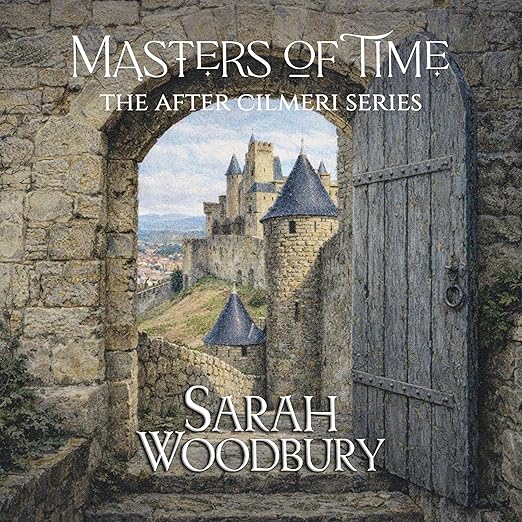
Two numbers on this listing contradict each other before you get anywhere near the audiobook itself. The description signs off by calling Masters of Time the tenth novel in the After Cilmeri series; the catalog files it as the twelfth. Underneath that, a rating of 4.7 sits above a counter claiming a single person has rated the thing, while five written responses are plainly visible on the same page. Seven hours and thirty-three minutes, read by Laurel Schroeder, published in March 2016 by the Morgan-Stanwood Publishing Group.
Sarah Woodbury has been running this alternate history long enough that the premise no longer needs defending. David is King of England in June 1293, Philip is King of France, a holy war neither man wants to fight is coming for both of them, and the time travel named in the last line of the description is treated as settled business rather than as a hook that needs re-explaining. The description is a list of nouns, and it is at least honest about the goods: love, honor, family, betrayal, destiny, time travel, in that order and with nothing between them.
The write-ups underneath are unusually specific about who this is for. Mary Johnston calls it an action-packed page turner, then admits the story leans on characters who have no active part in it, and finishes by advising anyone tempted to go read the whole series first. Elizabeth, the only four on the page, heads the note a fourth time reading and reports a habit of returning to the beginning whenever a new installment lands because something is always missed. Both are describing a book that assumes a shelf of prior volumes sitting in the listener's memory.
What Sarah Woodbury Gets Right
David is the reason the series holds, and JL LeGerrette's note explains it better than the sales copy does: the main character wins a reader over through intellect and a complex understanding of thirteenth-century dealings with princes, kings and official matters. That is the actual pleasure here. Not swordplay, but a sharp mind negotiating a medieval crisis, in which the pope is militant, the baron is treacherous, the brother is jealous, and each of those problems has to be talked down rather than fought off. Woodbury writes politics as a contact sport, and the medieval calendar does the plotting: a pope demands a crusade, a French king smells advantage, and an English king has to decide how much of his own advantage he is willing to spend on either of them.
Mary Johnston's enthusiasm arrives with a date attached, and the date is the odd part: February 17, 2016, roughly three weeks before this recording was published. JL LeGerrette's carries March 7, four days before. Both describe reading rather than listening, and one of them mentions a pre-order landing in a Kindle app the moment the notice came through. The audio edition inherited a column that had already formed around the printed release, and nobody on this page ever separated the two streams.
Laurel Schroeder is credited with the entire cast, which in a book of this kind means two kings, a militant papal faction, a jealous brother, a treacherous baron and a court's worth of smaller speaking parts. Seven hours and thirty-three minutes makes a tight fit for a novel this crowded with speaking parts. The record supplies nothing else about the production either: no director, no note on whether the same reader carried the earlier installments, and no cast list of any kind to place the voices against the names in the description.
Where Sarah Woodbury Loses Some Ground
Twelve or ten: the listing cannot make up its mind, and the difference is not cosmetic. Somebody buying the twelfth volume of a sequence expects to be lost; somebody buying the tenth expects to be lost two books earlier. Either way, the number in the catalog and the number in the author's own description disagree, and neither arrives with a list of what came before it. Mpaulson's write-up, dated May 2023, closes by declaring an inability to wait for the next chapter, which suggests the count was still climbing seven years after this file went up.
A rating of 4.7 above a counter reading one is not arithmetic anybody can make work: a single whole-star vote produces a whole number, not a decimal, under every rounding convention going. Five written responses sit below that counter, each carrying its own grade, so the counter is either counting something other than the written responses or it has mislaid most of them. Treat the badge as decoration, and read the five write-ups instead, which between them cover seven years of returning to this series.
Anyone using the catalog to work out whether this suits a teenager should ignore what it says. The record files the book under teen and young adult and tags it Arts and Entertainment, neither of which describes a novel about a holy war, a militant pope and a succession crisis running across two kingdoms. The oldest write-up comes from somebody who has been reading fantasy and science fiction for more than fifty years, ranks this series near Lord of the Rings, and admits to usually going bored around the fifth or sixth sequel. That is the audience the column actually shows.
Who Should Pick Up Masters of Time
Newcomers ought to be honest with themselves about what the column is telling them. Two separate write-ups recommend going back to the start, and one describes rereading the entire sequence before each new release as a matter of routine. This is not a series that welcomes arrivals in the middle, and the description's opening lines, four sentence fragments naming two kings and a war between them, assume a listener already knows why David is sitting on a throne he was not born to.
Woodbury's regulars need no persuading here, and they will find the familiar machinery running: court politics, family loyalty, and a threat arriving from two directions at once while everyone argues about precedence. Do not start here if you have never met David, because the book spends none of its seven and a half hours reintroducing him, and do not start here if you need a catalog entry to be accurate about what it is selling. Start at the beginning of the After Cilmeri sequence, wherever that count actually begins.