At a Glance
- Performance: Dave Clemente reads a bundle that never announces where its first half ends and its second begins.
- What it covers: Machine learning fundamentals, AI in medicine and finance, business automation, a short history of the discipline.
- Feel: Orderly, upbeat, pitched at the newcomer.
- Our call: A capable beginner's survey that will do nothing for anyone already working with these tools.
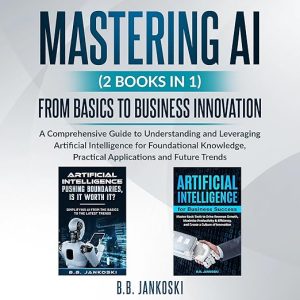
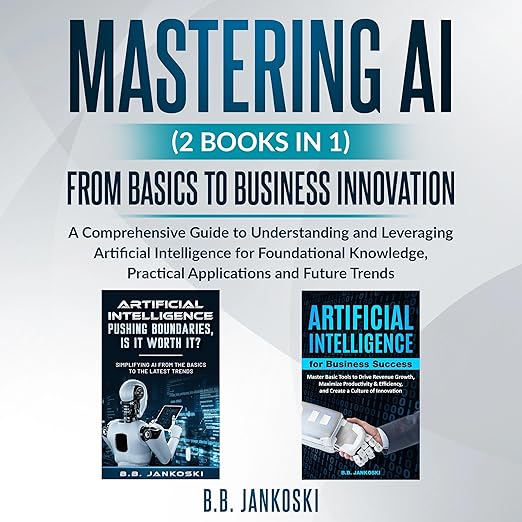
Peter Thiel's line about flying cars and 140 characters opens this description, which is a canny way to start a book about artificial intelligence: lead with the disappointment, then argue that what you were promised turned up in an unexpected shape. B.B. Jankoski runs from the small attempts of the 1950s through the robotics of the 1990s to a technology now sitting in a pocket, and the pitch reaches medical imaging, stock prediction, classroom support and round-the-clock virtual customer service. Five hours and fifty-six minutes of audiobook, released in October 2024, and the title promises two books folded into one. It never says which two.
The Missing Seam Between Its Two Books
Packaging is where this goes wrong first. The title advertises two books in one and the description calls it a two-part series, yet nothing on the listing names either constituent title, gives them separate summaries, or indicates where one ends and the next begins. The series lines are empty. A print buyer would see two title pages and two tables of contents. A listener gets one continuous file and has to infer the seam from a change of subject, which is a small annoyance right up until the moment you want to skip the half you already know.
On the content itself the responses are unusually consistent for a wall of five-star scores. One calls it a helpful guide that breaks complex AI topics down simply, good for beginners wanting a clear overview and for professionals wanting more depth, covering machine learning fundamentals through to business applications, and then adds the useful qualifier that some parts are a bit technical. Another lands on the opposite qualifier, calling the book beginner friendly and informative but definitely better for a beginner, and warning that anyone well versed in AI may not find much help in it. Read together, those two place the book precisely.
Two writers on this page open by stating four decades in information technology, which is an odd and rather charming thing to find in the pool for a beginner's overview. One describes the pleasure of reading about technologies from a personal past, told back from a younger generation's perspective, and credits the author with hitting the highlights while leaving out details that do not matter. The other recognizes the early tech days too, then reports passing the book to a non-technical spouse who found it fascinating as well. That crossover is the strongest signal on the page: the material reaches people at both ends of the technical range.
Dave Clemente Answers What Happens to the Bullets
What happens to a bulleted book once the bullets stop being visible is the question Dave Clemente's reading has to answer. The description is itself a list: analyze X-rays and MRI scans for diagnosis, track and predict stocks, improve education for teachers and students, automate tasks, staff customer support around the clock. Prose built that way reads on a page as a run of parallel items you can scan, and spoken aloud those items arrive as one continuous stream of sentences with an identical shape. A single steady voice is the right call for it, and the listener supplies the structure the page would otherwise have supplied.
Orientation rather than reference is what this book is actually for, and the pool keeps saying so without meaning to. Nobody here reports using it to do anything. They report understanding something. One notice says the explanations of AI learning and its potential impact were spot on and describes a recognition of where things are heading. Another is only just getting a toe in the water with the whole subject. Orientation travels well in audio, because a conceptual overview can be absorbed while your hands are busy, and nothing in the description depends on a diagram to make sense.
Every Rating Is a Five, the Verdicts Aren't
One reviewer states an intention the format will quietly defeat, planning to keep the book as a reference because it will be helpful for some time. That works with a printed volume you can open at the right page. It works badly with a linear recording, where finding the passage about medical imaging six weeks later means scrubbing through hours of continuous audio. If reference use is the plan, buy the text instead. The tag is its own warning. This sits under Programming and Software Development, and nothing in the description involves code, a language or an implementation of any kind. It is a concepts book wearing a developer label.
Then the clock. This is an artificial intelligence survey released on October 2, 2024, and three of its five written responses predate that release, all filed during September. Any general survey of a fast-moving subject is a snapshot of its moment rather than a description of current practice, and the description's own headline figure, a global market value of one hundred and ninety billion dollars by 2030, is a projection being quoted rather than a finding being reported. The pitch then closes by promising that all you need to do is type in your query, sometimes in just 140 characters, which is a tidy rhetorical loop back to the opening and also the full extent of the practical instruction on offer. One further oddity: every rating on this page is a five, and two of those five written responses still carry an explicit limitation. Unanimous scores, non-unanimous verdicts.
Built for Complete Beginners, Not Practitioners
Complete beginners are the audience, and the pool confirms it from two directions. Anyone who has watched this technology arrive from the outside and wants a structured account of what it is, where it came from and what it is being used for will get exactly that in under six hours. The two long-serving technologists in the pool are the more interesting endorsement, since people who lived through the earlier waves found the historical framing accurate rather than glib. And a listener who needs to explain any of this to somebody else will find the book supplies vocabulary rather than jargon.
Working practitioners can pass. The most candid reviewer on the page says outright that a well-versed reader may not find much help here. Implementation is the other gap, since the Programming tag promises something the contents never deliver. And if you intend to return to specific passages later, the printed edition earns its price several times over. What remains is a clear, unhurried, genuinely accessible survey for somebody starting from zero, and thirteen ratings without a single dissent among them suggest it lands for the readers it was aimed at.