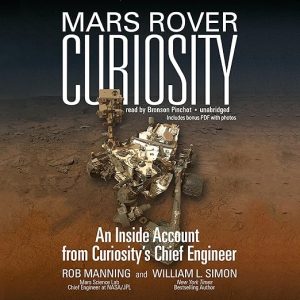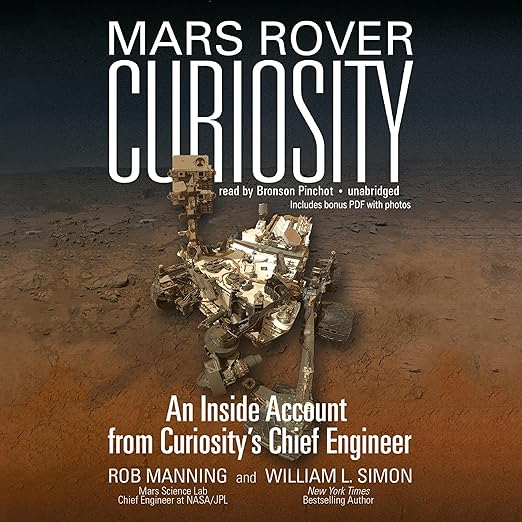
Rob Manning was JPL's chief engineer on the Mars Science Laboratory program, which means his account of building the Curiosity rover carries a different weight than most aerospace books. Mars Rover Curiosity, narrated by Bronson Pinchot across seven hours and 44 minutes, is the story of a decade of work and two billion dollars spent on a machine that couldn't be fully tested on Earth, landing in a way no spacecraft had ever attempted, on a planet that would not forgive errors. This audiobook is the kind of engineering memoir that works best when the author refuses to smooth over the parts that almost went wrong.
Manning doesn't smooth. The account covers technical setbacks, resource fights, the specific agony of leading brilliant people who disagree with each other, and the peculiar terror of staking your career on a system whose performance can only be confirmed 14 light-minutes away. The question the mission was built to answer, does life exist anywhere else in the universe, is presented not as rhetoric but as the actual organizing principle of years of grinding institutional work. That combination of cosmic ambition and daily bureaucratic friction is what gives this book its texture.
The book's most effective sections are the ones where Manning describes specific engineering problems and the solutions that emerged from them. One reviewer, an engineer who has worked on large projects, described the Curiosity account as unlike anything else in their experience of big project management. That credibility is audible in the prose: Manning knows what he's talking about at a level of detail that a journalist or a science writer translating from interviews cannot replicate. When he describes a technical problem, the solution isn't arrived at magically; it requires the kind of iterative, sometimes humiliating problem-solving that real engineering involves.
The specific moments where Manning describes near-failure are the most compelling passages in the book. The sky crane landing system, which was proposed internally and initially met with institutional skepticism, is one of the book's central stories. Manning walks through not just why it was chosen but how it survived the organizational challenges that accompany any proposal that sounds implausible before it has been proven. That institutional storytelling, the friction between bold engineering and cautious management, is rarer and more honest in NASA memoirs than the genre often allows.
Pinchot's narration deserves particular attention here. He is best known as an actor and his work in audiobooks spans several genres. The Bronson Pinchot who narrates this book brings precision, controlled momentum, and an ability to make technical language sound conversational without dumbing it down. The engineering sequences in Mars Rover Curiosity are denser than most listeners will expect from a popular science book, and Pinchot's ability to pace those sections, giving the listener enough time to absorb each element without stalling the narrative, is the difference between an audiobook that loses people in chapter three and one that sustains them to the landing.
What Works
The August 5, 2012 landing is the book's emotional climax, and Manning earns it across the preceding hours in a way that a documentary or a Wikipedia summary cannot. By the time Curiosity sets down on Mars, the listener has been inside the program long enough to understand what the landing represents: not just a scientific achievement but the survival of decisions made under conditions of radical uncertainty by people who knew they might be wrong. The rush of triumph Manning describes is not empty; it arrives weighted with everything that preceded it.
The accompanying PDF, noted in the audiobook's product information, contains visual material that enhances the technical sections but is not required to follow the narrative. Listeners who want to engage with the engineering diagrams and photographs should plan to access that material separately. The audio-only experience is complete as a narrative; the PDF adds context for readers who want to understand the hardware in visual terms.
What to Watch For in Mars Rover Curiosity
Manning's treatment of the EDL, the Entry, Descent, and Landing sequence, the seven minutes of terror that became famous in NASA public communications, is the most technically detailed section of the book and also the most emotionally concentrated. He explains why the sky crane system, which seemed absurd when first proposed, was actually the most logical solution to the problem of landing a one-ton vehicle on Mars, and he does it in a way that makes the logic feel inevitable in retrospect while making clear how far from inevitable it felt during development.
The book also covers the scientific discoveries Curiosity made after landing, though Manning is careful to position himself as an engineer rather than a scientist. His exclusive interviews with leading Curiosity scientists give those sections authority, but the book's strongest voice is the engineering one. Listeners who come primarily for the science will get it, but they will get more of the people who built the instrument than the results it produced. That balance is honest and reflects Manning's actual vantage point on the program.
Who It's For
Engineers, project managers, and listeners who want an insider account of large-scale technical development under institutional pressure will find this unusually credible for the genre. Space enthusiasts who followed the Curiosity landing will get the human context behind events they watched in real time. One reviewer noted wanting more depth on specific technologies; Manning's coverage is comprehensive at the popular level but not a technical manual. Listeners who want pure scientific results rather than program history should supplement this with mission science publications. The PDF companion is worth accessing if technical diagrams are useful to you.
Good to Know
Is the Mars Rover Curiosity audiobook accessible to listeners without an engineering or science background?
Yes. Manning's narration is insider-level in its detail but never assumes specialist vocabulary from the listener. Pinchot's delivery helps pace the technical sections in a way that keeps non-engineers oriented. Reviewers with varying backgrounds have found the book accessible, though engineers tend to get more out of the specific problem-solving sections.
Does the accompanying PDF significantly affect the Mars Rover Curiosity audiobook experience if I can't access it?
The audio narrative is complete without it. The PDF contains diagrams and photographs that add visual context for technical hardware, but Manning's descriptions are clear enough in audio form that most listeners won't feel they're missing load-bearing information. Plan to access it if you want a fuller picture of the engineering.
How does Bronson Pinchot's narration work for a dense technical aerospace audiobook like this one?
Surprisingly well. Pinchot brings controlled momentum to material that could easily become dry, and his ability to differentiate between Manning's personal voice and the voices of interviewed scientists gives the book a dynamic quality. The technical sections are paced rather than rushed, which matters for listener comprehension.