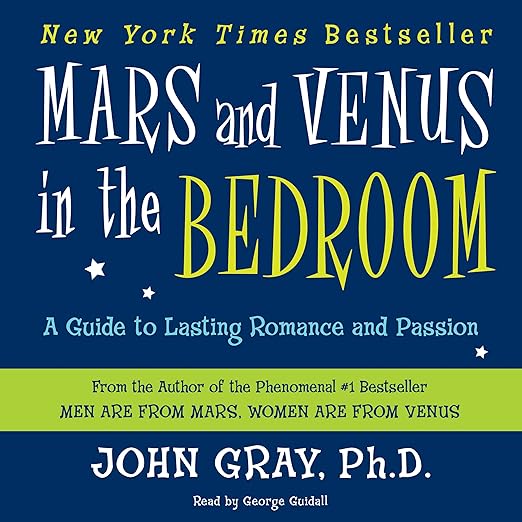
Quick Take
- Read by: George Guidall's measured, warm delivery suits the educational register of John Gray's relationship guidance, lending the material a calm authority without clinical coldness.
- At its heart: Sexual compatibility, long-term desire, gender difference in intimacy
- Vibe: Frank and warm, with a self-help sincerity
- Short version: A candid audiobook on sustaining intimacy that works best for couples willing to engage its gendered framework with some critical distance.
The craft of writing clearly about sexual intimacy without tipping into either clinical detachment or sensationalism is genuinely difficult, and John Gray's Mars and Venus in the Bedroom navigates that terrain with a directness that explains much of its enduring popularity. This audiobook, narrated by George Guidall, covers territory that the original book mapped out over three decades ago, but the questions it addresses remain as relevant as they were at publication. Why do couples stop having satisfying sex? How can partners with different drives stay genuinely connected? What practical adjustments actually help? Guidall's narration adds a stabilizing warmth; he reads Gray's guidance as though the information matters personally rather than as a manuscript to be processed, and that quality carries through a five-hour-and-forty-two-minute runtime that could otherwise feel like an extended lecture.
Gray builds the audiobook around a central thesis that men and women experience sexual desire through fundamentally different physiological and emotional pathways, and that most bedroom dissatisfaction stems from partners failing to understand and accommodate those differences rather than from any deeper incompatibility. That framework is familiar to anyone who has encountered the Mars and Venus brand, and listeners who find the broad gender-binary model reductive will likely find themselves resisting portions of the argument. The audiobook works best when Gray moves from the theoretical to the specific, as in his discussion of the mechanics of desire cycles and his treatment of why quickies serve a different relational function than most couples assume.
George Guidall Levels the Field for Couples
The reviewer who listened to the book with her husband and found it useful captures something important about the intended use case for this audiobook: it is material that works well when two people engage with it together. Gray's explanations are structured to give each partner a window into experiences that may have felt opaque before, and several reviewers noted genuine surprise at learning things about their own needs they had not previously articulated. That quality of mutual discovery is harder to achieve in a book read individually, and the audiobook format serves it particularly well because two people can listen to the same narration simultaneously, which levels the interpretive field in a way that summarizing a chapter to your partner does not.
George Guidall has decades of audiobook narration behind him, and his work here benefits from that experience. He does not exaggerate the more explicit passages for effect, nor does he drain them of their instructional weight by reading too neutrally. The result is a narration that matches the book's own tonal register: adult, direct, and fundamentally non-prurient. For a five-hour runtime on sexual intimacy, that consistency matters considerably.
Quickies to Anatomy, Delivered Without Evasion
The audiobook covers a structured curriculum: advanced techniques for more satisfying sex, the specific role of quickies in maintaining desire between longer intimate encounters, why sexual frequency declines in long-term relationships and what the underlying causes actually are, the anatomy of sexual response for both partners, and oral sex as a topic addressed without either clinical evasion or unnecessary graphic detail. Gray's method throughout is to treat his listeners as adults who can handle honest information when it is framed with context and care, which distinguishes this from both the sanitized self-help approach and the titillation-forward adjacent genre.
Reviewer Kate's comment that information she had heard before finally sunk in after engaging with this audiobook points to something worth noting about the format. Gray's explanations, combined with Guidall's paced narration, create conditions for genuine absorption that a skimmed article or a podcast segment rarely achieves. There is value in hearing a sustained argument about intimacy built and supported over five hours rather than encountering its conclusions in isolation.
Fixed Gender Categories That Some Listeners Resist
The Mars and Venus framework carries significant intellectual baggage for some listeners. Gray's model of fixed gender differences in sexual psychology has been questioned by researchers who emphasize individual variation over categorical gender differences, and listeners who approach the material with a more contemporary understanding of sexuality and gender identity will find themselves working around rather than with certain sections of the argument. That friction is real and worth naming upfront. The book was not written to accommodate complexity that contemporary discourse has since introduced, and engaging it on its own terms requires some interpretive latitude.
The rating of 4.5 across 976 reviews indicates a genuinely satisfied audience base, which is meaningful data for an audiobook on such a specific topic. The dissatisfied minority likely clusters around the framework objection rather than the practical content, which suggests that listeners who can engage the gender-difference model as a useful heuristic rather than a literal truth will extract more value than those who find the premise itself a barrier.
Shared Listening for Couples Losing Early Spark
Couples in long-term relationships who feel the spontaneous energy of early intimacy fading and want a structured, frank audiobook that addresses the underlying mechanics of that shift will find this highly useful. Listeners who are comfortable with Gray's established Mars and Venus framework and have found the broader series valuable will get the most from this specific entry. It rewards being listened to as a shared activity with a partner rather than in isolation.
Skip it if you find rigid gender-binary models of desire fundamentally unhelpful or if you are looking for material that accounts for a wider spectrum of relationships and identities. Listeners who want research-citation-heavy nonfiction may also find Gray's approach more anecdotal than rigorous. But for its intended audience, this audiobook represents one of the more candid and practically focused treatments of sexual intimacy in long-form audio format.
Common Questions
Is this audiobook suitable to listen to with a partner, or is it designed for solo listening?
Several reviewers specifically noted they found the audiobook most useful when experienced with a partner. Gray's framework is built around helping each partner understand the other's perspective, and simultaneous listening removes the interpretive gap that summarizing chapters to each other can create. It works as solo listening too, but the shared format is where the material tends to land with most impact.
How explicit is this audiobook, and is the content handled tastefully?
The audiobook is frank about sexual topics including anatomy, technique, and desire without being graphic in a way that would categorize it as erotica. George Guidall's narration maintains a measured, adult register throughout. Topics like oral sex and advanced techniques are addressed directly but without sensationalism, which is consistent with Gray's broader educational approach.